In his new essay, *The Return of Peripheral Nations*, published by Alouarn Editions, the Breton magistrate and writer Yvon Ollivier presents a indictment against French centralism. Convinced that the nation-state is undergoing a profound crisis, he sees in historical peoples, including Brittany, the possible foundations of a new political order. An ambitious book, sometimes radical, with a preface by the geographer Jean Ollivro.
"This book arrives just as the State hits a wall!" Yvon Ollivier recently wrote to us. This phrase summarizes quite well the content of his new work, which does not limit itself to denouncing the dysfunctions of the French Republic: it announces the exhaustion of a political model and considers what might succeed it.
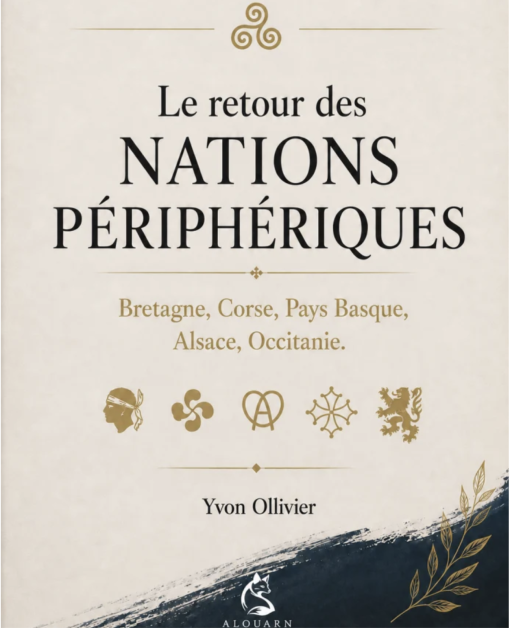
The book, which consists of 317 pages of text, follows a progression in five chapters with revealing titles: *Dominate*, *Convert*, *Assimilate*, *Collapse*, then *Our Old Peripheral Nations as a Recourse*.
France, a State Before Being a Nation
Yvon Ollivier's central thesis is that France was built more by the power of its State than by the spontaneous adherence of its peoples. From the monarchy to the Republic, Parisian power would have pursued the same ambition: to impose political, administrative, cultural, and linguistic unity on historically different territories.
For the author, the French Revolution did not break with this centralizing tradition. On the contrary, it would have given it new legitimacy by elevating unity and indivisibility to higher principles.
Thus, the Republic becomes, under his pen, a kind of political religion whose proclaimed values sometimes serve to justify the disappearance of differences. Brittany, like Corsica, the Basque Country, or Occitania, appears in this analysis as a historical nation deprived of political recognition.
This reasoning is not new in Breton political literature. But Yvon Ollivier develops it as a legal expert, attentive to the mechanisms by which law can both protect freedoms and enshrine the domination of a central power.
A Decentralization That Does Not Change the Essentials
One of the most convincing passages concerns decentralization. Yvon Ollivier believes that the reforms initiated since 1982 have not genuinely transferred decision-making power to the territories. They would have primarily created new administrative levels, new elected officials, and new expenses, without challenging the preeminence of the State.
This observation merits discussion, but it touches on a very real contradiction: local authorities have significant responsibilities while remaining largely dependent on the rules and resources determined in Paris.
However, the author goes further by questioning the profound meaning of this decentralization. What if it had no other purpose than to maintain a system based on the domination of the center by making local elected officials the best guarantors of a dominating regime?
The Announced Collapse of the French State
The fourth part constitutes the turning point of the work. Yvon Ollivier no longer believes in a gradual reform of the system. Public debt, democratic weakening, territorial inequalities, distrust of institutions, and authoritarian temptation would, according to him, form the symptoms of a crisis that has become structural.
His analysis aligns with certain contemporary concerns about the state of public finances and the functioning of French institutions.
The author argues that we are heading towards a deep crisis, as the State no longer has the resources for reform. More than ever, society is waiting only for the generosity of the State. The risk of extremism coming to power is significant, but it is in crisis that a nation is compelled to rethink its unity.
The author also mentions immigration and Islam to better highlight the inherent contradictions in the construction of the French state. Immigration is a desirable reality from an economic standpoint. However, this presence calls into question the relationship with the Other in France, based on the necessity to assimilate or eliminate any visible difference. This is a factor of discomfort that fuels the rise of extremes.
Yvon Ollivier sees additional destabilizing factors for French society.
The author makes a direct link between Jacobinism or "the unity founded against the Other" and the rise of the RN. According to him, the relationship with the Other in France, based on the necessity to subjugate and assimilate, is deviant and will necessarily need to evolve within an open and democratic society.
Old Nations as Democratic Recourse
It is in its final part that the book becomes the most original.
Yvon Ollivier does not simply propose replacing a centralized State with several independent States reproducing the same mechanisms of domination. He advocates for a different conception of politics, based on smaller human communities, attached to their territory, language, and culture.
The sovereignty he envisions is not absolute. It must be able to be shared and exercised at different levels, depending on common needs.
This vision aligns with certain principles of federalism and subsidiarity, even if the author favors a more community-oriented approach than a strictly institutional one.
In the final pages, he advocates for democratic, supportive communities that are mindful of their environment and capable of welcoming newcomers. He specifically calls for the development of direct democracy and popular initiative referendums.
An essential question remains: how to transition from this political philosophy to concrete institutions? What would be the relationships between these communities, their competencies, their resources, and their mutual obligations?
An Essay That Forces Reflection
In his preface, Jean Ollivro himself highlights the paradox of the expression "peripheral nation." Brittany is only peripheral if one considers Paris as the natural center of its universe. It can also be viewed as a historical space possessing its own centrality, open to the Atlantic and the world.
Perhaps this is where the main strength of this essay lies: inviting us to move beyond a representation of France in which territories exist politically only in relation to their distance from the center.
One may not necessarily share Yvon Ollivier's conclusions, nor his pessimism about the future of the French State. But his book raises a fundamental question: can a democracy sustainably ignore the existence of the peoples and historical communities that compose it?
The Return of Peripheral Nations provides a stimulating contribution to this debate.
Yvon Ollivier, Magistrate and Breton Writer
Originally from a peasant family in Léon, Yvon Ollivier has served as a magistrate, notably in Nantes. Committed to defending the territorial unity of Brittany, he participated in the Coordination of Breton Jurists and is a member of the Cultural Institute of Brittany.
He is notably the author of *The French Disunion: Essay on Otherness within the Republic* (L'Harmattan, 2012), which already denounced the contradictions of the French assimilationist model; *France as If... or the Unlikely Reform of the Jacobin System* (Le Temps Éditeur, 2015); and *The White Paper on the Unity of Brittany* (Yoran Embanner, 2018), a collective work he coordinated.
The Return of Peripheral Nations, Yvon Ollivier, preface by Jean Ollivro, Alouarn Éditions, 2026.