The Breton coastline is changing. The gradual warming of the sea is altering habitats, advancing breeding periods, favoring certain species, and weakening others. These changes have been observed on the ground for several decades, and scientific work by Ifremer now allows for a better understanding of them.
"In the fish holds, there are only octopuses," summarizes Grégory Pennarun, director of the Guilvinec fish market. This phrase alone encapsulates the evolution of marine fauna in Brittany. Fishermen are noticing a general decline in crustaceans, while the octopus, which preys on them, has become ubiquitous. At the same time, bluefin tuna is "everywhere," present even in the English Channel, and the meagre, once limited to the coasts south of Royan, is increasingly appearing in landings.
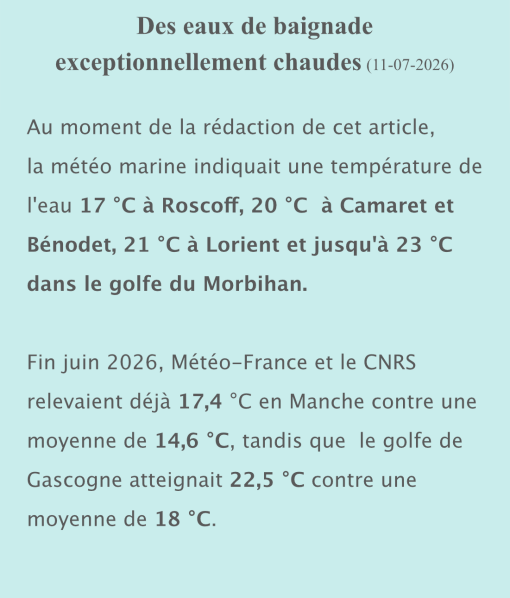
In Brest, on July 7, researchers from Ifremer presented the latest results of their work on marine heatwaves. Their observations https://www.ifremer.fr/fr/actualites/mancheatlantique-phenomene-emergent-depuis-20-ans-les-canicules-marines-ont-elles-un provide scientific insight into these field observations: the gradual warming of the sea is already altering the distribution of species, their breeding cycles, and the habitats they depend on. According to Ifremer, the English Channel and the European Atlantic coast have seen an average temperature increase of between 0.5 and 1 °C from 1982 to 2024.
Biologists are now talking about "meridionalization": as a result of warming waters, southern species are gradually moving towards Brittany, while some species characteristic of colder waters are declining or shifting further north.
Species that no longer live at the same pace
One of the first observed effects concerns phenology, in other words, the biological calendar of species. The national network Ecoscopa shows that oysters now reproduce two to four weeks earlier than a few decades ago. Their spawning period, once concentrated between mid-July and mid-August, now extends from late May to the end of September. Researchers are also observing a slowdown in oyster growth, with South Brittany appearing to be the most affected area.
Spider crab fishermen are also reporting a change in timing. Along the southern Finistère coast, females are now arriving near the shores for reproduction as early as the end of March, whereas this phenomenon was traditionally observed starting from the end of May. This evolution remains to be scientifically documented, but it is consistent with the phenological changes highlighted by Ifremer.
Cooler and more mixed, the oceanic area of the English Channel/Atlantic is warming less quickly than the Mediterranean; marine heatwaves have appeared there more recently. However, the phenomenon has been visible since 2006 and has significantly intensified since 2022, with initial effects measured on kelp forests in Brittany.
— Ifremer: press release from 07/02/2026
Habitats are changing too
Warming is not only transforming species; it is also altering the habitats they depend on. As early as 2012, Ifremer warned about the retreat of fucus that once covered a large part of the rocky upper shore of Brittany. This evolution is still visible today when comparing numerous old postcards to current landscapes.
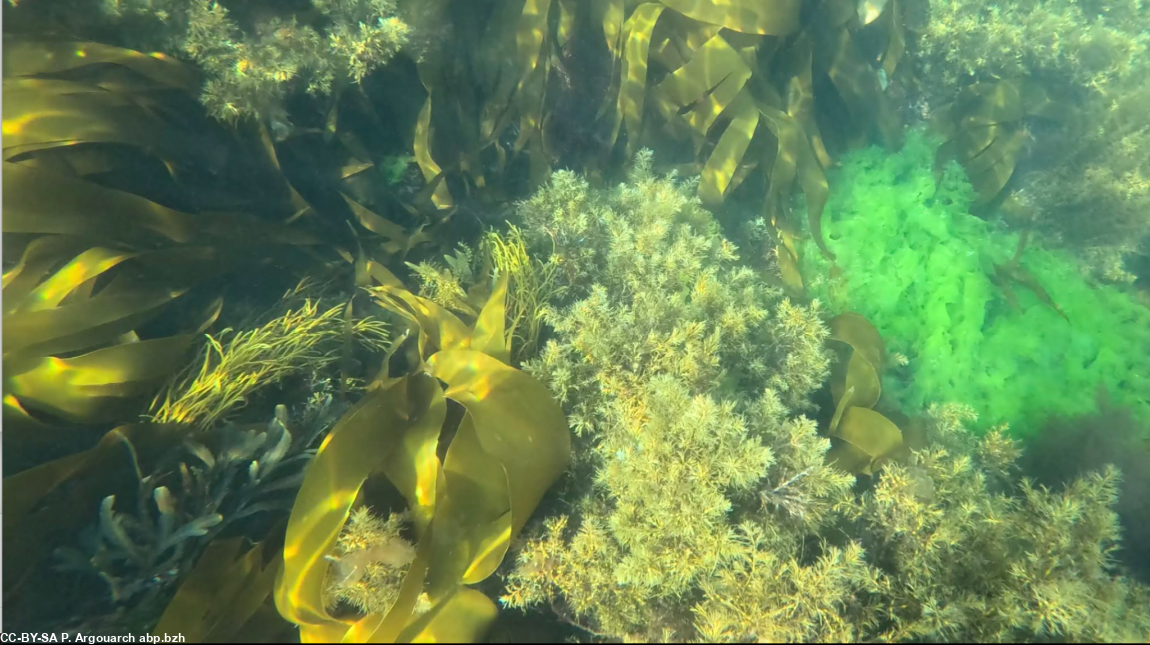
Concerns now also extend to large kelps, true underwater forests. Observations presented in Brest show their regression in several areas, notably around Houat, Hoëdic, at the exit of the Gulf of Morbihan, and in the eastern part of the Bay of Saint-Brieuc or in southern Finistère.
Seaweed harvesters confirm this trend. Where kelps still exist, they are less dense and sometimes smaller in size. However, these underwater forests provide essential habitats for many species, including pollock and spider crabs that come to stay there for reproduction.
At the same time, several divers and coastal observers are noting the expansion of Japanese sargassum, an invasive algae that is gradually colonizing the Breton coasts, often replacing fields of kelp.
A Breton Sea Becoming More Southern
Some species are becoming rarer, but others are appearing. According to Grégory Pennarun, the annual tonnage of landings has remained generally stable since the sharp decline in 2022, following the decommissioning of about a third of the fleet according to European directives.
“There are also new species. We see bluefin tuna everywhere, even in the English Channel, whereas it was once confined to the Mediterranean. We are also increasingly catching meagre, a species that hardly went beyond Royan just a few decades ago.”
— Grégory Pennarun, director of the Guilvinec fish market
The spectacular return of the octopus is probably the most visible symbol of this evolution. Largely disappeared after the exceptionally harsh winter of 1962-1963, it has become extremely abundant again along the Breton coasts. A major predator of crustaceans and shellfish, it profoundly alters the ecological balances of rocky seabeds.
The decline now affects all crustaceans. Fishermen must go further offshore than before to catch langoustines, while spider crabs are becoming rarer over a large part of the Breton Atlantic coast. In contrast, in the English Channel, and especially in the Côtes d'Armor, oyster farmers are observing an invasion of spiders in their bouchots, these predators being the cause of a notable decrease in mussel production.
However, not all changes are unfavorable. The red lobster (Palinurus elephas), long a victim of overfishing, is making a promising comeback at the tip of Finistère... proof that the management of fishery resources also plays a crucial role.
A Transformation Now Visible
Long perceived as mere impressions from fishermen, seaweed harvesters, or divers, these observations now resonate with scientific studies. Through the decline of fucus and kelp, the earlier arrival of spider crabs, the establishment of southern species, the expansion of Japanese sargassum, or the spectacular return of the octopus, a gradual reconfiguration of Breton marine ecosystems is underway.
The warming of the sea is no longer only reflected in record temperatures; a gradual reconfiguration of Breton marine ecosystems is taking shape.