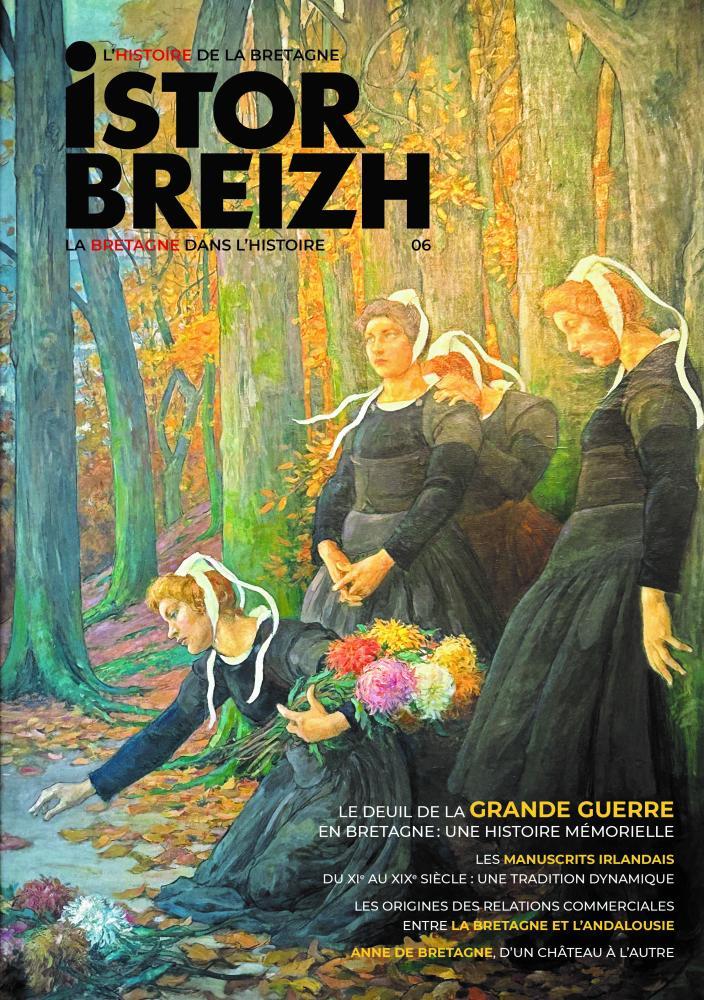
How did Breton society mourn the Great War, its soldiers who died in the mud of the trenches? The 20th century began on August 1, 1914, when the alarm bell rang. The earthquake shook Brittany. It provided battalions of soldiers. Among the other topics in this issue, we highlight four articles. The first analyzes and comments on Irish manuscripts from the 11th to the 19th centuries; the second explores trade relations in the late Middle Ages between Brittany and Andalusia; the third takes us into the wanderings of Anne of Brittany in her...
The mourning of the Great War in Brittany: A memorial history
• The 1914-1918 war monument in Sainte-Anne d’Auray. Interview with historian Frédéric Le Moigne, conducted by Christian Gouerou
• The pacifist speech of Émile Masson in 1917 (Introduction by Fañch Broudic), Christian Gouerou
• The calvary of Tréhou at the Franco-German cemetery of the Battle of the Frontiers, in Maissin, Belgium, Christian Gouerou
• The Battle of Dixmude and the naval fusiliers, Admiral Ronac’h, Christian Gouerou
• Linguistics and war memorials in Léon, Mikael Madeg
Numismatics: Guérande, a war coin (circa 1343-1365), Gildas Salaün
Celtic nations: Irish manuscripts from the 11th to the 19th century: a dynamic, creative, and intellectual tradition, Nina Cnockaert-Guillou
Relations Brittany-Andalusia
• Calle Bretones in Sanlucar, Jacques-Yves Le Touze
• Origins of the first trade relations between Brittany and Andalusia, Marc Danigo
• Breton fabrics destined for America in the mid-16th century, Luisa Danigo
The Breton folk song in the music of Jef Le Penven (1919-1967), Anne-Marie Dumerchat-Schouten.
Anne of Brittany, from one castle to another, Claire L’Hoër
Charles-Marie Guillois: “Me zo Koko deus Porz Gwenn,” Patrick Mahé
Sections
Kartenn wenn da / Carte blanche to: Rozenn Milin
Briefs
Point of view – When the peasant women of the Pays de Redon invented the sit-in in the 18th century, Marie-Christine Delamotte