In Guingamp, the Institute of Breton and European Documentation (IDBE), an association under the 1901 law, has put online 17,066 documents. This preservation work suddenly takes on a new dimension with the arrival of artificial intelligence. The IDBE library could become one of the most important resources for tools designed to speak about Brittany, its history, its culture, and to respond in Breton.
An idea from Yann Fouéré, a family and community project
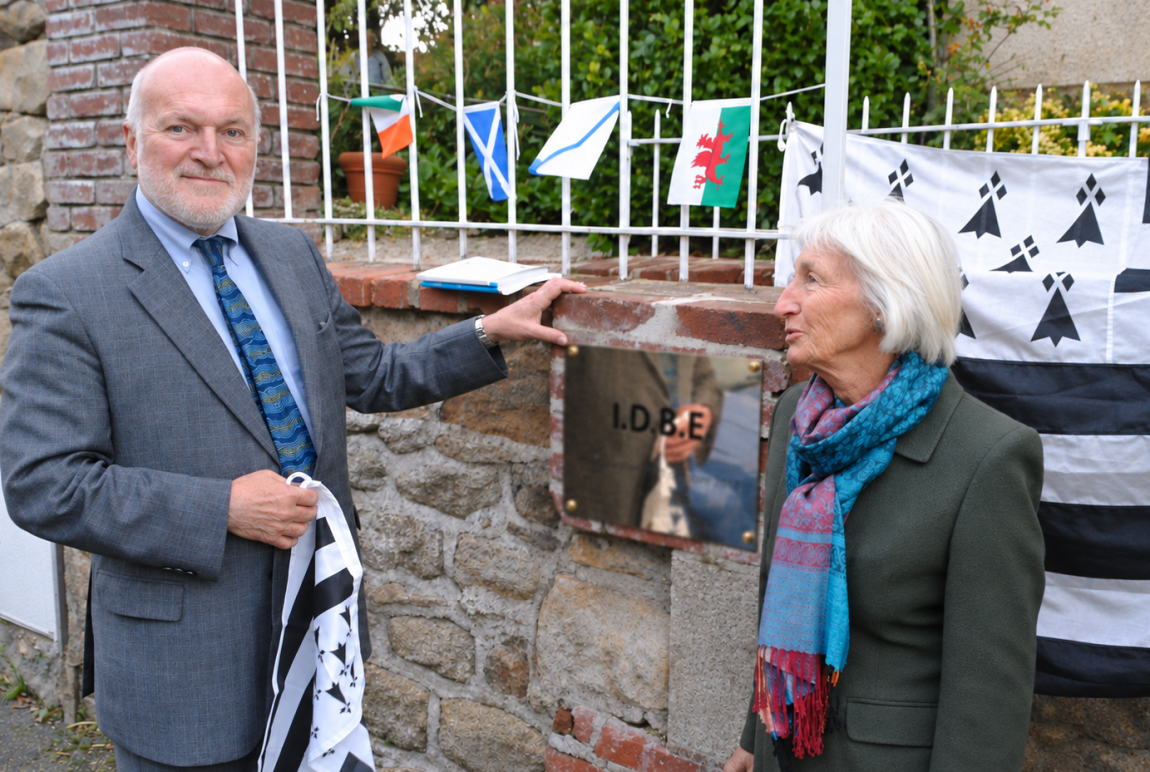
The Institute of Breton and European Documentation (IDBE) was created in 1998. Originally, Yann Fouéré, the visionary behind "Europe with a Hundred Flags," had the idea of gathering books, magazines, and archives on Brittany and European minorities to prevent their dispersion and allow the public to access them. His personal library formed the first core of the collections.
His daughter Rozenn, whom ABP asked how it all began, remembers searching for a location and participating in the creation of the Yann Fouéré Foundation's site. Originally established to house the IDBE, the Foundation became the Brittany Endowment Fund in 2014. After her father's death, Rozenn organized the consolidation of his libraries from Saint-Brieuc, Évran, and Ireland. Her brother Erwan, who presides over the IDBE, contributed to the European aspect of the project. He knew this field from the inside. In thirty-eight years of service to European institutions, he notably led the European Union delegation in South Africa and represented the Union in present-day North Macedonia.
Seventeen thousand documents scanned page by page
Rozenn recounts that Servane Huonic, the director of the institute, initiated the digitization and has organized it over the years, with the support of Erwan and too few volunteers. The counter on the site gives an idea of the colossal work accomplished. A single issue of a magazine like "Gwalarn" or "Ar Falz" represents dozens of pages to process. A book can contain several hundred. Pages must be turned, digitized, and checked to ensure each is readable. The IDBE does not have Google Books robots costing 100,000 euros.
AI comes to the rescue of OCR
For the computer to find a word in a document, it must convert the image to text. This is the role of optical character recognition, or OCR. An old font can cause it to confuse two letters. On a magazine page, the software may mix two columns. Texts in Breton pose additional challenges. Spotting errors and restoring the original text requires going back to the printed page. Today, AI can speed up this proofreading by suggesting, based on context, a word or letter that the software misrecognized. AI comes to the rescue of OCR to correct digitizations.
The IDBE comes to the rescue of the Breton corpus
The IDBE's digital library offers 17,066 documents. Users can download dictionaries, historical works, manuscripts, and collections of magazines. Texts in Breton are alongside those in French and English, as in the interceltic magazine "Carn." An AI assistant linked to this collection could find what the Breton press was writing at the time of the creation of the first Diwan schools, cite relevant passages, and refer to the original pages. An assistant that directs to a magazine issue or a book page provides better service if the reader can open the document and verify what they have just read. But above all, the corpus of the Breton language is too limited, the "Large Language Models" (LLM) at the heart of AI are not "Small Language Models." The models were created for major languages like English or French, not for minoritized languages like Breton. The Breton corpus needs to be expanded, and the corpus created by the IDBE has suddenly become a true treasure for AI.
Safeguarding the backup
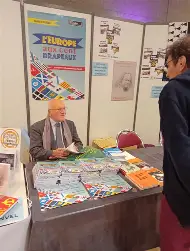
The IDBE is currently seeking memberships and donations to modernize its sites and maintain free access to the resources. It is very important that access to the digital library remains free; otherwise, AI will not be able to access it without a local application like the one offered by the Cultural Institute of Brittany - Skol Uhel ar Vro. The BreizhIA launched by Jean-Pierre le Mat in 2024 was a first step, but its corpus is too small. At a time when we are questioning which sources AI assistants will use to talk about Brittany, the IDBE has already gathered thousands. It took years to save them from dispersion and to democratize them by making them accessible to computers and mobile devices. It is this work that gives us hope today to see cultural heritage and the Breton language featured in the tools of tomorrow.