The Yoran Embanner publishing house, based in Cléden-Poher (Finistère), is releasing a modernized and unexpurgated version of Book XII of Bertrand d'Argentré's History of Brittany. This work, dedicated to the years 1458 to 1532, notably restores the passages that were censored at the end of the 16th century regarding the union of Brittany with the Kingdom of France.
A work seized by royal order
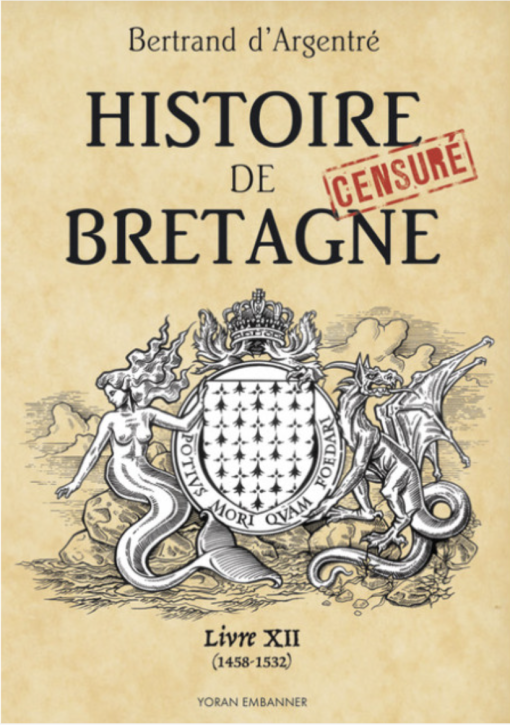
Bertrand d'Argentré (1519-1590), a Breton jurist and historian, began writing a comprehensive History of Brittany in the 16th century at the request of the Estates of Brittany.
Completed in the early 1580s, the work quickly provoked the anger of the French royal authorities. Even before its commercialization, the printed copies were seized at the initiative of the Attorney General Jacques de La Guesle.
The book was accused of containing passages that undermined the honor and rights of the Kingdom of France. A commission was tasked with examining the text and removing or modifying the passages deemed unacceptable.
A revised version was published in 1588, during the reign of Henry III. However, copies of the original text escaped censorship, allowing it to be preserved to this day.
What the royal power wanted to erase
The censorship primarily concerned Book XII, which recounts the last decades of the independent Duchy of Brittany, up to its union with France in 1532.
The most sensitive passages pertain to the circumstances of this union and, particularly, to the debates of the Estates of Brittany convened in Vannes in 1532.
Bertrand d'Argentré reports the objections raised by some Breton representatives, who were opposed to a union that they feared would erase the freedoms and institutions of the duchy.
These opponents were particularly concerned about the assignment of administrative positions to Frenchmen, the increase in taxation, the weakening of maritime trade, and the questioning of Brittany's rights and privileges.
In the expurgated editions, the developments highlighting the hesitations of the Estates and the difficulties faced by royal power were removed or altered.
These passages contradicted the image of a union that was unanimously desired and freely accepted by the Bretons.
A historical source to rediscover
The testimony of Bertrand d'Argentré is particularly interesting because it provides a Breton perspective on the events that led to the disappearance of the sovereign duchy.
His work is an essential document for understanding the debates surrounding Brittany's integration into the Kingdom of France and how this history was subsequently narrated.
An edition adapted for today's readers
Yoran Embanner's initiative aims to make accessible a text whose 16th-century language and numerous historical references made reading difficult. The French has been modernized, the Latin passages translated, and the place names updated. Historical figures are more precisely identified, and contextual elements help better understand the events.
Above all, the passages that were once censored are highlighted in red, allowing the reader to directly identify what the royal power sought to erase.
This reissue thus presents a dual interest: to restore access to a major text of Breton historiography and to concretely measure the intervention of royal power in the writing of history.
More than four centuries after its initial writing, Bertrand d'Argentré's History of Brittany thus finds new relevance, offering readers the opportunity to discover that the royal edict of 1532 was merely a forced measure.