The Celtic Planet: Celtic Archaeology, the Latest Discoveries in Europe.
The first (?) Europeans
By François Labbé
On January 16, 2019, the APB published a short note that I had written about the Celts in Baden-Württemberg, where I, a Breton from the Diaspora, reside.
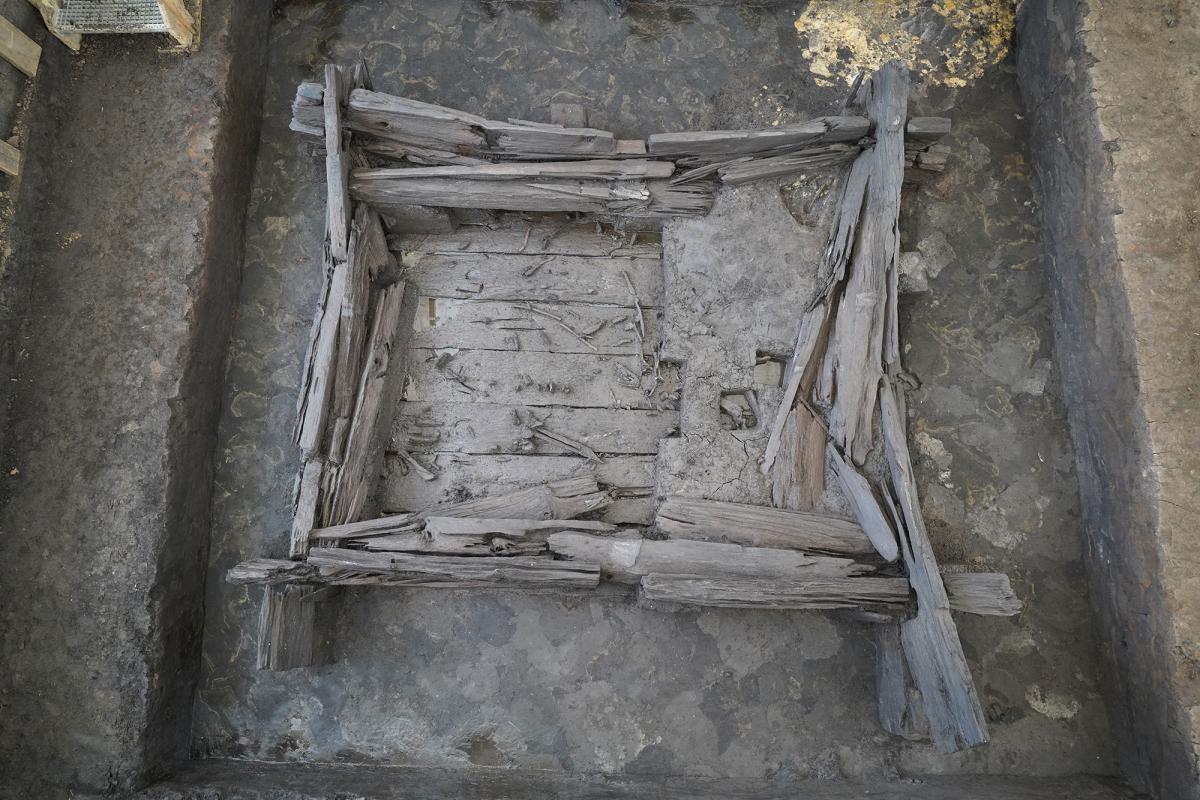
The Baden celtophile movement continues, friends from Brittany, and discoveries of interesting archaeological sites are multiplying. Thus, in 2024, a 2,600-year-old wooden burial chamber was discovered near Riedlingen (some rare French newspapers reported on it). The wooden structures are surprisingly well-preserved and were located at the center of a burial mound with a diameter of 65 meters. Unfortunately, this chamber was almost empty: looters, over time, have taken everything that was inside. The wooden structures are still being treated, and this chamber will be reconstructed at the Celtic museum center of Heuneburg. Due to the particular hydrological conditions of the site, the burial chamber has been well-preserved: the absence of oxygen in the soil has prevented the microorganisms that would have inevitably attacked the wood. A club-shaped artifact was found, likely abandoned by the builders. According to estimates from the scientific exploitation managers of the discovery, this wooden object likely came from an oak felled around 585 BC.
In Endingen as well, on the famous Kaiserstuhl, a new discovery was made in the same year during a pre-construction excavation. A unique Celtic burial garden. Composed of about fifteen graves (450-250 BC), it offers insight into the burial culture of the local Celtic population at that time: the cult objects discovered are currently undergoing restoration (anklets, etc.).
Most recently, it is in the hilly landscape south of the same Kaiserstuhl between Ihringen and Gündlingen, two small towns not far from Freiburg, that these barely perceptible hills have proven to be of great importance. Aerial archaeology had already drawn attention to these large burial mounds with a diameter of over 60 to 70 meters, heavily leveled in agricultural land. The initial excavations suggest that they constitute the largest group of burial mounds in the Upper Rhine plain, in southern Baden (at least 30), including a significant cemetery at the site known as "Löhbücke" as well as discoveries from the Hallstatt and La Tène periods.
This necropolis is formed of relatively flat burial mounds erected between the 15th and 5th centuries BC. The initial research is promising: handmade ceramics, jewelry such as bracelets made of sapropelite (a type of coal whose main organic constituents were generated in an aquatic environment), and wooden objects have been discovered. The small settlement of Ihringen has been documented since 962, but this wine-growing region has a much older history, as the earliest evidence is over 3,500 years old, with the Celts settling there only around 500 BC. Current research should allow for further exploration into the past and uncover traces of even older populations.
These discoveries are occurring while archaeological research in Brittany is also very active: such as the excavations of a domestic habitat associated with a cremation necropolis dating from the first and second Iron Age in Pleumeleuc, the stripping of 3 hectares revealing continuous occupations from the Neolithic to Antiquity, clarifying the extent of protohistoric populations in Sarzeau, or, in central Brittany, the study of farm networks and Gallic ditch enclosures that provide new insights into the territorial organization of the Osismii and the Veneti...
These research efforts are equally dynamic
- in Switzerland (in Grandvillard near Freiburg, at the end of 2025: discovery of a well-preserved tumulus dating from 650 to 550 BC, containing bronze jewelry indicating the burial of a high-ranking woman, or, still in the same year, in Unterlunkhofen, in Aargau: uncovering the enormous cemetery of Celtic tumuli in the Reuss valley, dating back to around 800 BC, or in Basel-Country: scientific analysis of the largest treasure of Celtic silver coins in Switzerland (355 quinaires of the Kaletedou type dating from 90–70 BC), etc.
- in Italy where the latest excavations on Celtic populations are concentrated in the north of the peninsula, particularly on the necropolis of Povegliano Veronese (near Verona) and on sites in the Po plain. These works illustrate the integration of the Celts (Cenomans) into local populations between the 4th and 1st centuries BC.
- in Spain with the continuation of studies on fortified Iron Age and Gallo-Roman habitats (such as the Castro de Viladonga), the excavations of Castrogoda and Colenda (Segovia) which, among other things, provide evidence of the Roman destruction of this large proto-urban Celtiberian oppidum (populated by the Arevaci between the 4th and 2nd centuries BC), or the discovery at Peña Castro (León) in January 2026 of a unique Iron Age religious complex in the north of the peninsula. This Celtic site reveals major cult structures and pre-Roman ritual deposits.
The Celtic planet continues to emerge and challenge the timid habits that have since persisted: confinement within borders, conquests, rejection of the other... In a word, what Montesquieu mocked with the famous mantra from his Persian Letters: "How can one be Persian?"