Virtuoso goldsmiths, artists with abundant imagination, communities connected by trade and kinship: a European civilization is taking shape today and reclaiming its place in Antiquity. Under the direction of Anne Lehoërff, nineteen specialists have worked for four years to trace its history, explore its traditions, understand its functioning, and present the heritage it has bequeathed to us. About a hundred illustrations, many of which are little known to the public, accompany this narrative.
When I was young, I received from my father the two volumes of The Celts by Henri Hubert. This major synthesis, published posthumously in 1932, opened new perspectives on Celtic societies, which had long been reduced to the image of "barbaric" peoples practicing human sacrifices. Nearly a century after its publication, what do we know now? The work directed by Anne Lehoërff provides an impressive answer: excavations and discoveries have transformed our understanding of their habitat, exchanges, techniques, and artistic creations.
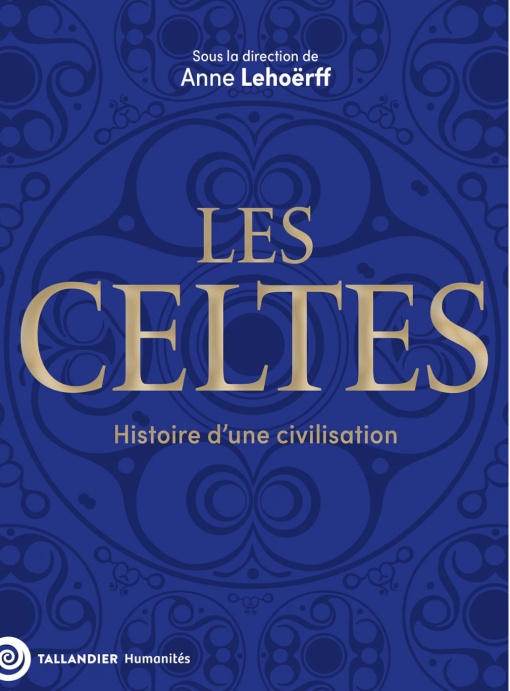 Les auteurs : Anne Lehoërff avec Barbara Armbruster, Philippe Barral, Katharina Becker, Veronica Cicolani, Diane Dusseaux, Nathalie Ginoux, Raimon Graells i Fabregat, Eneko Hiriart, Jan Kysela, Armelle Masse, Christophe Moulhérat, Laurent Olivier, Lionel Pernet, Ian Ralston, Joëlle Rolland, Réjane Roure, Coline Ruiz-Darasse et Quentin Sueur
544 pages, 100 illustrations. Chez Tallandier.
A professor at CY Cergy Paris University and a specialist in European Protohistory, Anne Lehoërff has gathered researchers from across Europe. Their field extends from the Iberian Peninsula to Central Europe, from the British Isles to Northern Italy. This change of scale is essential: the history of the Celts does not coincide with that of Gaul, nor with the borders of current states. The team has denationalized their history. It is the history of Europe.
To write this book, we asked ourselves: what is the most important? The most important aspect of this ambition to establish this Celtic civilization is indeed to highlight the common traits. What brings us together, from Central Europe to Scotland or to the Iberian Peninsula? What constitutes this common foundation? — Anne Lehoërff, interview with Thibaud Lanfranchi for the Mollat bookstore, broadcast on October 26, 2026.
Discoveries That Change Perspectives
For a long time, the Celts were primarily described by those who fought against them or observed them from the outside, and, as we know, history is often written by the victors. Greek and Latin texts remain essential, but their authors interpreted these peoples through their own values. Archaeology allows us to confront these narratives with other testimonies. More recently, genetics has enabled us to go even further by clarifying the migrations of populations.
The accumulation of discoveries does not merely produce a more extensive catalog. It alters the questions we can ask. The large areas studied through preventive excavations reveal the organization of rural areas, workshops, and settlements, some of which gradually transformed into oppida. Laboratory analyses shed light on diet, raw materials, manufacturing processes, and movements. Remains long considered modest become as valuable for understanding a society as a treasure of goldsmithing.
The book revisits old discoveries and reexamines them with new methods. In Lavau, in the Aube region, the princely tomb excavated in 2015 has renewed our perception of luxury and exchanges in the 5th century BCE. Its furnishings combine Mediterranean productions with the intervention of Celtic artisans. A Greek black-figure jug, in particular, was enhanced with gold and silver decorations: an imported object becomes the basis for a new creation, adapted to its host environment.
In Tintignac, in Corrèze, the excavations of 2004 uncovered an exceptional collection of weapons, helmets, and war trumpets. These carnyx, whose bell takes on an animal shape, evoke a universe that is both sound, visual, and symbolic. Their manufacture from thin sheets of bronze reveals a technical mastery that invites us to look differently at the equipment of warriors. Even war equipment, such as helmets with elaborate decorations, testifies to this artistic pursuit.
The new methods also bring to light older discoveries. Around the aristocratic burials in southwestern Germany, the paleogenetic studies presented in the book allow for the identification of kinship links and the consideration of long-distance family alliances. Behind the lavish tombs, lineages, transmissions, and power strategies are beginning to be distinguished.
Warriors, but also leading goldsmiths
One of the pleasures of this work lies in its magnificent illustrations. The details of objects, maps, and reconstructions allow readers to pause, compare, and return to the text with a fresh perspective.
The small gold boat from Broighter, discovered in Ireland, is one of those wonders that one lingers over for a long time. Its hull, mast, and oars form a miniature of extraordinary delicacy. Reproduced on page 75, it also opens up to the maritime world, vessels, and long-distance relations across the entire Atlantic facade. A tiny object is enough to broaden our representation of an entire civilization.
The torques and bracelets from the Erstfeld treasure in Switzerland offer another dazzling experience. Human figures, real or fantastic animals, and plant motifs intertwine in gold. One must follow their curves, decompose their shapes, and then bring them together visually to appreciate the sophistication of these creations. Beauty arises as much from the precision of execution as from invention.
The chapters dedicated to manufacturing make this virtuosity understandable. Filigree applies extremely fine and delicately organized metal threads. Granulation arranges tiny grains on the surface of the object. Assemblies, welds, and relief effects require sure gestures, knowledge of materials, and specialized workshops.
Barbara Armbruster, both a goldsmith and an archaeologist, is particularly well-placed to illuminate these skills. The book also shows how Celtic artisans adapted techniques received from elsewhere to their own tastes. Relations with the Greek and Etruscan worlds nourish original inventions, rather than a simple reproduction of prestigious models.
The Celts had a graphic language
Celtic art has its graphic language, which the chapter by Nathalie Ginoux helps to decipher. Among the Celts, craftsmanship is an art, and art is craftsmanship. Curves, spirals, interlacing, and compass compositions constitute a fully-fledged aesthetic and symbolic expression. The vegetal world nourishes this language: scrolls, leaves, and palmettes intertwine and mingle with human and animal figures. A face emerges from a motif, one animal combines with another, and a plant form becomes almost abstract. On the surface of a stater, a few lines are enough to compose a world where horses, human profiles, and signs respond to each other. To these forms is added color: gold, copper alloys, coral, and opaque red glass create contrasts of hues, materials, and reflections. Celtic art is an art of movement and metamorphosis, but also of polychromy.
These images fascinated André Breton, who collected Gallic coins in the 1950s. The founder of surrealism found in them a resonance with his taste for symbolic associations and the liberation of representation from reality. These hybrid figures are perceptible more than two millennia after their creation.
Brittany in this European civilization
For the Breton reader, the interest also lies in finding familiar sites within this European ensemble. The site of Paule, in Côtes-d’Armor, is among the significant discoveries mentioned right from the introduction. On page 362, the restitution of its aristocratic habitat showcases its buildings, organized spaces, and fortifications. It allows one to envision an establishment that was both agricultural and residential, linked to a powerful family established since the 6th century BCE.
The lyre statuette, reproduced on page 235, accompanies the evocation of bards and the sacred. Music was an integral part of this civilization. This small human figure gives a face to the world of musical practices, memory, and beliefs. Discovered in Brittany, it resonates particularly in this land where music remains so vibrant.
The numerous continental maps, very detailed, contribute to a broader perspective. They allow for tracking trade networks, settlements, and regional differences. Celtic Europe appears as a world traversed by circulations, where maritime routes, rivers, and land roads already outlined a European space of exchanges. Without yet carrying the political meaning we attribute to it today, this Europe knew the advantages of sharing and exchanges, from the Baltic to the Mediterranean.
The work obviously does not exhaust all inquiries. The reader passionate about the origin and diffusion of Celtic languages may wish for a more developed debate among the different hypotheses. A chapter is indeed dedicated to ancient languages and writings; Atlantic proposals are mentioned, and Celtic from the West, directed by Barry Cunliffe and John T. Koch, is included in the bibliography. However, the book's center of gravity remains the history of Iron Age societies, their achievements, and their relationships.
This choice gives coherence to the whole. However, it leaves the reader eager to learn more about the hypothesis defended by Barry Cunliffe: that of the formation of Celtic languages within the Atlantic networks of the Bronze Age, to which the resources of copper and tin gave major importance. The prosperity linked to these metals, particularly in Little and Great Britain, also deserves our full attention.
The postscript by Laurent Olivier further broadens the reflection by questioning the place accorded to the Celts in our view of Antiquity. One sentence powerfully summarizes this imbalance:
“ At the Louvre, all the great civilizations of Antiquity are represented in majesty, except one: the Celtic civilization.” — Laurent Olivier, postscript, page 463.
After reading this volume, the remark takes on its full meaning. Why does such artistic and technical richness still occupy such a discreet place in our general culture and in the history taught in our schools? The question goes beyond the showcases of museums. It is time to challenge the hierarchies we arbitrarily impose between civilizations.
Nearly a century after Henri Hubert, these 544 pages measure the path traveled. They offer a sum to consult, but also a museum-book, with works of art to admire without having to travel to Austria or Germany. Its success lies in bringing together the pleasure of discovering magnificent works and the understanding of the societies that produced them.
Who is Anne Lehoërff?
Born in Saint-Malo, she is a historian and archaeologist, a professor at CY Cergy Paris University, where she holds the chair "Archaeology and Heritage." A specialist in European Protohistory and ancient metallurgy, she studies the societies of the Neolithic and the ages of metals. She has notably published "Prehistories of Europe. From Neanderthal to Vercingetorix, By Arms. The Invention of War and Metal in Europe," as well as "The Bronze Age" in the "Que sais-je?" collection.
To learn more about the creation of this book, Anne Lehoërff presents the work in an interview with Thibaud Lanfranchi for the Mollat bookstore.