Histoire de l'âme bretonne
Réalisation : ABP
Conférence intégrale sauf pou la présentation et le film à la fin sur les photos Yvon Boëlle.
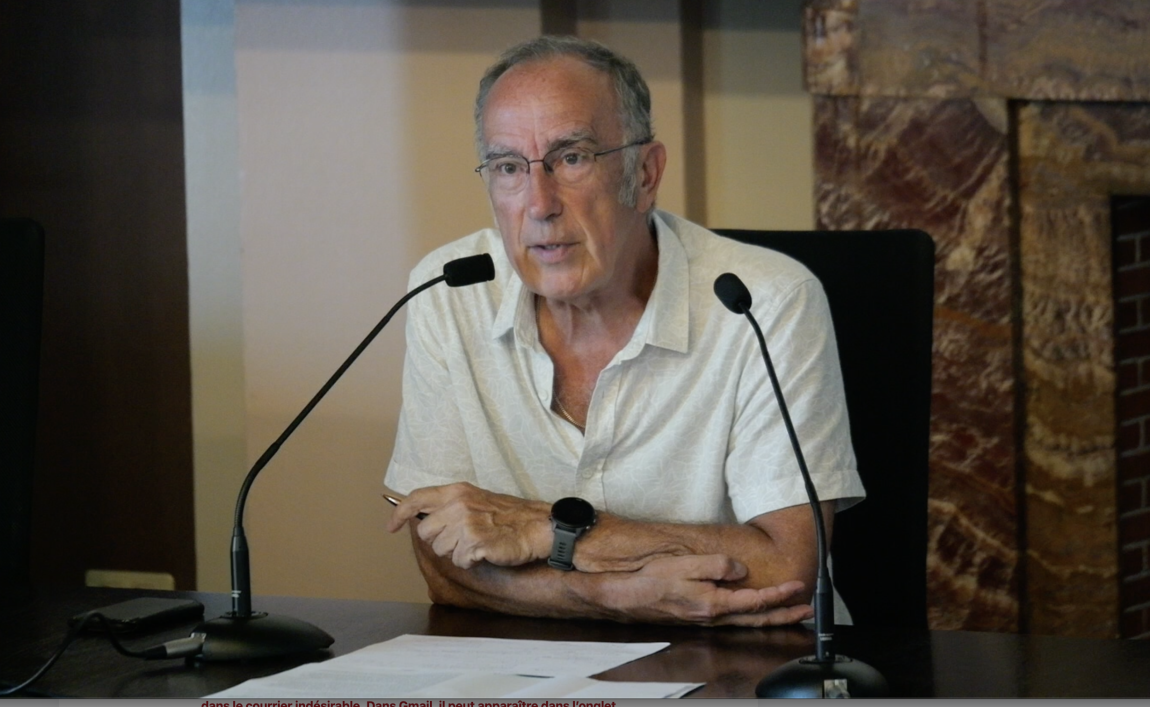
On the occasion of the Interceltic Festival of Lorient, historian and geographer Jean-Michel Le Boulanger came to present his latest work, Bretagne Monde, created with photographer Yvon Boëlle. For just over an hour, he questioned what, beyond history and geography, constitutes "the soul of Brittany."
The starting point of the book is a phrase from the writer Laurent Gaudé: “History will recount the facts. Who will recount the souls?” After dedicating numerous works to the “narrative of facts,” Jean-Michel Le Boulanger explains that he wanted to explore something much more subjective this time: the intimate bond that unites the Bretons to their territory.
Like Pierre-Jakez Hélias (1914-1995) before him and even earlier the great Scottish naturalist John Muir (1838-1914): "We are now in the mountains and they are in us," Jean-Michel Le Boulanger emphasizes this intimate connection between man and his territory: "We inhabit a territory and the territory inhabits us in return."
Landscapes, Language, and Resistances
This Breton soul, Jean-Michel Le Boulanger first seeks in the landscapes, in their often uncertain boundaries between land, sea, and sky, but also in the language, toponymy, spiritualities, and the omnipresent religious heritage.
But his narrative is also one of resistances and what he calls Breton “insolence”: the sardine canneries of Douarnenez, the Resistance, Glenmor, Gilles Servat, Stivell, the struggles against oil spills, Plogoff, Diwan, and the bilingual education systems.
Trusting the Youth
The former vice-president of the Brittany Region especially rejects the regularly advanced idea that we are witnessing the disappearance of the “last Bretons.” Each generation, he reminds us, has believed it was seeing the Brittany it knew disappear.
“The Brittany of 2050 will not be quite the Brittany of 2026. That is the life of territories. But we must also trust the youth.”
He particularly highlights the youth of the thousands of musicians and dancers in the bagadoù and Celtic circles, proof in his view that transmission continues and that Breton culture continues to produce new forms.
In the final part of his conference, Jean-Michel Le Boulanger finally outlines the Brittany he would like to see emerge: an autonomous Brittany (the word is not spoken but it is understood), capable of slowing down in the face of the constant acceleration of the contemporary world, open to the world while remaining rooted, committed to volunteering and the collective, and leaving room for values, artists, and imagination in a society increasingly governed by numbers.