Born in Morlaix in 1827, Charles-Gustave Rivoallan seemed destined for the peaceful career of a lawyer. However, the gold rush led him to California, and then to the Sonora Desert alongside the buccaneers of Count Raousset-Boulbon. Battles, heat, Apache attacks, and disillusionments turned his quest for fortune into a true survival ordeal. Before his discreet return to Brittany, Rivoallan had experienced one of those forgotten epics that transform an ordinary life into History.
Morlaix, between two horizons
There are names that one encounters without paying attention, yet they carry unexpected trajectories.
Born in Morlaix in 1827, at the borders of Trégor and Léon, Charles-Gustave Rivoallan is one of those. He grows up in this city turned towards the sea, where the gaze naturally extends beyond the horizon.
Between two nearby countries, but with different tones — the Trégor, taciturn and almost poetic, and the Léon, hardworking and cautious — this balance creates a framework that is both stable and open, without fixing the trajectories.
This openness does not prevent, however, the weight of social structures from imposing itself consistently. In the mid-19th century, lives often remain mapped out. Careers are inscribed in continuity, roles are passed down, and everyone finds their place in a readable order. Trained in law, Rivoallan could have followed this path, settled down, practiced, and inscribed his journey within this stability.
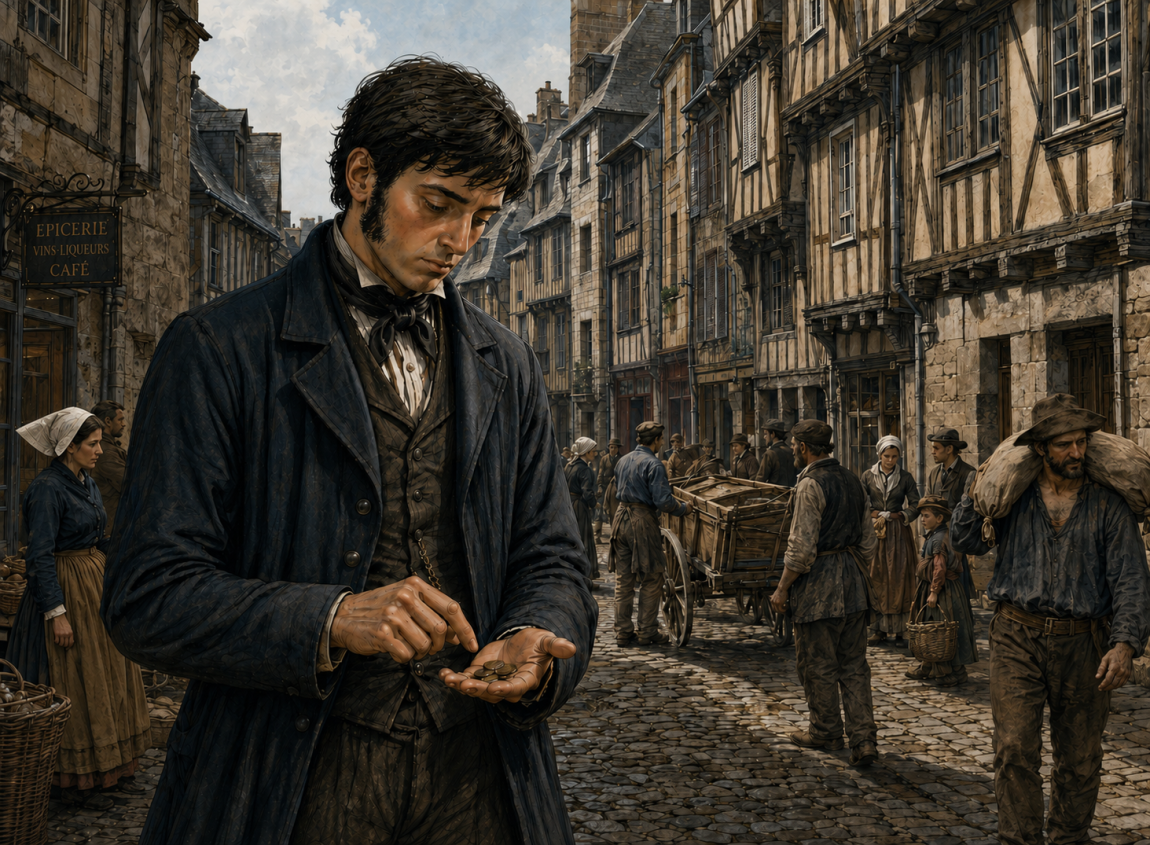
Yet, in Morlaix, with a few pieces in hand, he measures the modesty of what is offered to him.
And with it, a diffuse question, still unarticulated: should one be content with what is present or seek elsewhere what is lacking?
Nothing compels him to leave. Nothing truly obliges him. But nothing also holds him back completely.
And yet, like so many others at that time, he departs.
This departure is not a spectacular gesture. It is not accompanied by any declaration, any heroic tale. It is part of a larger, almost silent movement: that of young Europeans drawn to distant lands of which they know almost nothing.
For several years, California has become a horizon laden with promises. There, they speak of gold, of space, of a life to be restarted.
In the ports, these stories circulate. They pass from mouth to mouth, transform, gain momentum, until they trace for some an invisible line between the place one leaves and the one one imagines.
It is this line that Rivoallan decides to follow.
Leaving Morlaix does not mean breaking with who he is. It means distancing himself, with the idea — perhaps — of returning differently. But at the moment he embarks, nothing is yet written. Neither success nor failure, only this initial movement common to many destinies: crossing the horizon.
The Californian promise
The crossing is long, with no return possible once embarked. It carries men of diverse origins, united less by a precise project than by a common expectation. For Rivoallan, like many, California is not a place: it is an idea, shaped from afar, nourished by uncertain tales.
When he arrives, reality quickly imposes itself.
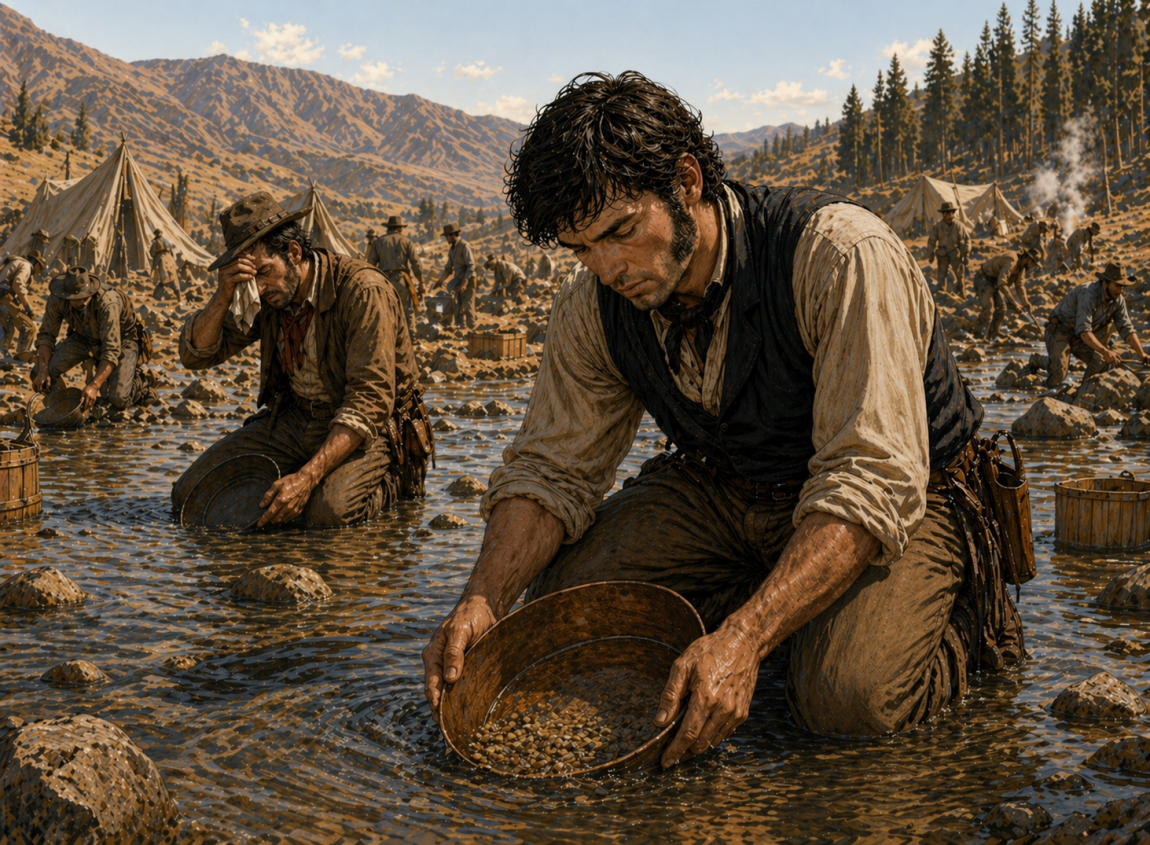
For several years now, the California Gold Rush has transformed the territory. The first easy veins are exhausted, the claims monopolized. What remains requires time, resources, or rare luck. The newcomers crowd into precarious camps, live by their wits, still hope, but without true illusion.
Rivoallan enters this world without finding his place.
Nothing corresponds to what he had imagined. The work is harsh, the gains uncertain, human relations often brutal. The days stretch between fatigue and waiting, in an environment where everyone primarily seeks their own survival. Gold, when it appears, does not transform lives. It mainly sustains the idea that everything could still change — tomorrow, perhaps.
But tomorrow is slow to arrive.
Little by little, the initial promise cracks. Not in a brutal collapse, but in a continuous wear. California ceases to be a horizon and becomes a constrained space, where one remains for lack of better options.
It is in this context that other perspectives emerge.
They do not come from the ground, but from the men.
The mechanism: Raousset and Sonora
For some time now, a name has been circulating among the French present on site: that of Count Gaston de Raousset-Boulbon. A former officer, a man of presence and word, he imposes himself with a singular presence, blending confidence and unpredictability. A leader for some, an adventurer for others.
Raousset does not just promise: he gathers and organizes. To the wandering of the camps, he opposes a collective project aimed at Sonora, a border region in northern Mexico, harsh and unstable, where silver mines, fragile power, and violence intertwine. In a world consumed by doubt, he offers direction — and the illusion of regaining control.
His objective is clear: to conquer Sonora to exploit silver mines — and to defend them by force. Officially, he acts on behalf of a concession obtained from the Mexican authorities. But in the shadows, his enterprise resembles those advances that France tolerates without signing, the first lines of an influence that has yet to reveal its name.
For those who, like Rivoallan, have found nothing in the placers, the idea is taking root.
The adherence is not an isolated choice. It is part of a group dynamic, where former soldiers, workers, sailors, and opportunistic adventurers mingle. Many are French; all share the same weariness and the same expectation.
Rivoallan commits to it.
The gesture is not heroic. It is both an opportunity and an impulse. By joining the expedition, he leaves behind the logic of the gold rush to enter another form of uncertainty, more structured in appearance, but just as fragile.
Hermosillo: the trial by fire
Entering Mexico changes the nature of the expedition. What was once an uncertain project suddenly takes shape. Raousset's band of buccaneers now advances as one, armed, structured, under an authority that is no longer questioned.
But very quickly, reality clashes with paperwork: the concession is contested, and local authorities refuse to allow an armed foreign troop into their territory. In Hermosillo, the capital of Sonora, mistrust turns into opposition. But Raousset does not intend to yield.
As the city approaches, tension rises. People speak less. Everyone understands that the moment is approaching when they will have to confront other men, weapons in hand.
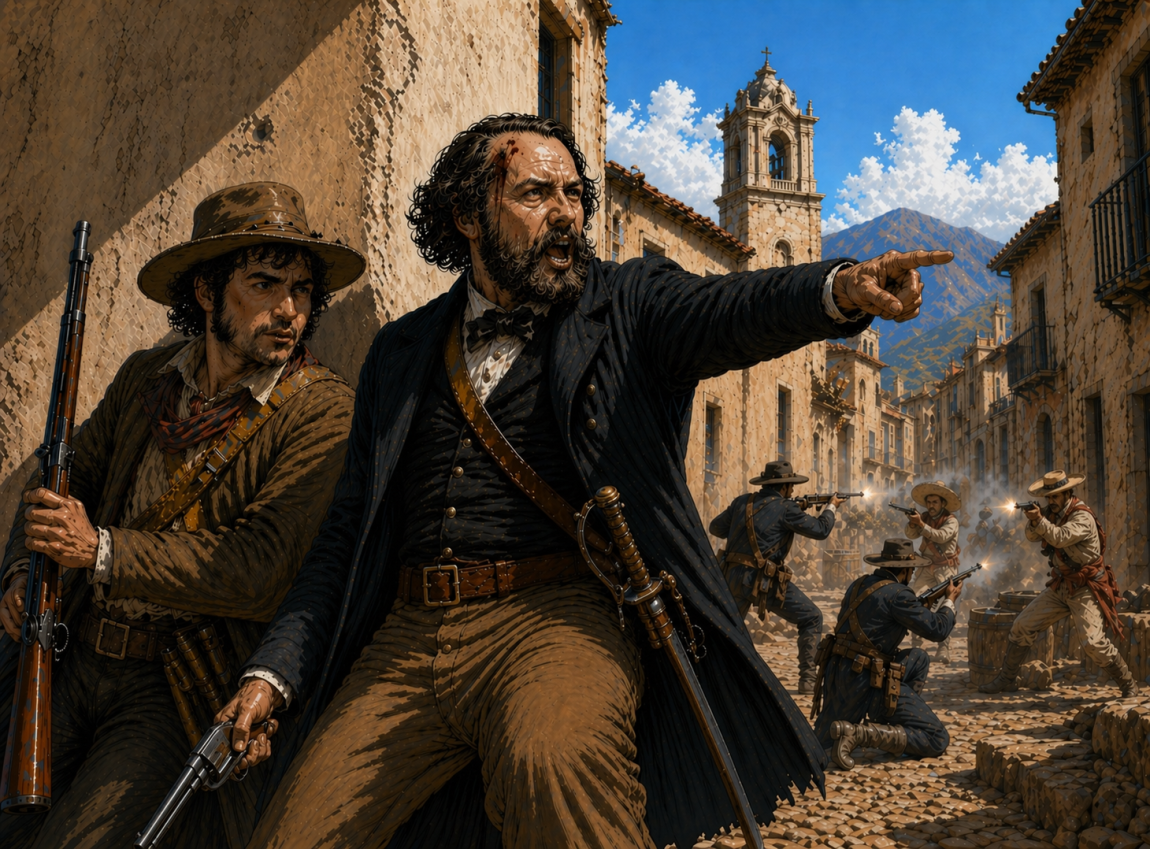
Shots ring out, first scattered, then more sustained. They take cover behind a wall, hastily reload, and advance by a few meters gained under fire. Those who have already fought take the initiative; the others follow.
Rivoallan is there, among his own.
He shoots, like the others. The gesture is simple, repeated: load, aim, respond. The fight does not last long. Yet it is enough to shift the expedition into another reality.
Hermosillo is occupied.
The victory is real: barely two hundred and fifty men, facing far superior forces, seize a city that promised them nothing.
This success gives meaning to their commitment. But it remains fragile. The troop is heterogeneous, resources are limited, and the terrain is uncertain.
This is not an end point.
It is a high point — and already, a limit.
The desert: sand, heat, and doubts
Indeed, they must set off again. The mines remain their goal, and Hermosillo can only be a stopover.
But nothing opens up: on the contrary, the landscape closes in, flattens, empties. The burning desert of Sonora engulfs them.
The sand invades everything, slows them down, tires them out, wears them down. Under the sun, the light becomes harsh, almost white. Bodies struggle. Little is said. Doubt settles in, without a word.
The territory they are crossing is not empty: it belongs to the Apaches, who know every trail and defend access to it. Their advance does not go unnoticed — it calls for a response.
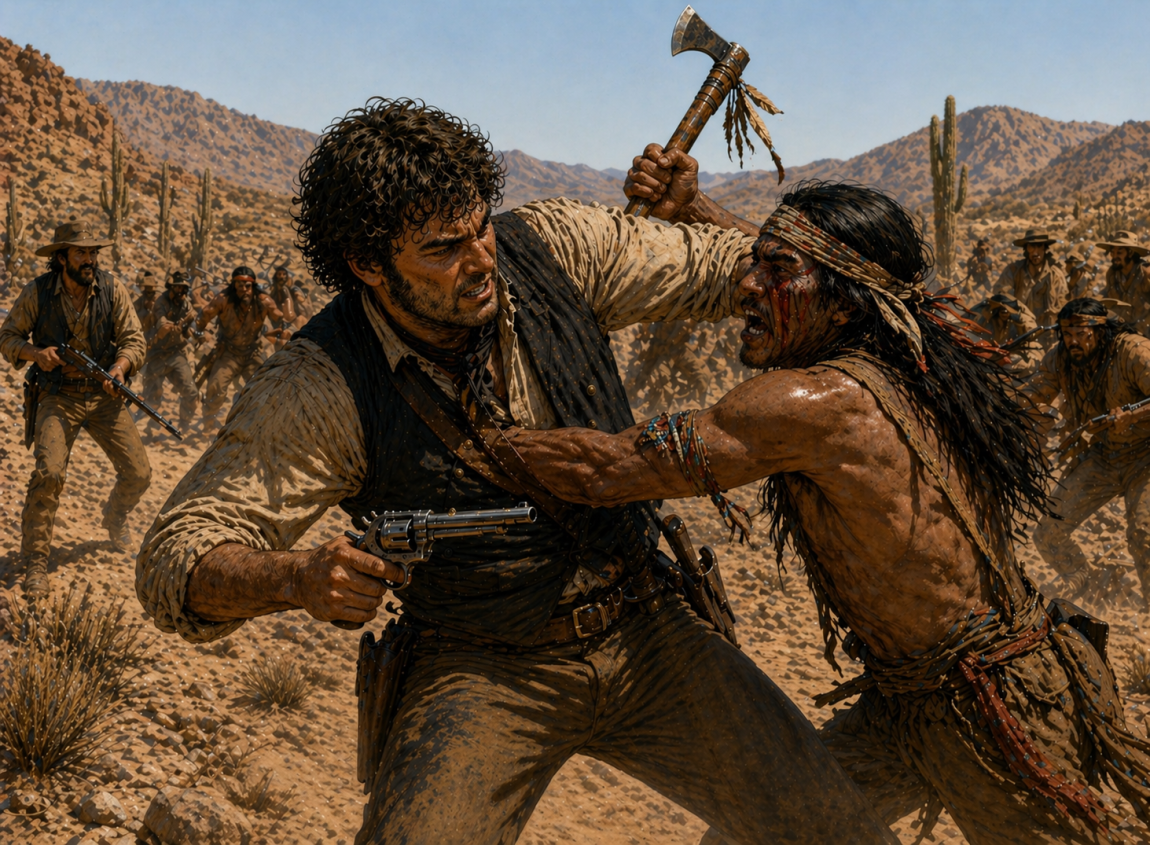
The attacks continue. They never take the form of a frontal confrontation. The Apaches strike on their own ground, at their own pace. A shot, an appearance, then nothing more. The silhouettes emerge from a distance, sometimes drawing closer, then disappearing immediately.
In a narrow passage, the shots erupt closer this time. The men take cover.
Rivoallan fires, without seeking to stand out. A few figures pass within range, quick, elusive. The fight is brief, but leaves a lasting mark.
Nothing is decisive. And that is precisely what weighs heavily.
The following days blur together. The attacks come in fits and starts, with no apparent logic, sometimes leading to hand-to-hand combat. They do not break the troop, but keep them on edge, in vigilant march, in a constantly precarious rest.
Fatigue, heat, dull tension.
The momentum is dissipating. The advance becomes a crossing.
The Collapse
No clear break: only a gradual loss of strength.
The mines recede, now reduced to an uncertain prospect.
The losses accumulate. Men fall, under the heat, fatigue, and a form of despair that nothing can contain anymore. They are buried hastily, then they move on.
Authority still holds, but differently. Raousset maintains a demand that no longer corresponds to the state of the men and whose outcome seems increasingly out of reach.
They move forward without believing it, more to exit Sonora than to reach the mines.
Fatigue becomes general. Minds close. Some mention returning. Others fall silent, but slow down.
The Return to Morlaix
The end does not take the form of a defeat. It imposes itself. Isolated, weakened, the expedition can no longer hold. Negotiations bring the venture to an end. It is no longer about conquering, but about retreating.
Raousset still holds onto the idea of a goal to achieve. But the men no longer respond. The momentum has dissipated. The gap has become too wide between what is envisioned and what remains possible.
Thus comes the separation.
For Rivoallan, the movement continues naturally towards the coast, then towards Europe. The return is part of a form of withdrawal, as if the journey could no longer be recounted in the same way.
A few years later, he is found as a notary in Morlaix.
Nothing in the streets he left behind bears the trace of what he has gone through. He settles back in, into a stable life, more in line with his training.
And yet, this is not a simple return.
Between the departure and this point of arrival, there has been the desert, the battles, the losses. Nothing in this destiny that seemed charted hinted at such an epic journey.
If nothing spectacular remains, something endures, more discreet: an experience that is not spoken of and that silently transforms one’s perspective.
Rivoallan did not conquer the world.
He took a detour.
And perhaps that is where everything is at stake: the question that made him leave — to stay or to seek elsewhere — does not find a clear answer. But it transforms. It calms.
For leaving does not always lead further. It simply instills, in the one who returns, a new distance with what they find again — and it is in this discreet gap that a form of peace can be born.
References
- Michel Le Bris, *When California Was French*
- Olivier Le Dour and Grégoire Le Clech, *Bretons in the California Gold Rush*
- Jean-Baptiste Pigné-Dupuytren, *Account of the Expedition in Sonora by Mr. Count Raousset-Boulbon*