A survey by Ifop published on October 22, 2026, reveals that 56% of residents in the five Breton departments support the attachment of Loire-Atlantique to the Brittany region, compared to 44% in 2012. Support reaches 62% in Loire-Atlantique and 52% in the other four departments. Conducted for Regions and Solidarity Peoples (R&PS), the survey also shows a majority support for federalism and the recognition of regional languages.
Reunification is progressing in the five Breton departments
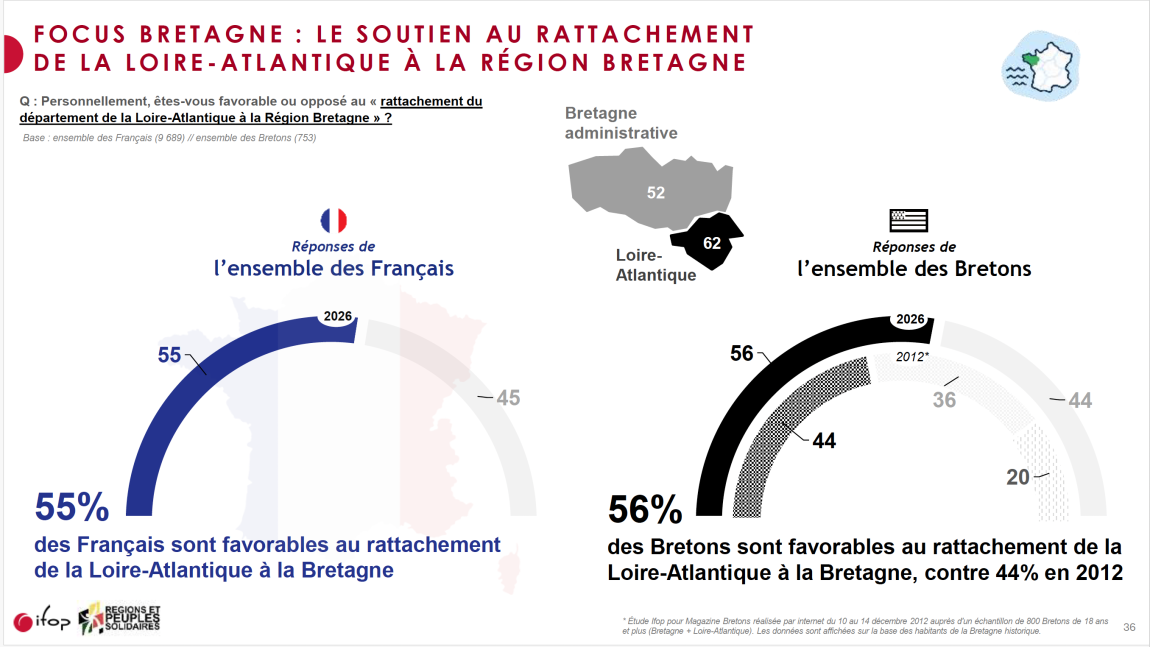
This is one of the main findings of this survey for Brittany. According to Ifop, 56% of the inhabitants of historical Brittany support the attachment of Loire-Atlantique to the Brittany region, representing a 12-point increase compared to a survey conducted in 2012.
Support is particularly strong in Loire-Atlantique, where it reaches 62%. However, it is also a majority in the four departments of the administrative Brittany, with 52% of favorable opinions.
At the level of metropolitan France, 55% of respondents also express support for this reunification.
These results show that reunification is not just a demand put forward by associations or political movements. It now gathers a majority of favorable opinions among respondents, both in historical Brittany and at the national level.
It should be noted, however, that an opinion poll does not constitute a referendum and does not prejudge the institutional modalities of any potential attachment.
A majority in favor of regional federalism
The survey reveals a more general evolution in the relationship of the French to the central state. Thus, 74% of respondents wish for decision-making powers to be more localized in the regions, a 28-point increase since 2002.
Even more significant, 58% express support for an evolution of the French political system towards a federalism that would allow each region to adopt its own laws and standards in certain areas.
This result goes beyond simple administrative decentralization, which essentially involves transferring certain powers from the state to local authorities. The federalism mentioned in the Ifop question also implies the recognition of regional normative power.
The study further reveals that 58% of respondents wish for regions other than Corsica to benefit from special statuses that take into account their specificities, compared to 43% in 2001.
Regional languages: 65% in favor of the European Charter
The recognition of regional languages also enjoys majority support. According to Ifop, 65% of respondents are in favor of France ratifying the European Charter for Regional or Minority Languages.
Another proposal goes further: 54% support the possibility of making regional languages official languages in their region, alongside French.
For Breton and Gallo, this distinction is important. The ratification of the European Charter and co-officiality do not correspond to the same legal commitments. The latter would imply a much deeper evolution of the status of regional languages, particularly in light of Article 2 of the Constitution, which states that "the language of the Republic is French."
Corsica and Alsace also concerned
Corsica represents another finding of the survey. At the national level, 57% of respondents support full and effective autonomy for the island, compared to 52% in 2025. In Corsica itself, this proportion reaches 77%.
In Alsace, 78% of the residents surveyed wish for the creation of a distinct Alsace region separate from Grand Est, compared to 68% in 2019.
These results reflect different institutional aspirations depending on the territories: administrative reunification in Brittany, a return to a distinct region in Alsace, autonomy in Corsica.
They nonetheless show that demands for territorial recognition are not isolated and that they encounter, in various forms, measurable support in public opinion.
Attachment to Brittany does not exclude attachment to France
The survey also focuses on territorial identities. At the national level, 52% of respondents say they are as attached to their region as they are to France.
In historical Brittany, 36% say they feel more attached to their region than to France. This proportion reaches 40% in administrative Brittany.
These figures invite a distinction between cultural and historical attachment to a territory and institutional choices. A strong regional identity does not necessarily imply a desire for independence, just as support for federalism does not challenge belonging to France.
Six months before the presidential election
Commissioned by the federation Regions and Solidarity Peoples (R&PS), this survey comes six months before the 2027 presidential election, while issues of autonomy, decentralization, and recognition of regional identities remain relatively absent from the national political debate.
For Brittany, the most notable result remains the increase in support for reunification between 2012 and 2026. However, the survey also shows that demands for regional power and linguistic recognition are part of a broader evolution in French public opinion.
It remains to be seen what place these issues will occupy in the programs and debates of the upcoming presidential election.
Source
Ifop study for Regions and Solidarity Peoples, conducted via an online self-administered questionnaire from September 25 to 30, 2026, among a sample of 9,689 people, representative of the population living in metropolitan France aged 18 and older. The survey includes 753 respondents from historical Brittany, of which 223 are from Loire-Atlantique. The results were published on October 22, 2026.