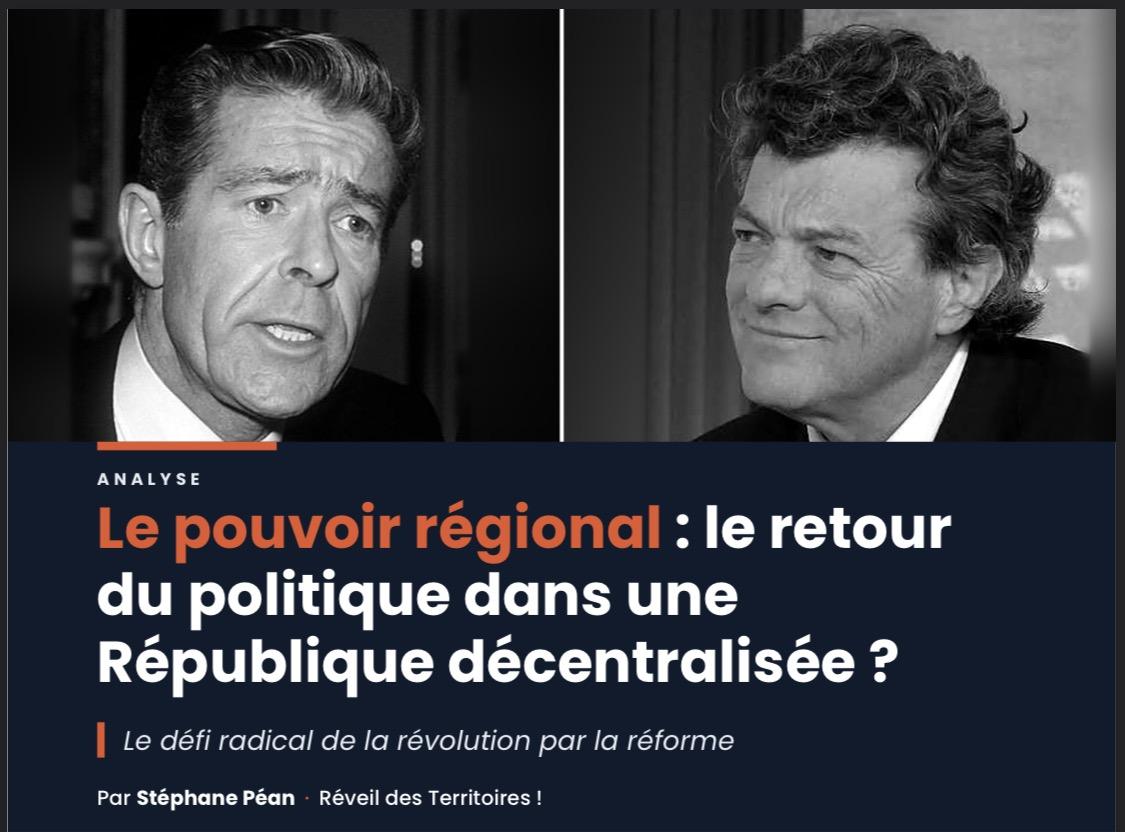
In the early 1970s, Jean-Jacques Servan-Schreiber, a figure of leftist reformist radicalism and European federalism, advocated in Le Pouvoir régional for a genuine capacity for political decision-making by regions. The modernity of his thought could help bring back to the forefront of the debate the issue of regional autonomy and the institutional future of Brittany.
Jean-Jacques Servan-Schreiber defended an ambitious conception of regional power, counter to the concentration of power under the Gaullist Republic. Close to Pierre Mendès France, whose actions he supported through the creation of L’Express, this figure of leftist reformist radicalism and European federalism carries another idea of the democratic transformation of the Republic. Could his thoughts today contribute to renewing the debate on the autonomy of Brittany?
In 1971, with Le Pouvoir régional, JJSS does not only raise a question of administrative organization. He questions the distribution of power, the capacity of territories to decide, and the conditions for a democracy that is not concentrated at the top of the State. At a time when regional institutions are established, but where their political autonomy remains limited, does this reflection deserve to be rediscovered? And why is this reformist tradition so little present in contemporary debates on decentralization?
For Breton regionalists, another question arises: what constitutes a politically constituted region? Brittany had already engaged in this collective work with CELIB, which carried a common vision of its interests and future. JJSS also cites Morvan Lebesque and his "will to be" to evoke the progression of regional identity. But is regional power constructed solely from a pre-existing collective consciousness? Can the work of elected officials, political debate, and deliberation within new democratic institutions also contribute to its emergence and strengthening? Wouldn't the modernity of regional power lie in the ability of institutions and democratic debate to bring forth a true regional political subject?
Michel Rocard already raised, in Décoloniser la province (1966), the question of the relationship between the center and the territories. Without conflating their doctrines, can we bring these reflections on regional construction methods closer together? Must the same institutional model be applied everywhere, at the same pace, or should we recognize the diversity of territorial trajectories? And how do we move from a claim for autonomy to the concrete construction of a democratic, responsible regional power equipped with means of action?
The territorial reform of 2015 redrew the regions. But did it spark a genuine democratic debate on their construction and degree of autonomy? For Brittany, the question is not only about what place to give to its history or singularity, but what power it wishes to exercise, under what rules, and with what articulation with the State and Europe. Can regionalism today renew itself by carrying a civic and institutional project, rather than limiting itself to the affirmation and recognition of a cultural identity?
These questions are at the heart of my analysis "Le pouvoir régional : le retour du politique dans une République décentralisée ?", published in Réveil des Territoires!.
Through the trajectory of Jean-Jacques Servan-Schreiber and the debates of the 1970s, this essay revisits a political tradition whose modernity deserves to be reexamined.
"Regional power is taken more than it is decreed." — Jean-Jacques Servan-Schreiber (1924-2006)
Read the full analysis on LinkedIn or download the PDF (6 pages)