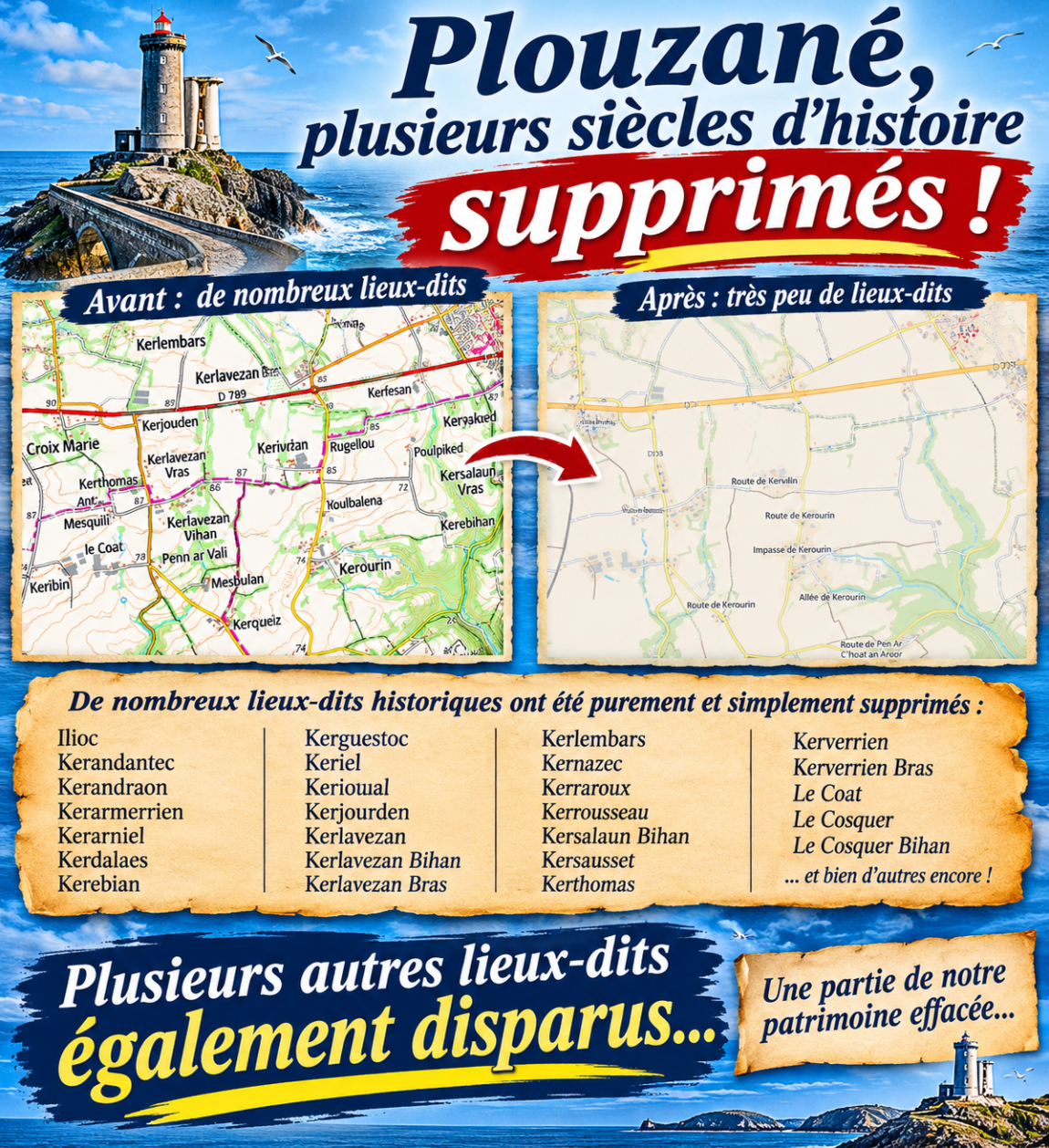
You are not dreaming! Here is the list of about fifty names of disappeared localities in Plouzané! This represents half of the localities, the others having been renamed. A true Breton scandal on which our elected officials must speak today. Silence is no longer possible. This open letter is addressed to the mayor of Plouzané, Yves Du Buit, to the president of the Brittany region Loig Chesnais-Girard, president of Megalis, to Paul Molac, director of the Breton language office, to the Minister of Culture, and to the director of heritage at...
Plouzané: here is the blacklist of toponymy:
About fifty names of disappeared place names!
Open letter on a Breton heritage disaster:
Yves Du Buit, Mayor of Plouzane
Loig Chesnais-Girard, President of the Brittany region
Paul Molac, Director of the public office of the Breton language.
Mr. Lazare Eloundou Assomole, Director of the UNESCO World Heritage Centre
Mrs. Catherine Pegard, Minister of Culture.
Here is the list of disappeared place names in Plouzane:
Allegot
Ilioc
Kerandantec
Kerandraon
Kerangoff
Kerargouris
Kerarmerrien
Kerarniel
Kerdalaes
Kerebian
Kergo
Kerguestoc
Keribin
Keriel
Kerioual
Kerjourden
Kerlavezan
Kerlavezan Bihan
Kerlavezan Bras
Kerlembars
Kernazec
Kerneac'h
Kernevez
Kerraroux
Kerrousseau
Kersalaun Bihan
Kersausset
Kerthomas
Kervao
Kerverrien
Kerverrien Bras
Le Coat
Le Cosquer
Le Cosquer Bihan
Le Petit Minou
Lesvezien
Mesbiodou
Mesprat
Mesquili
Mezelles
Mezer Bras
Penhoat
Poncelin
Poulpiquet
Poulzeroun
Ringuindi
Stanc Guéguen
Toubalena
Ty Ruz
You are not dreaming!
The new addressing by the municipality of PLOUZANE carried out in 2023 combines everything that should not be done. The result? A colossal loss for our intangible heritage while the elected officials of this municipality could not ignore the attachment of the Breton people to its historical toponymy:
And Mr. Yves Du Buit, mayor of Plouzane, had the audacity to respond to us through the press that he was defending the Breton language!
• About fifty place names have been permanently removed in Plouzané, which is 50% of the total number of place names.
• All other place names have been renamed to 'alley of...', 'road of...', 'street of...', 'dead end of...'
• No more precise location of the place name on the road, loss of historical information as the place name is now assigned to a road several kilometers long where it previously designated a specific location.
• Officially, there are no more place names in Plouzané as no address has been classified as 'place name' in the National Address Database.
• Plouzané did not follow the best practices of the government which states: "The municipality must not remove place names in favor of a road name. The names of hamlets and place names must be recorded as such in the Local Address Database and transmitted to the National Address Database."
• Plouzané did not follow the "Guide to Naming and Numbering Roads" from the Brest Country SIG which explicitly states "Due to their richness, the names of places or Breton toponyms belong to the heritage of Brittany and are intimately part of its identity. To safeguard and enhance this unique millennial heritage."
• The new names in Plouzané are all disconnected from the local context, such as the name Rosa Bonheur for the school instead of Coat Edern.
• Alley of the Town Hall
• Path of the harbor
• Place of the Republic
• Place Jules Ferry
• Pvs Blaise Pascal
• Street Alain Colas
• Street Claudine Hermann
• Street of the Montgolfier Brothers
• Street Louis Braille
• Street Suzanne Valadon
Mr. Mayor of Plouzane, Yves du Buit, what do you have against the Breton language?
Was there a genuine desire to de-Bretonize led by the Municipal Council and its mayor Yves Du Buit? There are always French nationalists who cannot stand difference, even in Brittany regarding their own language and culture.
Is this the product of unconscious psychological mechanisms instilled by the violence of historical assimilation that has led us straight to collective suicide for so long?
Or is it the result of an unparalleled indifference to this day in Brittany?
It would undoubtedly be the product of a form of incompetence and ignorance regarding the necessity of obtaining fiber optics as quickly as possible.
Koun Breizh can only express outrage and call on all Bretons, elected or not, to make their discontent known.
We can only lament the carelessness with which La Poste and Megalis – the regional arm for the implementation of fiber – have managed the standardization of addressing. We cannot understand why Megalis, chaired by regional president Loig Chesnais-Girard, did not impose the principle of absolute respect for our toponymy, a condition for obtaining fiber.
Instead, this structure has pushed for the standardization of addressing while retaining "if possible" our place names in the Breton language or relegating them to supplementary addressing, which means slow death.
Our field studies show that it is the desire to implement fiber that has motivated local elected officials to normalize their addressing, as in Plouezoc’h.
What is the point of reminding here that the normalization of everything French means death for Brittany, which is always condemned to resist?
What is the point of reminding that these place names, some dating back to the 5th century, are essential sources for historical research and are still used today by historians? They are also used by genealogists, and the oldest documents of a municipality often refer to these place names? That on the war memorials of municipalities, the names of soldiers who died for France are often accompanied by the place names where they lived at the time of their death? To remove these place names is, once again, to erase a part of our collective memory and the history of those soldiers who gave their lives for the homeland.
How can one be so careless?
We address this open letter to Yves Du Buit, mayor of Plouzane, to the President of the Brittany region, Loig Chesnais-Girard, as well as to Paul Molac, president of the public office of the Breton language, to ask them what they plan to undertake to repair this serious attack on our intangible heritage and to revive the list of the fifty place names!
We will continue this fight because we are facing a true steamroller, and unfortunately, with the support of all those who should be most concerned with respecting our Breton language and heritage, namely the elected officials.
Of course, it was possible to respect all our toponymy in the Breton language while complying with the law, as in the Basque Country or elsewhere. And if the law commands us to dehumanize, then we must find the strength to resist!
Now more than ever, we are indignant.
This is indeed a Breton scandal. It is the face of Brittany that is disappearing. Breton political leaders cannot remain silent.
In the near future, we will go to Plouzane to express our indignation in a manner yet to be determined.
We ask the recipients of this open letter: "And now, how do we repair such a heritage disaster?"
For Koun Breizh
Y OLLIVIER
Director of Koun Breizh