With his new album, Gérard DELAHAYE launches.... "A Bottle to the Earth"... Three influences intersect and resonate: French song, Breton and Celtic music, but also... rock and pop. The guitar remains at the forefront, and renowned Breton musicians are by his side.
Here is the… "Nth" album by Gérard DELAHAYE!
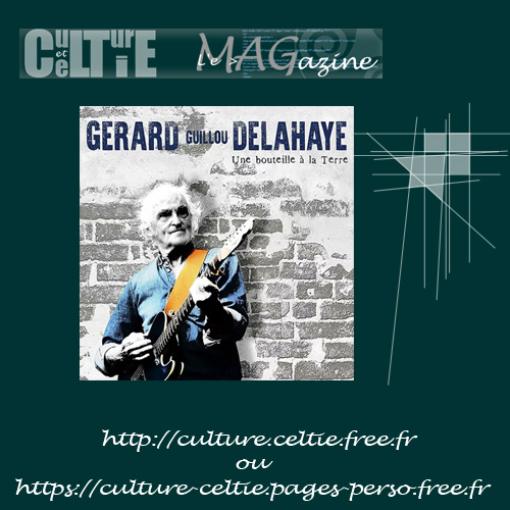 Jaquette du CD de Gérard DELAHAYE - Un bouteille à la terre. Jacques ROLAND
Contrary to what this familiar connotation might suggest, which could imply a certain weariness or potential recurrence, it is, really, quite the opposite that we want to express right from the outset of this chronicle that follows. "Nth"... it is indeed, thus, in all modesty, astonishment, and generosity, that the prolific and poetic Breton artist "of all colors," an excellent "musical storyteller" more than a rigorous accountant, regularly presents, during the radio shows where he is a guest, his latest discographic creation titled "Une bouteille à la terre."
We would rather say, with enthusiasm, pebez plijadur!... here is the "Nth" record by Gérard DELAHAYE! For you, faithful visitors-readers-listeners of our online pages, to whom we introduced his previous solo opus "Jardin d’Eden," as the 10th, ( Our chronicle , it would be, if our calculations are correct... the 11th for adults, since, let us not forget, his warm voice, divinely misty from Armor, also addresses, through numerous publications, children.
"Farine de froment, farine de blé noir" (album Hop là! - 2008), does that ring a bell? Well, this considerable hit for young audiences is by him!
And then, you who keep yourself informed... E.D.F.? To the credit of this famous folk and Celtic music group from Brittany, formed in 1999 by three figures of the Breton scene: Melaine FAVENNEC (*), Patrick EWEN, and… Gérard DELAHAYE, there are still many records released on which our friendly and mischievous "singer of songs," as he defines himself with mischief, but with extreme and undeniable relevance on the header of his official website pages, is featured. All these releases, since the time of the musical cooperative Névénoé! This brings us, after all, to about thirty vinyl records, silver Compact Discs, up to this day, and the less poetic digital music streams or downloads.
But, as a creator and loyal listeners, connected, on both sides, by this substantial and inspired musical and textual work, when one loves, one does not count!
So, let us indulge in this brand new album "Une bouteille à la terre," and, moreover, through its "physical" version, as one is compelled to specify today, in this often hyper-virtual world, that is to say, with, in hand, a beautiful cover and a booklet of about ten pages that only justifies itself when, through its pages, it unfolds substantial texts, whether poetic and/or figurative... and it is, as is often the case, largely so for Gérard! Is this warm, tangible, concrete presentation outdated? Certainly not, and you often confirm this to us, especially since the artist, who knows how to fit into the present times, has even called upon A.I. to generate the plant backgrounds that, gradually, as one turns the pages, seem to healthily invade the bound and glossy presentation, just as the musical and textual discourse tinged with healthy ecology emanates from the published work. Must this [I]ntelligence [A]rtificielle go through the concrete artistic creativity of [I]ntelligence... [A]rtisanal!
11 tracks, including 8 compositions of text and music by the artist "with 2 Bs," since he is Breton and from Ille-et-Vilaine, more than 36 minutes sung, in French, of course, but also in English and… in Breton, with pieces extending around 4 minutes and very aesthetic "pastilles" just exceeding a minute, this is how this "interstylistic" musical journey unfolds, sometimes evolving on the discreet, yet present, melodic orbits of Brittany and Celtic music.
The program opens with a picturesque narration of a youthful romantic rendezvous thwarted by another choice of heart from the hoped-for beloved, this, after having specifically traveled from Brittany... to Quebec in the 1970s, during a heavy storm, in temperatures below 20°, when a rejected and disappointed Gérard, guitar in hand, was hitchhiking on a freezing evening.
Following this, in these harsh thermal circumstances, is a comical yet, nonetheless, salvatory encounter with a welcoming wealthy driver in a Rolls, appearing at the opposite end of our visceral 68er who, at that moment, barely dares to reveal his deep anti-capitalist convictions.
The excellent performance by the singer is quite delightful and wonderfully conveys, avoiding ingratitude and with honesty, the ambiguity of the situation.
Set to music that is distinctly tinged with melodies linked to this predominantly French-speaking Canadian province, with an enchanting violin interspersed with vigorous and mocking female choruses, this "Tabarnak de Cognac" is a true short film with very "roots" accents.
Brittany... Quebec; the Breton diaspora there is significant, even major. In 2025, didn’t the 55th edition of the Interceltic Festival of Lorient honor, through Quebec, our "Cousins d'Amérique"!
Still with the lyrics and music by Gérard DELAHAYE, you will enjoy, on track 2, "L’accordéon, ça me donne des boutons," illustrated by the evocation of Brest's streets of Siam, Kéréon, and the Recouvrance bridge.
The title given to this piece evokes, more, the buttons of the Breton "diatonic devil's box" that has been denounced by the clergy since ancient times, rather than a hypothetical aversion to the sound of this popular musical bellows that, among other things, animates, if you will, the gavotte of the traditional fest-noz.
It is, in fact, quite the opposite for the singer, who formulates, through this piece, a true praise for it!
"Bouest an dioul, c’est la boite du diable,
Que les curés ont maudit, en breton
Tous les désirs, les plaisir coupables
S’envoient en l’air dans leur jolie prison.
Tout ce qui est agréable, c’est péché, c’est cochon.
L’accordéon ça réveille Cupidon."
Inevitably recalling Jacques BREL and, in his song "Vesoul," his famous "Chauffe Marcel!" directed at his accompanist Marcel AZZOLA, Gérard DELAHAYE punctuates this tune, necessarily... "devilish" with a "chauffe Yannig!" this time, aimed at the Breton virtuoso accordionist, Yannig NOGUET, invited on this recording.
Gérard DELAHAYE is also a skilled guitarist who has been playing this instrument since the age of 12! It is on the electric guitar that the singer introduces, then, on track 3, the eponymous title, "Une bouteille à la terre," thus highlighting an introductory chorus performed... in English that will punctuate each verse:
“Yes we’re gonna dream, a new dream you and me,
And we’ll soon swim in a new stream you and me,
Put your hand in mine,
A new sun will shine.”
“Oui, nous allons rêver, un rêve nouveau, toi et moi,
Et bientôt nous nagerons dans un nouveau courant, toi et moi,
Mets ta main dans la mienne,
Un nouveau soleil brillera.”
The melody composed by Gérard is superb and the text by the same author is unifying, as desired.
The guitar is warm and round, the harmonica programming seems to transition us from the "Armorican Wild West" to the "American Wild West," the choruses snap as much as they wonderfully vocalize—will you forgive us this neologism—by "Anglo-Saxonizing," internationalizing the ecological message that seems to come as a direct complement to the previous "Garden of Eden."
What could be better than to entrust, almost halfway through the piece, a song of hope to a child's voice, that of Emile CHIRAT:
"Come with me, if you take my hand.
Together we will build the path,
We will swim in pure water, tomorrow.
A new sun will shine,
Tomorrow."
French, English... and Breton!
This is not the first time, notably with E.D.F., but to sing it even better, yes, Gérard even enrolled in several language learning sessions.
It was, by the way, during a linguistic workshop held in Brasparts (Finistère), under the auspices of Skol Vreizh, that he met a Breton-speaking teacher, Frank BODENES.
He made an adaptation, in Breton, of "Dirty Old Town," an original composition by the engaged British singer, composer, publisher, actor, poet, and playwright James Henry MILLER, known as Erwan McCOLL.
One can only remember it, popularized by the POGUES. Frank BODENES's version, which closely respects the original, captivated Gérard DELAHAYE, who decided to sing, on track 4, arranged by himself, this electro-acoustic ballad with saturated guitars, passing through Celtic spirals of violin and flutes, this cover under the title "Kaoc’h ki brest," a name derived from a famous Brest expression "koc’h ki gwenn ha koc’h ki du" (White dog poop, black dog poop).
A title precisely named thus appears as the first track on side A of Gilles SERVAT's first 33 RPM vinyl record "La Blanche Hermine" (1971).
Gilles also covered, on his album "Sur les quais de Dublin" (1996) with the Irish singer, folk musician, and member of the DUBLINERS, Ronnie DREW, a bilingual adaptation of this current "Dirty Old Town," under the name "Vieille ville de m…, certainly of 'mer'???"
I never quite heard this "what, rigorously, my mother forbade me to name here," as sung by "Grand Georges."
It is not by chance that we programmed, at the opening of this page, an excerpt from the too-short "Water is taught by thirst," which appears on track 5 of the album "Une bouteille à la terre."
This is a very beautiful composition by the Breton artist that transcends the first line of a poem by the American poet, Emily DICKINSON (1830-1886).
It is deliciously bluesy and suits the nearby voice of Gérard DELAHAYE very well, here, distilled in the breath on his intimate and velvety string and acoustic play, extended by the syrupy, charming violin of Gabriel FAURE, whom you had "crossed" on violin, mandola, and viola d'amore, on the album "Deltu" by PEVARLAMM ( Our review
“Water, is taught by thirst;
Land, by the oceans passed;
Transport, by throe;
Peace, by its battles told;
Love, by memorial mould;
Birds, by the snow.”
Gérard DELAHAYE is the story of a long and rich artistic journey, marked by works intended for both young audiences and adult listeners, with the common thread being a tenacious desire to tell stories, alternately making people smile, think, or evoke emotion, while maintaining a personal, sometimes biting, perspective on the world around us.
A long artistic journey, certainly, but also a long marital journey of half a century with the same partner, a motivating and inspiring woman to whom the singer dedicates two original compositions, both lyrics and music, in this new album.
In an interview with Glenn JEGOU, host of “La table d’Arthur,” broadcast on ICI Armorique, Gérard confides:
“[…/…] The rudder of life is Love; I was lucky enough to find it a long time ago and to keep it […/…] I have been living with the same woman for over 50 years; she is my one and great Love, and I have written many songs for her…”
Thus, you will be able to listen to track 6, a song that recounts, during their period of meeting, the particularly serious accident suffered by Gérard’s beloved, enigmatically titled “I Love Hunters.” You will see, and finally hear, why?
The dark rhythmic and melodic tones, particularly in the first two verses of this interpretation, seem to somewhat recall the sung narration of another accident, that of Coluche, in “Putain de camion,” a tribute composed by Renaud in 1988.
Gérard’s acoustic and electric guitars sharply highlight the various sequences of this film, the ending of which could have been tragic.
Let’s keep the theme of lasting Love, as another particularly tender testimony follows that the artist offers to his wife, with “Les années.”
A very graceful and inspired guitar line “in the style of Mark KNOPFLER” stretches throughout this very beautiful, deep, affectionate, and poetic piece, with a pictorial sung text, carried by undeniable faith, making this moment the most caressing, luminous, and intimate chapter of the album.
It’s short, 2 minutes 34… but intense… and, in its intrinsic message, magnificent!
Track 8: Here is one of the little “musical snippets” mentioned at the beginning of the review.
“Nothing is serious, everything is fear”… these are words heard from the mouth of a homeless person that Gérard sings here, in a loop, like a maxim to repeat every day.
Then, Gérard DELAHAYE resumes, under the title "Camions 76-26," his composition of lyrics and music that he had recorded on his album "Le Grand Cerf Volant," released in 1976 by Névénoé.
With one word changed, which has today become pejorative, even insulting, the text remains identical, but this version, which escapes the folk side of the time, takes a distinctly more rock route. The subject remains highly relevant, as road transport of goods by trucks and heavy vehicles accounts for about 89% of domestic land freight traffic in France, with all the environmental harm that this mode of transfer generates.
"Trucks, trucks, trucks on the highway.
Tarpaulin-covered trucks, mud-covered trucks.
Open tomb trucks, blind trucks, crazy trucks.
Three hundred horses under the hood,
Full speed ahead, in the morning,
You have to arrive before the train,
Otherwise, you take your bag tomorrow."
Track 10, a very short text:
"I sing
I sing
I sing in the desert"
Repetition (9)
But 4 minutes and 36 seconds of music, with very prospective reverberated ambiance, a litany of choirs, "aquatic" programming, a tuba overview, Gérard's voice alternating between narration, singing, and incantation.
Here is a very unexpected piece that we greatly appreciated for its creativity, originality, and boldness.
Is it an assertion? A question? A disappointed hope?... In any case, for us and many of you, Gérard DELAHAYE is far from singing in the desert!
After this unsettling interpretation, to conclude this opus, here is, based on a traditional Spanish nursery rhyme, "El pelele està malo," the second "musical nugget" previously announced, as it lasts only 1 minute and 23 seconds. It is titled "Fil de couleur."
"El pelele està malo," "The effigy is sick" is the first line of a traditional Spanish song, associated with the game of burning an effigy, a rag doll or straw doll, during celebrations such as carnival or local festivals.
"The powder and the lightning
Have broken my heart
Who can sew it back
With colored threads."
With "Une bouteille à la terre," in a trilingual balance of French, English, and Breton, a linguistic cocktail already explored with the Trio E.D.F., blending French song, Breton music, and sometimes music from elsewhere, prioritizing melodic quality, Gérard DELAHAYE offers us, once again, shades of nursery rhymes for young audiences, transitioning to musical narration for adults, moving from para-traditional to rock to pop, showcasing a very wide range of his talents as a songwriter, composer, and guitarist, not forgetting his skills as a performer, all within an assumed and often atypical artistic freedom.
"Depending on the pieces, one of these influences takes more prominence, but the others always remain present. A mix that can sometimes become particularly intimate and give birth to unexpected songs," comments Gérard DELAHAYE on ICI BREIZH IZEL, interviewed by Baptiste MEBROUK.
The guitar, we have often highlighted its remarkable contributions, whether electro-acoustic or electric, remains at the heart of this new program.
But the seasoned guitarist also knows how to surround himself with very talented Breton musicians, in addition to those mentioned during this chronicle, such as:
- Cédrik ALEXANDRE, on drums,
- Patrick BOILEAU, on tuba,
- Vincent BURLOT, on tuba,
- Marie-Suzanne DE LOYE, on viola da gamba,
- Yannick HARDOUIN, on electric bass,
- Dominique MOLARD, on percussion,
- Jean-Luc THOMAS, on flutes,
not forgetting the choirs, Maëla LE BADEZET, Jean-Jacques LE POULICHET, Fabienne OGIER-GUILLOU, Mike RANDALL, whose relevance and aesthetics we have mentioned throughout the listed titles.
As you can see, there are, as is commonly said, some "big names," and many of them were already present on the work "Jardin d'Eden."
"A bottle to the earth," you have, we hope, perceived through our humble words, is very varied and rich in its diversity, in accordance with what the artist specifies:
"The songs do not resemble each other within the same album... I do not try to find a global sound... each song clears its own path."
Perhaps, Mr. DELAHAYE, but your album, due to the common quality of each of its texts, the relevance and permanent sincerity of each discourse, and the consistency of all its music, remains perfectly homogeneous, almost conceptual, under a title that could be named "TalentS."
When will your "Nth +1" record be released, which will, for the attention of all our visitors, have its rightful place on Culture et Celtie, the e-MAGazine?…
Gérard SIMON
ORDER THE ALBUM ON THE OFFICIAL WEBSITE OF Gérard DELAHAYE: HERE
____________________
(*) : We dedicate this column to Mélaine FAVENNEC, to whom we paid tribute in our e-LETTER No. 266, since, on July 13, the artist joined the Tír na nÓg…
For the record, Trio E.D.F. Patrick EWEN, Gérard DELAHAYE, and Mélaine FAVENNEC: "On the Road to Glory" ( Chronicle
Sound illustration of the page: Gérard DELAHAYE - "Water is taught by thirst" - Excerpt from 00:59.
The website of Gérard DELAHAYE: www.gerarddelahaye.fr
Other sound excerpts on Culture et Celtie, the e-MAGazine ( See site
The tracks of the CD "Une bouteille à la terre":
01 - Tabarnak de cognac - 04:27.
02 - L'accordéon ça me donne des boutons - 03:34.
03 - Une bouteille à la Terre - 03:57.
04 - Kaoc'h ki Brest - 03:33.
05 - Water is taught by thirst - 02:05.
06 - J'aime les chasseurs - 04:48.
07 - Les années - 02:34.
08 - Rien n'est grave tout est peur - 01:25.
09 - Camions 76 - 26 - 04:26.
10 - Je chante dans le désert - 04:36.
11 - Fil de couleur - 01:23.
Total duration: 36:48.
CD Gérard DELAHAYE - "Une bouteille à la terre."
Release: October 2026.
Production: Dylie Productions
Distribution: Gérard DELAHAYE
Stage Contact: Ipisiti
Reference: DY326.
© Culture et Celtie