4th and new solo album by Didier DREO. Five generations united by music: the vibrant family saga of the Breton guitarist.
Dear faithful visitors of the Culture et celtie website, the e-MAGazine, you have undoubtedly already come across, throughout our online pages, the name of this as brilliant as discreet figure of the Armorican scene, a composer, singer, and guitarist from Finistère, particularly attached to the Breton language and culture.
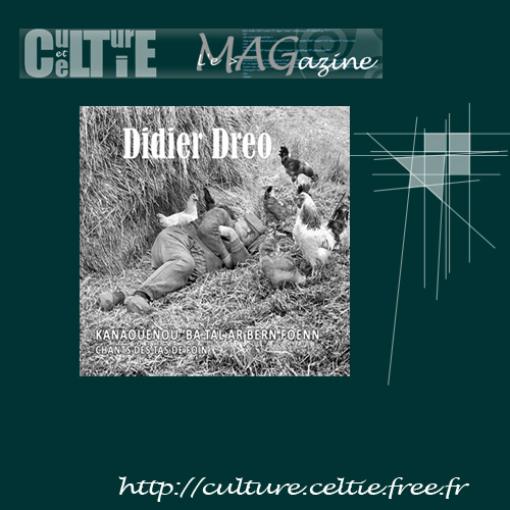 Jaquette du CD de Didier DREO - Kanaouenoù 'ba tal ar bern foenn - Chants des tas de foin Pierre LE GALL
Therefore, it is not surprising for you to have heard and seen him alongside a visceral, tenacious, and oh so multi-talented ambassador of the Breton language, the excellent author-composer-performer and actress, Nolwenn KORBELL, whom he accompanied on records and on stage between 2010 and 2012, including for the albums "Noazh," released in April 2010 (Our review) , "Skeud ho roudoù – the shadow of your traces," published in June 2015, (CD to remember) , an opus from which she primarily created her 2016 show, of the same name, accompanied by six excellent musicians, five of whom significantly contributed to the aforementioned recording; Among them, he appears in the second photo of our report, the aforementioned and described… Didier DREO! (Our report)
A professional musician since June 1996, he co-created, in 1992, with singer Kristen NIKOLAS, the now-defunct group KERN, which recorded three CDs, and co-founded, in 2000, the group ARSA (Didier DREAU (Acoustic guitar), Stéphane HARDY (Bombarde), Lors LANDAT (Vocals, Lower Brittany Singing), Stéphane LE DRO (Clarinet), Marc PAULO (Trumpet, Wooden flute, Bombarde), which won the Dagan Trophy for the best Celtic music group in 2001. Didier DREO also composed, in that same year 2000, after meeting the traveling poet-writer from Rennes, Michel DEMION, who is also a player of the KEVRENN BREST SANT MARK, a Celtic oratorio called "TRAMAR."
In 2007, Didier DREO recorded his first solo album, inspired by Celtic music and titled "Kerdin da Zirostan" (See his official website)
Among other rich artistic experiences, he was also the choir director of MOUZIOU PLUGUEN in Pluguffan, the CHORALE DES ETANGS in Rosporden, and MOUEZH BRO KONK (The voice of the Concarneau region).
Drawing inspiration from the stories of his childhood, nurtured by tales told in his family in Breton, Didier DREO presents us with his 4th and new opus, "Kanaouennoù 'ba tal ar bern foenn – Chants des tas de foin."
Produced by Kat PLUGUEN and distributed by ARFOLK, you will greatly appreciate a generous album consisting of no less than 14 tracks, including 6 instrumentals, all showcasing a wide musical stylistic spectrum, an album stretching, for our utmost pleasure, over 50 minutes of a pastoral and rooted journey. Surrounded, supported, and accompanied by his children, the artist delivers, by judiciously alternating instrumental compositions and original songs in Breton, music and songs composed and written from stories gleaned from his family, parents, and grandparents, which suits the guitarist perfectly, who regularly composes the vast majority of his songs in the Breton language.
For non-speakers, there is no risk of exclusion from understanding, as almost all the lyrics are translated into French throughout a booklet of about ten pages, which is also illustrated with beautiful photos or graphic page backgrounds.
Born from two years of meticulous work preserving authenticity, with texts bequeathed by his family, used word for word without rewriting, this new artistic and discographic project is part of the continuity of the musician's journey, certainly eclectic, but having as a common sphere, Brittany, a certain neo-Celticism, and, above all, the transmission of the vernacular language.
“A Breton that one could hear, that one could understand without always knowing how to speak it, but who truly spoke to us,” he confides to Télégramme, specifying that by setting this intimate language to music, he claims to have reconnected with the universe in which his ancestors lived.
The opus thus allows us to trace, from the voice of the grandfather to the first notes of the little girl, five generations of the same family.
Magnificently illustrating the front visual of the cover, the proposed program opens with the eponymous title “Ba 'tal ar bern foenn – On the front of the haystack.”
Didier is on classical and electric guitars, his daughter Maïwen, on vocals.
[……]
Lors oa ‘tont deus ar foar,
Leun e gof karget doull g’ar boesson.
‘Oa ket gouest diramp(añ) deus kein ar marc’h,
Risset(klet) e dreid plat tapet ul lamm sec’h ‘koue’ho !
Kouezhet ba ‘tal ar bern foenn !
[……]
Lors revenait de la foire
Après avoir généreusement refait les niveaux (d’alcool)
il était incapable de se (dé)califourchonnner de son cheval
ses pieds plats ont glissé, il a fait une chute fracassante
Est tombé sur le front du tas de foin
Mixed with the ambiance of a flowing stream, birdsong, animal and pastoral sounds, bells… the scent of the Breton terroir emanates from the outset of this beautiful composition where the singing of Maïwen and Didier merges in counterpoint or responds wonderfully, on a folk theme that “rocks” with the guitarist's electric playing, which seems to highlight the desired intergenerational aspect.
As for a collection of photos, this is an authentic family album, and now, it is the voice of the artist's father who, briefly, in shared laughter, prefaces, spiced with a flavorful well-timbred Breton, the second track of the recording titled “Per Borich.”
This piece tells the story of a specific and picturesque character from the early 20th century, capable of healing sick people and animals, predicting the best time to harvest, to gather hay, a true seer… or perceived as such! A sage of the countryside, a doctor in his spare time, who inspires and nourishes, here, a true tale… for a legend!
With a very nice string motif that seems to “turn the pages” of this memorial narrative, here is a very smooth and bluesy melody sung gently over a line of classical and folk guitar by Didier, who, thanks to re-recording, occasionally doubles his voice for an imaginary and pictorial circular musical traveling around the well where Per Borich often came to fetch water.
We are now at the heart of the illustration of this page of the booklet, dedicated to this text.
A short sample of the father's voice fleetingly punctuates the first third of the presentation, before expressing itself more broadly, echoing the terms of the text, during the conclusion of the piece that he ultimately marks with his laughter.
You will find this paternal voice, even longer, and in a more serious narrative register, during the piece that concludes the album, titled “Skol ar republik – School of the Republic.”
In a format quite similar to a contemporary slam, Didier DREO has set the entirety of the text spoken by his father to his original musical composition, which he shares with two guests, Lukian PERON on mandolin and banjo, and Quentin JULIARD on tambourine.
On the last page of the booklet, it is specified that: “The text of Lors, taken on the spot, is transcribed as is by Didier.”
You will grasp, from the outset, the essence of the subject which seems, already, to be implied in the title of the piece and which, with unjust dictation, is clarified in the phrase that somewhat encapsulates it.
Ne ‘gaozin ket brezhoneg ken ba’ c’hourt.
I will no longer speak Breton in the yard.
Of course, this reminds us that for more than a century, the Breton language was banned in schools. Indeed, from the early 19th century until the 1950s, school was the central tool for the repression of Breton by the French state, determined to establish a single language throughout the country.
By association of insulting and abject ideas, a ban, expressed almost as a slogan, was sometimes posted in schools in this form:
“It is forbidden to spit on the ground and to speak Breton.”
A scandalous hygienic amalgamation between a practice that is obviously to be prohibited and the practice of a regional mother tongue. Not to mention the social and cultural discrimination that resulted between children from the countryside and towns who were encouraged to denounce each other.
Met ni ouiemp ket gakkeg ‘nomp
Setu ni chomé sabatuet tout, ba ‘c’horn deus ar c’hourt.
Setu ni chomé sabatuet tout, harpet tout
Den ‘bet deus ar re war ‘maez ouié c’hoari galleg ‘nén (zho).
Setu int… c’hoarient ket tamm bet ken ‘nén (zho).
But we didn’t know how to play in French
So, we remained prostrated in a corner of the yard
We remained prostrated, blocked
None of those from the countryside knew how to play in French
So, they didn’t play at all
It is with a rather trance-like rhythm, an almost Mediterranean-oriental melody that the ardent defender of the Breton language, Didier DREO, delivers this “testimony” text with rock-tinged guitar accents, the heart of which will, over time, be softened by the creation, in 1977, thanks to the musician, Breton speaker Reun L'HOSTIS, of the DIWAN school, whose first president will be the singer, musician, and bookseller Gweltaz AR FUR, who will hold this position until 1980.
From that moment on, it became possible to receive education in a minority language, a possibility that later opened up in the university cycle. Today, there is a training offer in the Breton language throughout Brittany that includes this higher education curriculum. However, nowadays, the preservation of the Breton language remains a very sensitive subject!
Still in the family register, since this is the cornerstone chosen for the realization of this opus, we find Didier's other daughter, Sterenn, who, in track 6, notably plays the piano on the eponymous title that her father composed at her birth. A very graceful moment where the struck strings blend fluidly and poetically with the plucked strings.
Also on piano, but at the very end of the piece, you will find Sterenn for another instrumental, titled "An Dorioù – The Doors," where, in addition to his daughter, Didier shares the score with another guest musician, Vincent TISON. The classical guitar merges with more contemporary "world" sounds, generated by effects on other strings and some percussion from Vincent's drum pad.
On track 4, Sterenn's singing is combined with that of her sister Maïwen, Anaé COILLARD, and the actress and singer from Monts d’Arée, Loeiza BEAUVIR, for a sparkling, mischievous, and "swinging" composition titled "Goustatig," which… slowly highlights all the parental recommendations received by the child, particularly those that emphasize not wasting time, ultimately proposing the antidote of a certain wisdom in time management.
Goustadik, sioulik, trankilik,
hastit fonnus da gemer ho amzer
Buan, buan, buan, buan, pas chom da c’hoari
Buan, buan, buan, buan, pas chom da rêviñ
Tan dei’hi, krog ‘barzh, tizh dei’hi, fonnus
Redek war lec’h an amzer a red
Ha me lâr goustadik, sioulik, trankilik,
hastit fonnus da gemer ho amzer
[…/…]
Lentement, tranquillement,
dépêche toi de prendre ton temps
Vite, vite, vite, vite reste pas jouer
Vite, vite, vite, vite reste pas rêver
Mets le feu, croche dedans, en vitesse, rapidement
Courir après le temps qui court
Et moi, je dis, lentement, tranquillement,
dépêche toi donc de prendre ton temps
[…/…]
A collective vocal expression between syncopated reggae rhythm and jazzy swing accents, around Didier's guitar and voice, where all the female voices harmonize elegantly in the singing and counter-singing, which perhaps reflects another generational existential approach.
To wrap up this cultural and linguistic spiral of Breton transmission that embraces five generations in the DREAU family, you will clearly distinguish, in the same vocal configuration as previously mentioned, but additionally featuring the singing of Meltan DREAU, the singing of the granddaughter Anaé, who is only 5 years old and, in "Mad an traoù – Good Luck," joins in a generous "Yec’head mad, Yec’head mad d’an holl." A very beautiful and tender "musical nugget," during which you will notice the bridge of a very "choral" vocal layer, reminiscent of Didier's choir-leading functions.
Not wishing to alter your own pleasure of discovery, we will not mention in this column all the pieces that, in their varied registers, are all worthy of interest. However, we will not conclude our digital paper without mentioning, in track 11, "Heol teñval penn ar bed - The Dark Sun from the End of the World," a masterful instrumental that captivated us greatly.
For us, this is the most "progressive" piece on the album, where Didier called upon Vincent TISON and his drum pad. The range of guitar styles—classical, folk, electric—combined with multiple effects creates a wonderful soundscape, this long… but, for us, too short musical exposition that connects, in several aspects, to the "Floydian universe."
This instrumental also marks a stylistic break in the arrangement of the proposed titles by introducing, notably, on the next track "Reuz zo ba roc’h an Ankoù," where the granite-like Breton language, even when Didier's singing becomes softer, even narrative, competes with rock through the wild lines of electric guitars.
Ah, forgive us! In conclusion, for our "defending reason," we also wanted to mention this excellent piece.
With "Kanaouennoù 'ba tal ar bern foenn – Chants des tas de foin," Didier DREO delivers, in a way, a conceptual album, a genuine living testimony of family memory, expressed in the language of which he is one of the most fervent and involved defenders.
The stories passed down by his parents and the elders, formulated in an evocative Breton that is sometimes untranslatable, are not adapted here but reproduced, word for word, without rewrites, in the very spirit of oral transmission.
It is not surprising, in this context, to read, right from the start, on the first internal page of an aesthetically pleasing cover featuring artistic black and white photos by Robert DOISNEAU's friend and Niépce Prize winner, Pierre LE GALL (See site), the following authentic phrases that seem to serve as a warning:
"You can't translate that into French, you know!
Who from my generation hasn't heard that?
And for good reason, you can't!
Or else, it loses all its meaning!
It's a very different mental geometry, much simpler and more instinctive."
For "Kanaouennoù 'ba tal ar bern foenn – Chants des tas de foin," Didier DREO has done remarkable work in creating melodies that perfectly match the natural musicality of the Breton language, as well as in the raw integration of collected texts that are not, by nature, initially song lyrics.
Musically, the album offers a great diversity of styles, blending blues, jazz, rock, and sometimes progressive influences, even incorporating flamenco colors, as in the penultimate track, "Redadeg."
Although this record is not directly inspired by Celtic or traditional Breton themes, it nonetheless carries some traces of them; this album remains deeply rooted in Breton tradition, particularly through its narrative oral sounds. Didier allows us to enter the intimacy of his family life, both rooted and contemporary, renewing, through his own vocal texture that escapes traditional singing, the pleasure of listening to Breton sung in a different way.
We greatly enjoyed this album, sincere, authentic, generous, undeniably well-rooted in the Breton argoat terroir, but also so contemporary, with a very interesting spectrum of guitar sounds and play that, within the same piece, know not only how to coexist but also to respond to and even challenge each other.
Just like us, you will undoubtedly appreciate "Kanaouennoù 'ba tal ar bern foenn," by Didier DREO. We recommend purchasing the recording, as they say, in the streaming age, in physical format, because the object, presented in a triptych, is well-crafted, and on the pages of a beautifully illustrated booklet, the translation of the texts provides an additional entry into the family universe of the Breton guitarist from Finistère.
The CD is available in the online store of ARFOLK (See page) , as well as in the usual distribution networks.
Gérard SIMON
Sound illustration of the page: Didier DREO - "'ba tal ar bern foenn" - Excerpt from 01:20.
The official website of Didier DREO: (See site)
Other sound excerpts on culture and celtie, the e-MAGazine (See site)
The titles of the CD Kanaouenoù 'ba tal ar bern foenn - Chants des tas de foin.
01 – Ba tal ar bern fouenn - 05:14.
02 – Per borich - 04:16.
03 – War gein ar marc’h - 02:46.
04 – Goustadig - 03:53.
05 – Mad an traoù - 02:42.
06 – Sterenn 02:36.
07 – Park al lann - 03:35.
08 – Park ar vamm - 02:44.
09 – An dorioù - 03:46.
10 – La suave - 03:32.
11 – Heol tenval penn ar bed - 05:09.
12 – Reuz zo ba roc’h an Ankou - 04:41.
13 – Redadeg - 02:30.
14 – Skol ar republik - 03:15.
Total duration: 50:39.
CD by Didier DREO "Kanaouenoù 'ba tal ar bern foenn - Songs of Haystacks".
Release date: June 19, 2026.
Ref: AR1251.
Production: Kat PLUGUEN.
Distribution: ARFOLK (See site)
© Culture and CeltieCulture and Celtie