Michel Le Coz – Cornouailles, nos voisins d’en face
Réalisation : ABP – 372 vues
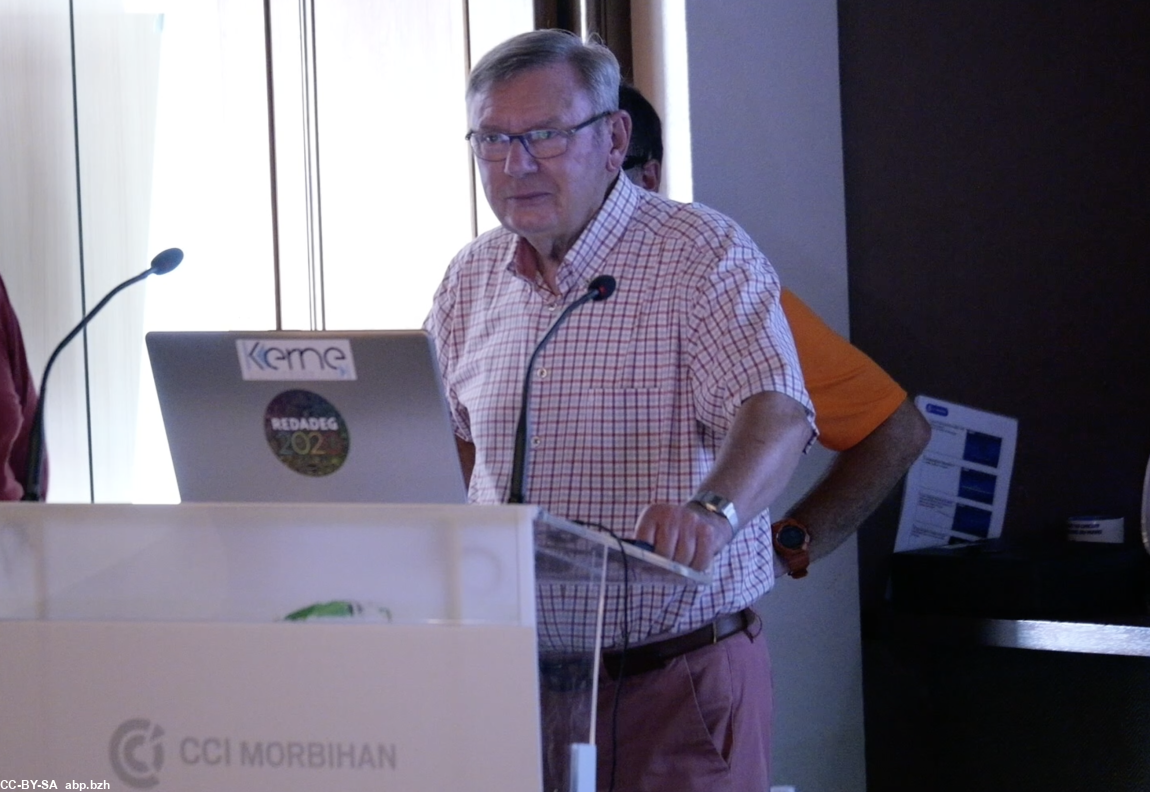
Emglev Bro an Oriant organized this conference held at the CCI of Lorient during the Interceltic Festival. With British Cornwall being the guest of honor this year, Michel Le Coz recounted over 10,000 years of history of this Brittany across the Channel, whose language, Cornish, is so close to Breton that many words and expressions, as well as part of the Cornish toponymy, are immediately understandable to a Breton speaker.
Speaker based in Quéven, in Morbihan, Michel Le Coz has a scientific background. Bilingual in Breton and French, and now retired, this scholar passionate about the history of Brittany and Celtic countries regularly gives lectures on these subjects.
Himself originally from Cornouaille in Brittany, Michel Le Coz emphasizes throughout his presentation the many links between the two Cornwalls. He notably mentions the existence, in the 6th century, of a "double kingdom" on either side of the English Channel, associated with Conomor, sometimes identified with King Mark from the legend of Tristan and Iseult. Toponymy and languages also testify to this proximity: some Cornish expressions remain immediately understandable to a Breton speaker.
From Prehistory to Present-Day Cornwall
Michel Le Coz organizes his journey through history around ten major themes: the current perception of Cornwall; the Mesolithic, Neolithic, Bronze Age, and Iron Age periods; Cornwall before and after the Roman conquest; the long resistance of the Bretons to the Saxons; the Anglo-Norman then Plantagenet administration; the particular legal system of the Stannaries, linked to tin mining; the Tudors and popular revolts; Cornwall during the English Civil War; the Industrial Revolution and the mines; finally, the decline and then the revival of the Cornish language and Cornwall in the 21st century.
From Mines to the Revival of Cornish
Significant attention is given to the tin and copper mines that shaped the economy, landscapes, and society of Cornwall for centuries. The 18th and 19th centuries were a period of full employment and relative prosperity linked to mining. Their decline and the closure of the last mine in 1998 have profoundly marked the territory. This history, or let’s say this memory, also explains why new projects for lithium, tin, copper, or tungsten extraction today encounter an attitude in Cornwall that is often less resistant than in Brittany. There is a collective memory of this prosperity, and the ruins of that era are everywhere, even on the beaches and cliffs.
Michel Le Coz finally reflects on the long decline of Cornish until its disappearance as a language spoken daily, and then on its revival from ancient texts and connections with Breton and Welsh.