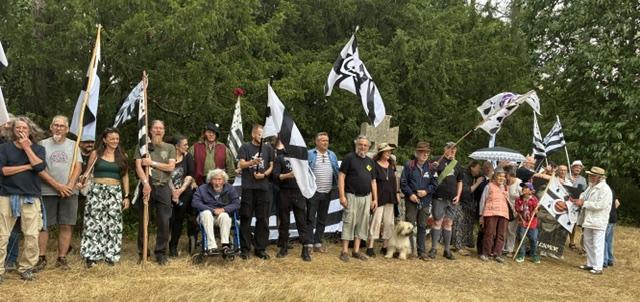
Speech by Koun Breizh Commemoration of July 26, 2026: 538th anniversary of the battle of SAINT AUBIN DU CORMIER
538 Years Ago
538 years ago, on this moor, the Battle of Saint-Aubin-du-Cormier took place.
A battle among many in the history of humanity. A battle where men of numerous nationalities faced each other. And we know that there were French and Bretons on both sides.
This battle hastened for us a process of loss of independence, with a treaty quickly violated and the gradual loss of our freedoms.
Beyond the factual historical dimension, this battle reminds us of one essential thing.
Our history does not begin in 1789, as some would like us to believe. The Breton people existed long before that date and they are still standing today, despite everything. This gathering today demonstrates it once again.
We are rich in a glorious history, marked by the fierce will to perpetuate our independence and the constant concern to never let anyone dictate our will.
German historians remind us that the Franks could never overcome the Bretons. The revolt was constantly brewing.
But you will never hear about that history in the school of the republic, nor even at the University. The history of our beautiful regions is reduced to that of their incorporation into France.
With Koun Breizh, for many years, we have cultivated this Breton memory, with the establishment of plaques or commemorative statues, with legal actions to save our menhirs, our toponymy, or our calvaries, and many other things that we will tell you about in the autumn.
Our history must be known by the Bretons. The Breton people cannot be reduced to the "region" of Brittany, stripped of Loire-Atlantique and endowed with trivial powers. This region today functions merely as a relay of central power.
The Breton people deserve much better than that. It is freedom and the open sea that call them.
Our history still helps us to think about the present and to react usefully when peril threatens. We have already lost a lot, but it is always possible to lose even more, such as the very name of "Brittany."
The French political situation is terrifying. We must be aware of it. The RN, the favorite in the polls for the presidential election, promises the disappearance of the regions. The other extremist party, LFI, envisions a new redistricting of the regions according to watersheds in the name of ecological concerns.
Tomorrow, it may well be that the political troubles facing the nation of France lead to the outright eradication of Brittany.
This evolution is the logical continuation of a Jacobin republic.
We all know that without a community endowed with genuine autonomy, it is futile to claim to save our languages and our culture. So without a territory named Brittany, how would we do it? It would be the end of all our hopes.
When peril becomes reality, will we know how to come together as a people, or will we continue down the path of renunciation?
From renunciation to renunciation, it happens that a people simply disappears.
But it also happens that a people regains its strength and finds within itself the seeds of a resistance that was thought lost.
It is in our collective memory that we will find the spring of resistance to the new forms of domination that we will undoubtedly face.
This is one of the objectives we pursue with the commemoration of this 538th anniversary of the battle.
Tomorrow, perhaps, we will remind the world that we are still here, despite the veil of prohibition and silence that has been swiftly cast upon our shoulders.
Tomorrow, perhaps, we will need to tear this veil.