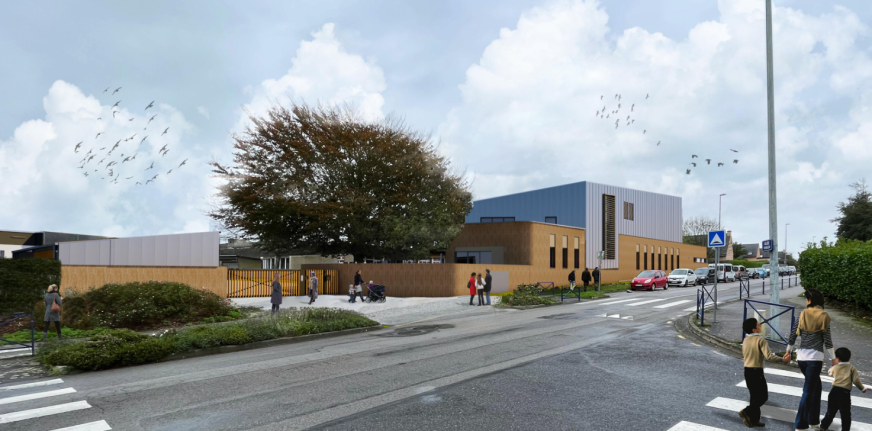
The article published in Ouest-france about the de-Bretonization of the Coat-Edern school allowed the mayor of Plouzane, Yves Du Buit, to avoid answering our legitimate questions and to caricature us by calling us "nationalists." This warranted a response from us. Above all, this example once again demonstrates the disinterest of certain elected officials in our Breton heritage.
KOUN BREIZH responds to the mayor of Plouzane
The reaction of Mr. Du Buit, Mayor of Plouzane, in the Ouest-France article from October 26, to our inquiry about the de-Bretonization of the Coat-Edern school and that of Kroas-Saliou to follow, as well as for his entire work since many place names in the Breton language have been removed due to his recent addressing, deserves some attention.
Mr. Mayor refused to answer Ouest-France to the questions we submitted, opting to sidestep. He tells us he cares for the Breton language and labels us as obtuse nationalists.
What should we deduce from this?
Of course, one is always free to respond as one wishes in a democracy. One even has the right to lie! And yet, the regular functioning of a democracy recommends that elected officials account to citizens by responding clearly and precisely to inquiries that are rarely illegitimate. This is what happens within established democracies.
It is up to Mr. Du Buit to tell us that he cares for the Breton language without specifying what concrete actions he has taken. We would just like to understand how one can simultaneously claim to support the Breton language while throwing numerous place names into the dustbins of history when one is at level 2 of the Ya d’ar Brezhoneg charter. We also regret the lack of response from Paul Molac to our legitimate questioning.
Bretons, who are attached to their heritage, can all the less tolerate Mr. Du Buit's disdain, especially since he was asked to show a little openness by associating Rosa Bonheur with the name of the Coat-Edern school. Even that was too much to ask!
Contrary to what his response suggests, Yves Du Buit is not free to do whatever he wants in his municipality. He has accounts to settle with the Breton people who care about their intangible heritage. To avoid answering an uncomfortable question, it is customary to attack and delegitimize the one who poses it. This is the spirit of the times, and this is what he has done here by calling us "nationalists."
Koun Breizh is a heritage association, recognized as being of general interest by Mr. Le Préfet, and strives to defend Breton heritage and culture, sometimes under difficult conditions. We could even add that it sometimes feels very alone.
Are we the armed wing of Breton "nationalism"? Has the Mayor sought to learn a bit about what we have been doing for years? Everything is on the internet! The only nationalism we know is French and is characterized by its current danger. Our social purpose is that of an association concerned with our languages, our culture, and our heritage. It reminds us that nothing is possible without respect for humanist values.
And when we mention the "Breton people," it is because they exist despite centuries of public misinformation. They exist enough to publicly demand accountability from you regarding the lightness with which you de-Bretonize their heritage. In this, we are in line with our associative purpose.
Even though the task is difficult, we will attempt to list all the place names in the Breton language that you have removed from addressing or placed in complementary addressing, which amounts to the same thing, and we will symbolically offer them to you. This work should be carried out by the OPAB because the Breton people have the right to know.
We would also like to recover the "Koat-Edern school" sign symbolically, of course, as it is an example of current de-Bretonization, for the attention of future generations.
Our elected officials are deserving people. But many of them still practice this curious way of approaching the Breton language. Beautiful salon speeches about the benefits of diversity, and in reality, no effort worthy of the name or a sovereign disinterest.
Many see no problem in removing Breton names from places for advanced technical considerations or simple convenience.
How is it that the Region, which should feel primarily concerned and which controls Megalis in charge of fiber - and which advocates for the standardization of addressing - did not immediately establish the principle of full respect for toponymy in the Breton language? The municipalities would have followed, and it would have been the technical constraints that would have yielded to the Breton language and our most precious heritage!
We would have avoided a Breton scandal. Because the worst part of this story is that it is the Bretons who are removing Breton from their land. But that should definitely not be said!
For Koun Breizh
Yvon Ollivier
President