Paul Molac : « Nous sommes un peuple, le peuple breton »
Réalisation : ABP – 109 vues
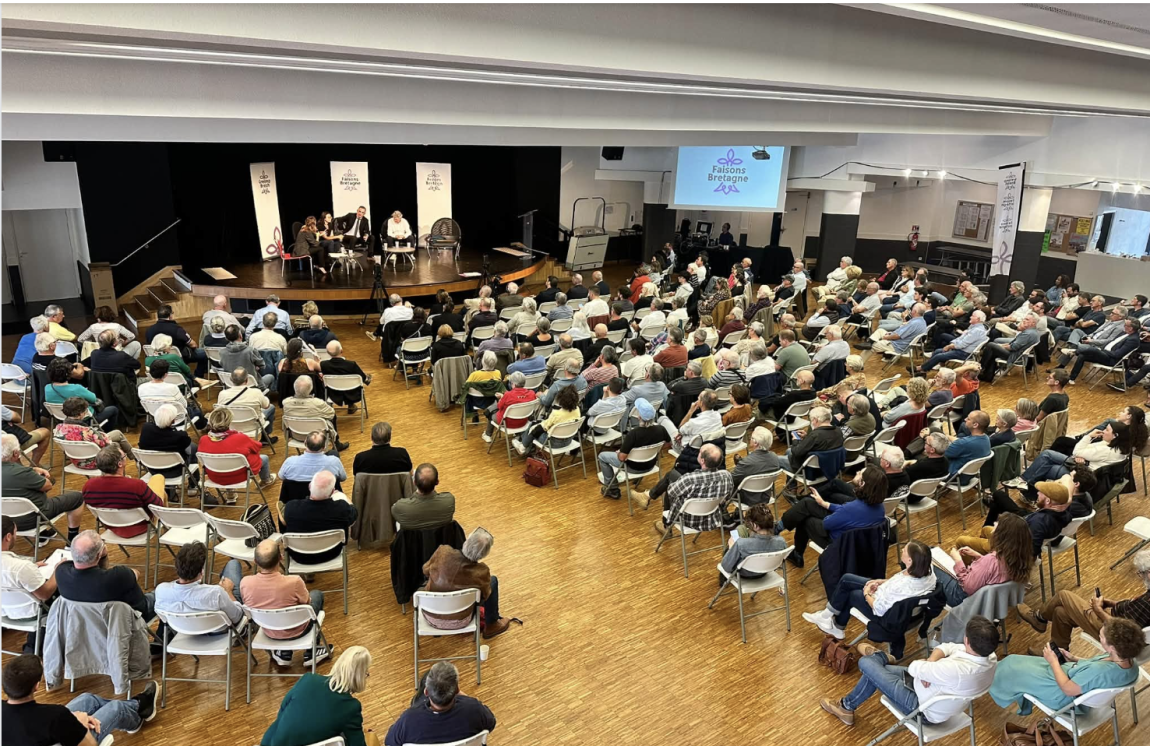
As France goes through a period of political instability, social tensions, and budgetary difficulties, with public debt now approaching 3.6 trillion euros, elected officials from the regions and political figures such as Jean-Louis Borloo and Paul Molac are proposing a thorough review of the organization of the Republic. On Saturday, October 3, in Pontivy, Faisons Bretagne brought together elected officials and political leaders around a common idea: to transfer a large share of power to the regions.
"The French system no longer works"
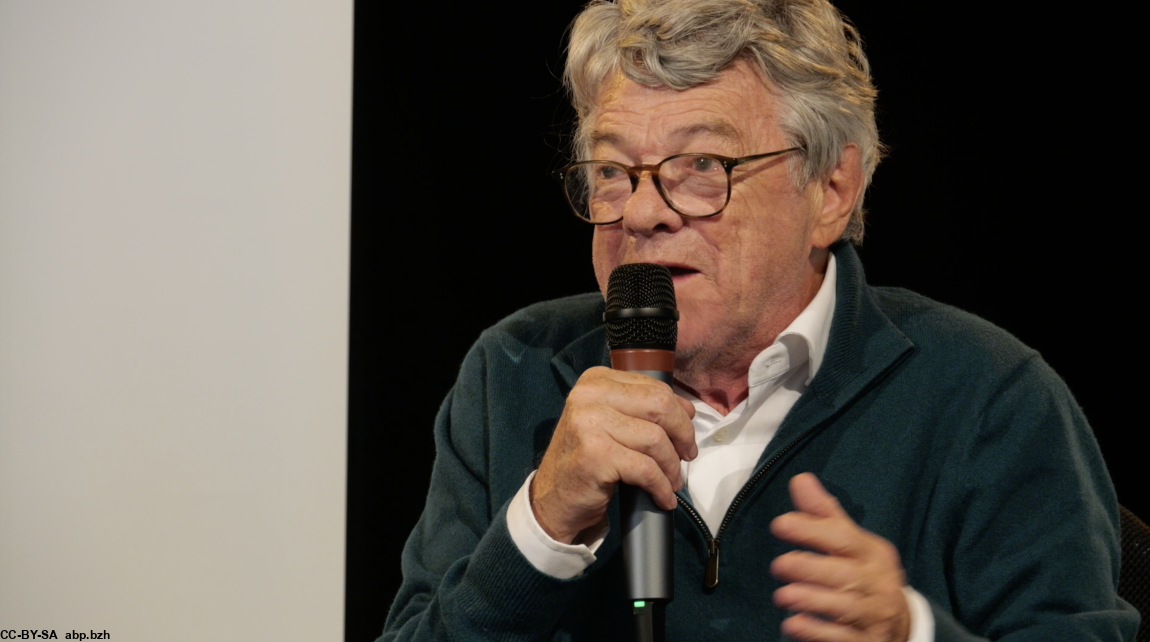
Jean-Louis Borloo did not mince words. For the former minister, it is no longer a matter of adding another layer to French decentralization but of revisiting the organization of the country. He points to the accumulation of norms, controls, administrations, and levels of decision-making. Housing, health, agriculture, education: no one clearly knows who decides, who finances, and who is responsible anymore.
His proposal is radical: redefine who does what. Borloo recalls that General de Gaulle had, in his view, "anticipated" this necessity as early as 1969 with his regional reform project. The state should handle sovereign functions and major strategic issues, while territories should manage everything else. Using Brittany as an example, Borloo believes it should be able to legislate on housing, urban planning, education, ecology, land and subsoil management, and vocational training: "Let Brittany legislate," he says, referring to a Parliament and "a small government of Brittany."
For the former minister, Corsica has paved the way. Addressing Gilles Simeoni, he says: "You were the pilot boat at the entrance to the port. Thank you for being the pilot boat."
Borloo denounces a society organized around mistrust and control and traces the historical origins of centralism:
It must be understood that centralism is a military organization. France is a country that was organized militarily with 2% of a generation that could read and write," [...] Today, 92% of the French can read and write. It makes no sense. Collective intelligence prevails. - Jean-Louis Borloo
He summarizes the persistence of Jacobinism with another phrase: "We have the same mental model as Robespierre." In his view, this system is based on mistrust: the administration controls local authorities, local authorities must seek permissions, and everyone controls everyone. Conversely, he calls for rebuilding an "organization of trust," with clearly assigned responsibilities. "It is the people of France in their diversity who must take back control, trust themselves, and reorganize," he asserts.
Gilles Simeoni: "Change the Constitution rather than ask the Corsican people to disappear"
The mayor of Bastia, Gilles Simeoni, brought the Corsican experience to this indictment against centralism. Since 2015, he recalls, nationalists have won several elections in Corsica and chosen to pursue their demands through democratic means. However, successive governments have long refused to open a genuine discussion on autonomy, and regarding the law passed by the National Assembly, it is uncertain whether it will be adopted by the Senate.
Gilles Simeoni condemned this absence of democracy: if a political movement is asked to abandon violence and go through the ballot box, it must also be considered afterward what the results of those ballots are. Alluding to the passed law that rejects the notion of a Corsican people, he declares: "If a Constitution does not allow for the recognition of a people, it is better to change the Constitution than to ask the people to disappear."
He once again rejects the idea that autonomy would mechanically lead to independence. He cites several European territories where it has, on the contrary, eased relations with the central state. Conversely, he believes that institutional blockage can reinforce separatism.
The State in the dock
The second roundtable moved from constitutional matters to lived experiences. Several elected officials recounted their confrontations with state administrations. In the room, some of these accounts provoked indignation.
Patrice Gautier, mayor of Évran, recounted the case of the Dinan–Saint-Malo hospital. For several years, he explains, local elected officials were excluded from the matter on the grounds that health was not within their competence. Then the project was called into question, and Loïg Chesnais-Girard mentioned a gap of 300 million euros that local authorities were then asked to help fill. The president of the administrative region summarizes the contradiction: the State tells local authorities that they are not "big and mature" enough to manage health, then asks them to contribute when the project's funding falls through. "It is high time to hand over the reins, including on these issues," he concludes.
Sandra Le Nouvel, president of the Kreiz-Breizh community of communes, recounted another conflict. Together with local elected officials, she opposed an agrivoltaic project covering several dozen hectares. Despite their negative opinion, the prefect ultimately authorized the project. "This is an intrusion into the autonomy of the territories."
Chesnais-Girard questioned on his record
At the end of the first round table, the moderator directly questioned Loïg Chesnais-Girard about what he had concretely achieved for the autonomy of Brittany, beyond statements and votes.
The president of the Regional Council recalled the vote of the regional assembly in favor of autonomy and the report subsequently submitted to the State. "It must have been placed in a cabinet somewhere or forgotten at the train station. We have never received a response," he quipped.
The wish "for an autonomous Brittany in a Republic of territories with strengthened democratic foundations" was adopted by the Regional Council on April 8, 2022. It specifically called for the opening of discussions with the State on a model of autonomy that includes a share of legislative and regulatory power. The report resulting from this work was then personally handed over by Loïg Chesnais-Girard to Prime Minister Élisabeth Borne on September 28, 2023, in Saint-Malo. Three years later, according to the Regional president, no response has been provided.
Chesnais-Girard nevertheless defended the necessity of moving further: "Territories need to take the country," he stated, framing this evolution within the context of the Republic and Europe.
Molac: "fiscal, regulatory, legislative autonomy"
In his closing remarks, Paul Molac summarized the political objective of Faisons Bretagne in three words: "Fiscal, regulatory, legislative autonomy." The deputy from Morbihan clarified that he is not an independentist and places Brittany within the French and European frameworks. However, he explicitly claimed the existence of a Breton people: "We are a people, the Breton people, an integral part of the French people."
For him, autonomy is not only a right stemming from Breton uniqueness but also a response to the operational crisis of the French State. "This autonomy is legitimate for us because we are different, but it is legitimate for everyone because it will simply improve administration."
Towards a "Pontivy call"
The day ultimately led to a political proposal. Jean-Louis Borloo called on regional presidents, former ministers, mayors, deputies, and senators who share this observation to come together to advocate for a territorial reorganization of France. “It’s called the Pontivy call,” he stated. Paul Molac reiterated the idea in his conclusion. The text does not yet exist: it remains to be collectively drafted. The announced objective, however, is clear: to present it to the candidates for the upcoming presidential election and ask them to take a stance. The presidential election will be followed by the legislative elections. However, Molac reminds us, true legislative autonomy would require a modification of the Constitution and then an organic law.
In Pontivy yesterday, it was the very architecture of a French state built over two centuries around Paris that was called into question, with a proposal on the table: to return decision-making power to the territories.