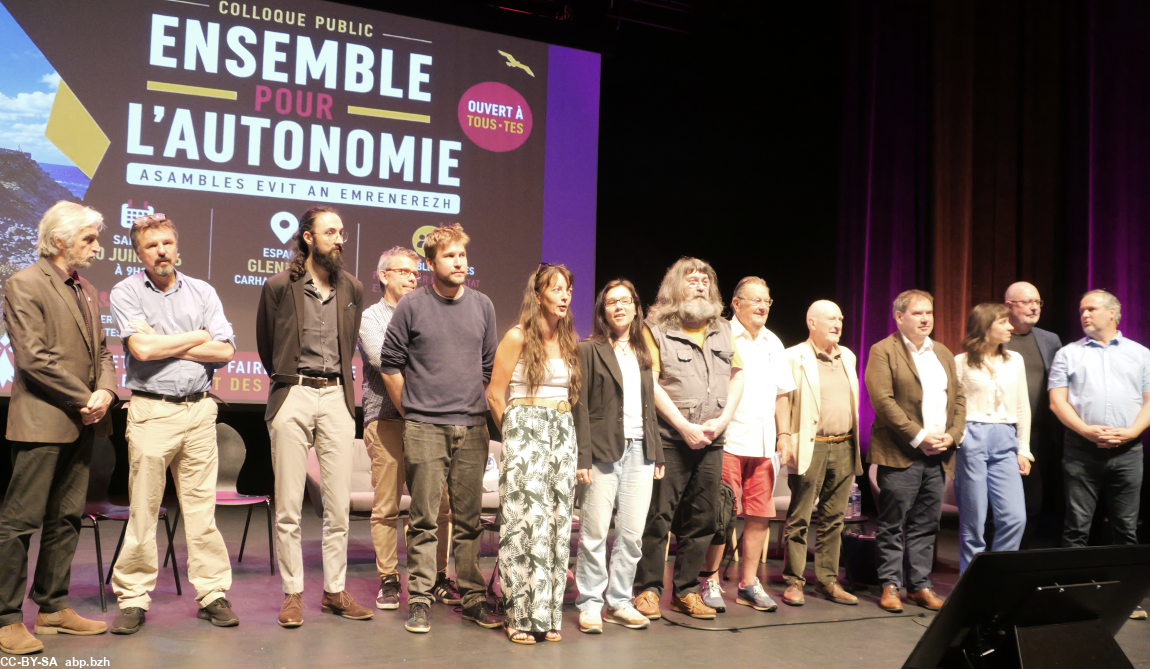
Gathered in Carhaix at the invitation of Mayor Christian Troadec and lawyer Yvon Ollivier, representatives of autonomist, federalist, and independentist parties and movements made multiple calls for unity. All emphasized the need to build a common project capable of addressing the daily concerns of the Bretons.
The day, hosted by Sten Charbonneau from the Cultural Institute of Brittany, revolved around two round tables. During the first, journalist Francis Brochet, author of "When Parisianism Crushes France," denounced the hyperconcentration of economic, political, media, and cultural powers in Paris. According to him, France is an exception in Europe due to the weight of its capital, to the detriment of the regions. He also advocated for greater freedom to "live and work in one's homeland," echoing a Breton phrase recently highlighted at the European level.
The discussions also focused on the consequences of centralization for languages, regional cultures, and territorial management. The speaker from the Basque Country recalled the advancements achieved thanks to the Basque Agglomeration Community and advocated for new steps towards autonomy. For his part, Gwenaël Henry, president of Bretagne Majeure, presented the research conducted by his association on public finances in Brittany, arguing that budget transparency is a crucial issue to illuminate the debate on autonomy. This involves assessing the relationship between the tax contributions of Bretons and the resources allocated by the state to public services in Brittany.
The second round table brought together representatives from the Breton Party, UDB, Douar ar Frankiz, War-Sav, the Breton Federalist Alliance, and Faisons Bretagne, the movement launched by Paul Molac.
Beyond the diversity of sensitivities represented, one theme emerged throughout the discussions: the necessity of building a common project capable of uniting the different components of the Breton movement. Amélie Barrely called on the various sensitivities to "focus on what brings us together and not on what divides us."
Several speakers, such as Mathieu Guihard and Gaël Roblin, argued that autonomy alone could not constitute a sufficient political offer and that it was now necessary to propose a project to Bretons that addresses their daily concerns: health, housing, transportation, employment, and land use planning.
In conclusion of the day, jurist and writer Yvon Ollivier provided a more serious analysis of the political situation. Believing that French institutions are running out of steam, he called on Bretons to organize themselves in order to take control of their destiny as a people.