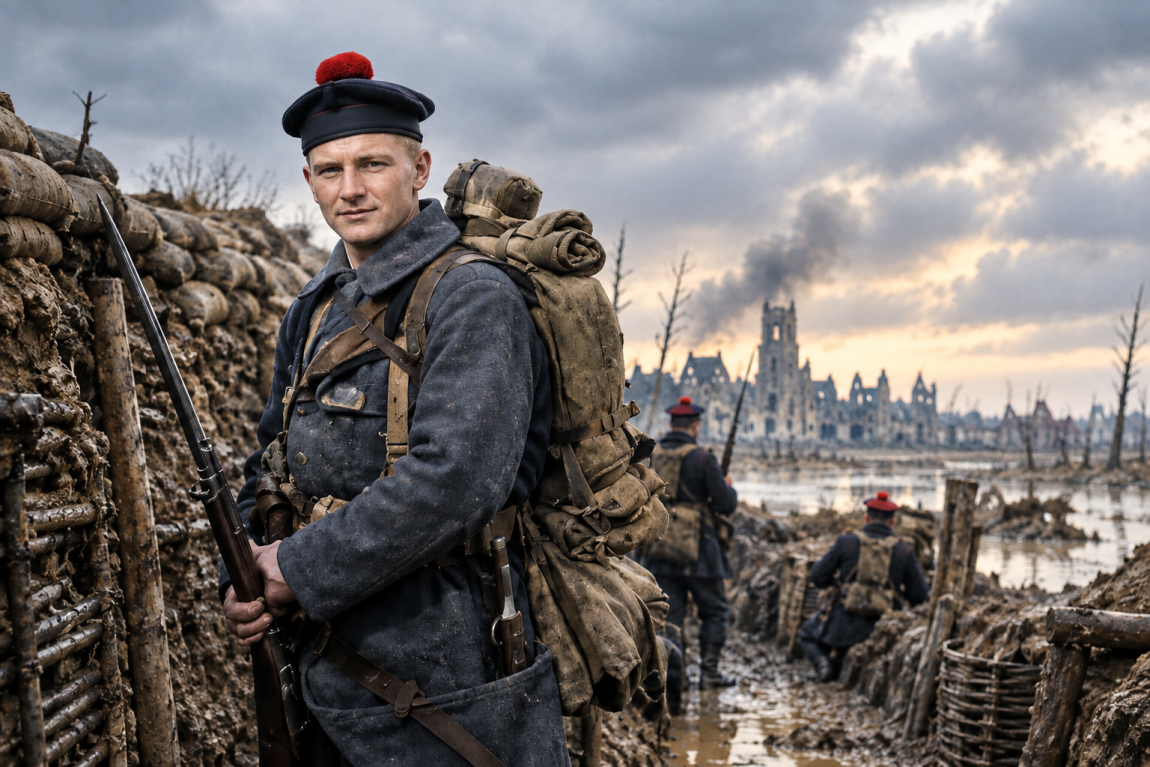
In Nieuport, on the banks of the Yser, a Breton delegation will pay tribute on Saturday, September 19, to quartermaster Yves-Marie Carval, a sailor from Plogoff killed in January 1915. Behind the fate of this man lies one of the bloodiest chapters of the First World War: that of the marine rifle brigade of Breton Rear Admiral Pierre-Alexis Ronarc’h, sent to Belgium in the autumn of 1914 to halt the German advance.
Sailors Transformed into Infantrymen
When war broke out in August 1914, nothing destined these men to fight for months in the mud of Flanders. In response to the considerable losses of the French army in the first weeks of the conflict, the Navy made several thousand men available, primarily from the depots in Lorient, Brest, Cherbourg, and Rochefort.
A brigade of about 6,500 naval fusiliers was formed under the command of Rear Admiral Pierre-Alexis Ronarc’h, born in Quimper in 1865. It included many Bretons and a lot of very young sailors. In Paris, where they were initially sent to participate in the defense of the capital, their youth earned them the nickname "the ladies of the Navy." But in October, their destination changed: it was no longer Paris that needed defending, but Belgium.
Hold at the Yser
After the fall of Antwerp, the Belgian army retreated westward while German forces sought to reach the Channel ports, essential for supplying the Allied armies. The Ronarc’h brigade arrived in Dixmude on October 15. With about 5,000 Belgian soldiers, the 6,500 French sailors had to face German forces that were vastly superior in number, estimated between 45,000 and 60,000 men.
The order given to Ronarc’h is to hold.
Around Dixmude, the sailors hastily dug their trenches. For several weeks, attacks and bombardments followed one another. The city was gradually destroyed, and the losses became considerable.
From the end of October, the Belgians opened the sluices at Nieuport. The sea gradually flooded the polders between the Yser and the railway. Miles of countryside were transformed into a vast flooded area that helped to halt the German offensive.
On November 10, after nearly a month of fighting, Dixmude was nothing but a field of ruins. The naval fusiliers retreated to the left bank of the Yser. More than half of the brigade's personnel had been killed, wounded, or reported missing. They were supposed to hold for a few days. They held for nearly a month.
From Dixmude to Nieuport
However, the battle did not stop at Dixmude. The front stabilized along the Yser, and the naval fusiliers remained in Belgium.
Fighting continued, particularly in the Nieuport sector, a few kilometers from the North Sea, amid the dunes, canals, and flooded polders. The men lived in trenches often filled with water and under bombardment.
It is here that Yves-Marie Carval dies.
Born in Plogoff on November 15, 1889, he was a quartermaster fusilier in the 1st regiment of naval fusiliers. He was killed in Nieuport on January 15, 1915, at just 25 years old.
Under the conditions of the front, his comrades buried him on site with other soldiers in a mass grave. A small wooden cross was said to have marked the spot before disappearing over time. More than a century later, his family was still searching for his burial place.
A Grave Found More than a Century Later
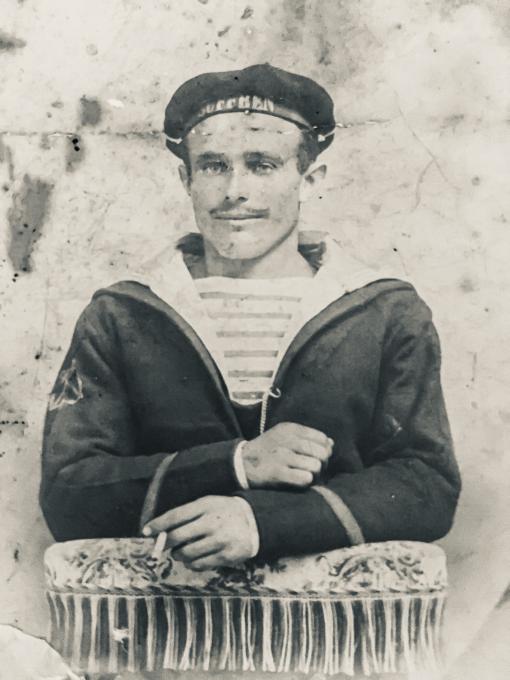
After being contacted by his descendants, the Koun Breizh association undertook research. With the help of the French embassy in Belgium and individuals working on French memory in Flanders, the location of the grave was found.
A ceremony is to take place in front of it on Saturday, September 19, at 11:30 a.m., in the presence of Yves-Marie Carval's family, local authorities, and a delegation from Koun Breizh. A religious ceremony in the Breton language is also announced.