A confirmed rating in Bern, about ten Breton documents reported in Saint Petersburg, new classified corpora, and exchanges initiated with several European networks: BRETAGNE-DOC presents the verifiable results of its week of work and the steps that remain to be pursued.
The archives of Breton history are scattered well beyond Brittany. Some pieces are known but difficult to locate; others appear in foreign catalogs, under old spellings or amidst larger diplomatic files. The work of BRETAGNE-DOC consists of finding these traces, verifying the references and provenances, and then linking each document to a comprehensible and verifiable notice.
The week of October 19 to 23, 2026, brought several concrete results. It also allowed us to consolidate our classification method and open new exchanges with institutions, researchers, and cultural networks. All these efforts do not have the same status: some documents are already in our possession, others have only been located, and several cooperations remain to be built.
In Bern, a confirmed reference and a passage from 1493 found
The Archives of the State of Bern sent us photographs of pages 258 and 259 of a register currently kept under the reference A IV 6, "Band F: 1491-1494." Benjamin Ryser then confirmed this reference, resolving an uncertainty caused by a reversal of numbers in an initial exchange.
Page 259 contains the minutes of a meeting held in Lucerne on March 5, 1493. The passage corresponds with paragraph 456 g of the edition of the old Swiss federal reces. It reports the arguments presented by the envoys of the King of France regarding the "young lady of Brittany" and the daughter of the King of the Romans, that is, in their historical context, Anne of Brittany and Margaret of Austria.
This text does not constitute either a Breton treaty or a legal decision of the Swiss cantons. It preserves the trace of diplomatic words reported during a negotiation. The claims of the ambassadors must therefore be distinguished from the facts they purport to establish. The photograph now allows for a precise collation with the printed edition, particularly for the corrections, additions, and formulations that the German summary may have simplified.
In Saint Petersburg, about ten documents related to Brittany reported
The National Library of Russia provided us with another important lead. From the 1993 catalog dedicated to French letters of the 15th century from the Pierre Doubrovski collection, a curator from the Western Manuscripts Department identified about ten documents related to the history of Brittany.
This initial set would notably include two letters from Anne of Brittany, one letter from François II, and two letters from François, Count of Vertus, the illegitimate son of Duke François II. The report is precise and comes directly from the conserving institution, but detailed notices, references, dates, and reproductions still need to be obtained and verified.
We do not present these letters as newly discovered documents nor as pieces already studied by our team. The acquired result is their identification in a determined collection and the opening of an exchange allowing for further exploration. The 1979 catalog of the collections of the Doubrovski collection also offers a lead for continuing research into the 16th century.
Maximilian, Charles VIII, and Brittany: a printed source from 1493
Research dedicated to Maximilian led to the study published in 2021 by Marina Blum on a power of attorney from Emperor Frederick III to his son. Dated Linz, February 11, 1493, this text gives Maximilian the power to mobilize against Charles VIII and calls upon the forces of the Holy Roman Empire to support him.
The source belongs to the context of the conflict between Maximilian and the King of France, in which the affairs of Burgundy and Brittany are closely linked. It is known through printed sheets preserved notably at the Tiroler Landesarchiv, under the reference Inkunabel 11, and at the Austrian State Archives, under the reference AT-OeStA/HHStA, SB Einblattdrucke 5. The original from which the text was disseminated is not currently located.
This power of attorney should not be confused with the act of renunciation by Maximilian sometimes attributed to December 28, 1493, which we are still trying to identify by a reference or a verifiable edition. However, it constitutes an important source on the early use of print in political mobilization against Charles VIII after his marriage to Anne of Brittany.
Organized and Documented Corpora
This week was also dedicated to organizing the documents already gathered. Our private workspace, Recogito Studio, now contains fifteen projects and 494 documents. Each file receives a preliminary classification: primary source, copy, scholarly edition, secondary study, working document, or item whose identification remains uncertain.
Among the classified sets are the five documents from Simancas related to the agreements concluded in 1483 between Francis II and the Catholic Monarchs, a modern manuscript copy of the edict of Plessis-Macé from 1532, the scholarly edition of a mandate from Jean V dated September 8, 1423, as well as the authentic copy of the League of Gien from April 15, 1410, preserved at the National Library of France under the reference NAF 23126.
This material distinction is essential. The copy of the Plessis-Macé preserved in file 1 J 858 at the Maine-et-Loire departmental archives should not be described as the royal original from 1532. Similarly, Chantal Reydellet's article on the mandate of Jean V provides access to an edition of the text, but not yet to images of the original preserved in Ille-et-Vilaine under the reference 1 J 654.
The thirteen images of the five documents from Simancas have been compiled with their descriptions and metadata. They concern negotiations with the Duke of Brittany, adherence to peace and alliances, the passage of horses to Brittany, and the appointment of Gutierre de Cárdenas as the conservator judge of the agreements. Their public dissemination must respect the reuse conditions of the Archivo General de Simancas and PARES.
An Enhanced Public Notice for the Act of Anne of Brittany from 1490
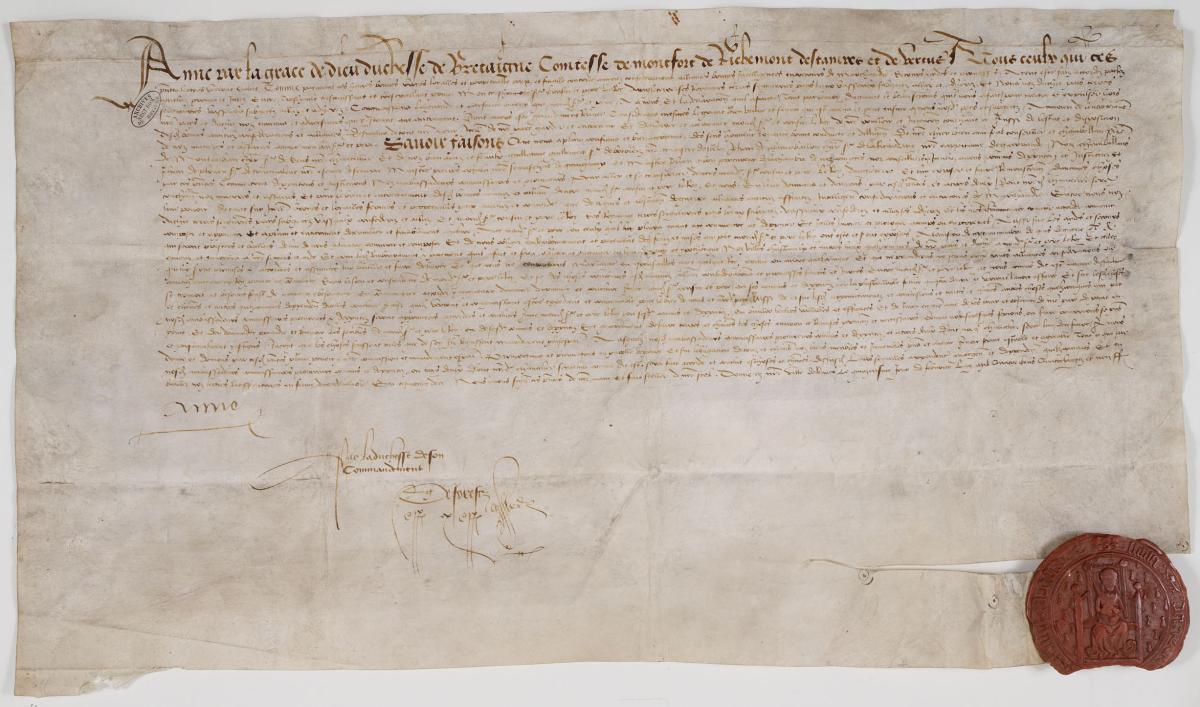
The notice dedicated to the power of attorney given by Anne of Brittany to Philippe de Montauban on February 15, 1490, has been enriched and published in a second version on Zenodo. The document is preserved at the National Archives under the reference AE/II/525, former reference T//189/6.
The new notice maintains a cautious comparison with the act TNA E 30/596 from the British National Archives. The two references may correspond to copies of the same act or closely related acts, but only a complete collation would allow for a determination. The public deposit does not therefore transform this hypothesis into certainty.
Zenodo notice, current version
Permanent link to all versions
Pelagios: Mapping Places Without Erasing Uncertainties
On October 20, we participated in a meeting of the Pelagios community. Our question concerned historical spellings, uncertain geographical identifications, and contradictions between sources. How to link a medieval place name to a modern map while preserving the date, source, and degree of certainty of the identification?
Discussions around PLATO, Wikidata, and the future Peripleo have confirmed the interest in a model based on documented attestations rather than a unique identification imposed on all periods. One participant proposed to present her work in Wikidata and to examine with us a small case study BRETAGNE-DOC. This session is yet to be organized and does not yet constitute a formalized institutional partnership.
Our first cartographic dataset brings together twenty-four places and institutions. It is published in an open repository to allow for its verification and improvement.
Europeana, IIIF, and responsible access to images
BRETAGNE-DOC has joined the Europeana Network Association and continues its discussions around the IIIF protocol. This allows for linking a digitized image, its metadata, its provenance, and annotations without unnecessarily multiplying copies.
A first technical pathway has been completed: Recogito Studio has been selected as the main workspace; liiive can be used for occasional collective annotation sessions; IMMARKUS offers possibilities to represent the links between people, places, and documents. These tools do not replace the examination of originals or the verification of reproduction rights. They help to make the documentary reasoning visible.
The public project presented on EU-Citizen.Science has also been enriched with the cartographic dataset and its permanent link. Dissemination remains limited to metadata and files whose reuse is authorized.
Cultural cooperations under construction
Several initiatives have been undertaken with Breton and European stakeholders. A reconnection has been initiated with the team of the Pan Celtic International Festival in Carlow for 2027 to explore the possibility of an intervention, a documentary presentation, or a remote exchange. No format or travel has been confirmed yet.
Exploratory exchanges are also underway with Europe for Scotland, regarding cultural relations between Brittany and Scotland, with KAD in Brittany, as well as with cultural associations contacted individually. A meeting with Christophe Tricart from Trinka is scheduled for October 27 to present BRETAGNE-DOC and explore illustrated mediation avenues.
A proposal titled "Bretaigne DAO – Linked Brittany Historical Archives" has also been received by the Time Machine community for review. Its submission is confirmed, but its acceptance as a project or institutional partner is not yet confirmed. The same caution applies to our contribution submitted for DH2027: the acknowledgment of receipt confirms the submission, not the selection.
A method: showing evidence and limits
This week illustrates the method we want to apply. An archive response is not yet a reproduction; a reference number is not yet a transcription; a resemblance between two acts is not yet their identity; a meeting is not yet a partnership.
Each step, however, produces something useful: a corrected reference, a localized image, a discarded lead, a qualified contact, or a better-described document. By linking these results, BRETAGNE-DOC is gradually building a corpus dedicated to Brittany and its European relations from the late Middle Ages to the early modern period.
The next steps will be to obtain detailed notices of the letters reported in Saint Petersburg, to continue collating the register of Bern, to identify the act of renunciation attributed to Maximilien in December 1493, and to prepare shareable case studies with the Pelagios and Europeana communities. The results will be published as they are verified and in compliance with the rights attached to reproductions.
BRETAGNE-DOC / Bretaigne DAO https://www.bretaigne.bzh/
Zenodo deposit https://zenodo.org/records/23578980
ORCID https://orcid.org/0009-0009-8046-369X
Editorial note: the documents reported in Russia have not yet been reproduced or studied by BRETAGNE-DOC. The announced exchanges with Pelagios, Time Machine, Pan Celtic, Europe for Scotland, KAD, and Trinka are at different stages of progress; only memberships, meetings, or deposits that have been explicitly confirmed are presented as such.