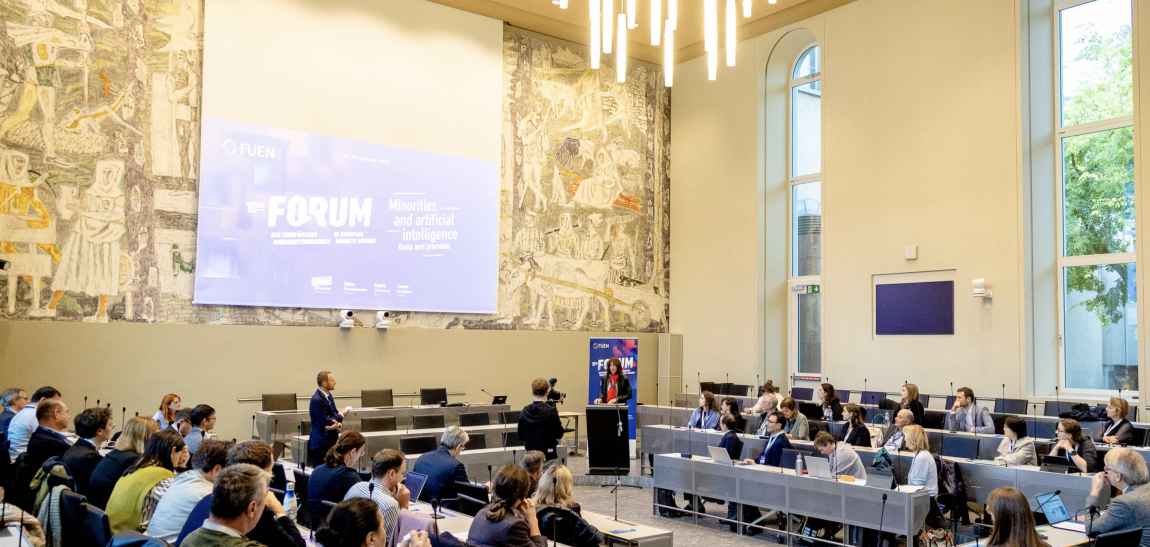
Gathered on October 23 and 24, 2026, in Chur, Switzerland, for the 10th Forum of European Minority Regions organized by FUEN, representatives of linguistic minorities, researchers, and technology companies presented the opportunities offered by artificial intelligence to preserve and develop their languages. From Romansh to Irish, including Ladin, initiatives are multiplying. Experiences that could also inspire the digital future of Breton.
At the opening, its president Olivia Schubert reminded that linguistic diversity must be taken into account in European policies on artificial intelligence. FUEN particularly requests that minority languages be integrated into the digital policies of states and that their communities participate in decisions that concern them.
According to Marius Lukosiunas, a representative of UNESCO, of the approximately 7,000 languages spoken in the world, only 1,000 would be represented on the Internet. For Martin Bühler, president of the government of Graubünden, when a digital tool works better in a dominant language, it gradually encourages users to abandon their own language.
Romansh develops its own digital tools
The organization Lia Rumantscha presented several achievements, including ClaviRom, an Android keyboard adapted for Romansh, and ALAS, an automatic translation system that has completed over 460,000 translations in 178 days. These initiatives illustrate the concept of "linguistic digital sovereignty": allowing communities to maintain control over their linguistic resources and the technologies that exploit them.
Irish focuses on voice technologies
Ireland presented its strategy for integrating the Irish language into digital public services. Neasa Ní Chiaráin particularly outlined the work of the public project ABAIR, dedicated to automatic speech recognition and voice synthesis in Irish. Mastery of linguistic data by communities is also a priority.
Ladin enters smartphones
Ladin, a Romance language spoken notably in the Dolomites, benefits from several innovations. Samuel Frontull, a researcher at the University of Innsbruck and the Ladin Institute, presented Tradutur, an automatic translation system, as well as artificial intelligence tools operating directly on users' devices.
The companies Lenovo and Motorola participated in the localization of over 200,000 words for a smartphone interface in Ladin. This collaboration also led to the development of LiLa, an open-source automatic translation model.
In Romania, in Szeklerland, a team is developing a conversational assistant aimed at helping Hungarian speakers with their administrative procedures.
Google presents its open models
Daan van Esch, a representative of Google, indicated that the company's smartphone keyboards support around 900 linguistic varieties. He also presented Gemma, a family of open-weight artificial intelligence models that researchers can adapt to their own linguistic corpora. This approach allows for the consideration of models specialized in minority languages without having to develop an entirely new artificial intelligence from scratch.
And Breton?
The experiences presented in Switzerland resonate particularly in Brittany. Several digital tools already exist for Breton, including Anaouder, a voice recognition system that automatically transcribes audio and video recordings.
But large language models open up other perspectives: conversational assistants capable of responding in Breton, contextualized translation, educational tools, or even document research in Breton corpora.
The challenge concerns both the creation of quality corpora and the consideration of grammatical mutations, dialectal variations, and the evaluation of results by competent Breton speakers.
The Basque Country develops its own language model
The Basque projects were not presented at the conference. Latxa is a large language model (LLM) developed for Basque by the HiTZ research center at the University of the Basque Country. Adapted from open models from the Llama family (Facebook) and trained on a corpus representing 4.2 billion tokens (units of text used by AI models), Latxa is not limited to automatic translation: it aims to understand instructions, produce texts, and engage in dialogue in Euskara.
"Nothing about us without us"
At the conclusion of the forum, the vice-president of FUEN, Sterică Fudulea, recalled the principle: "Nothing about us without us."
Artificial intelligence can accelerate linguistic homogenization, but it can also contribute to the revitalization of minority languages, provided that their speakers participate directly in the development of the technologies that concern them.
Sources:
FUEN, report of the 10th Forum of European Regions of Minorities, October 26, 2026;
HiTZ research center, Latxa project.