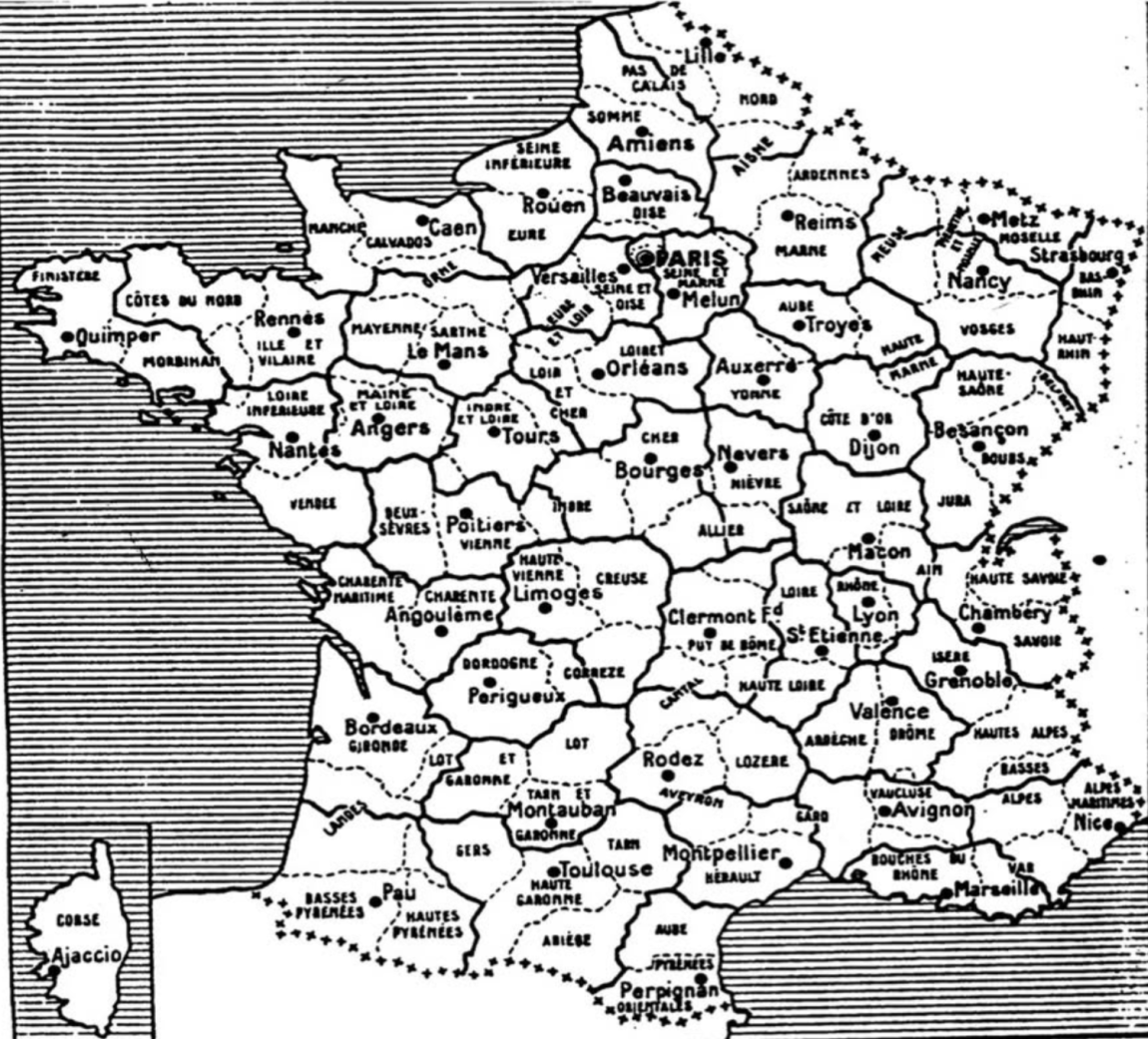
The presidential candidate, David Lisnard, wants to replace departments and regions with around fifty provinces. The map by Michel Debré from 1947, cited as an example in his program, would divide the current administrative Brittany in two. What if the reform started by reunifying it?
David Lisnard, candidate for the 2027 presidential election, proposes to reorganize France around three levels: the State, the province, and the communal block. The provinces would replace the departments and regions. Here is how his program, that of Nouvelle Énergie, formulates it:
Thus, France will offer a clarified and simplified administrative map around, in addition to the municipalities and their intercommunalities, about forty or fifty provinces (see regarding this the map of the large departments designed by Michel Debré; the number will result from the work of defining boundaries in line with historical, geographical, and human realities, as well as the consultations that will follow) that will replace the current departments and regions. — Nouvelle Énergie Program, "Generating a Civic Renewal"
Where is the reunification?
The program refers to the map of the 47 large departments drawn by Michel Debré in 1947, one of the major Jacobins of the post-war period. On this document, historical Brittany is divided into three. This choice is difficult to reconcile with the promise to take into account historical, geographical, and human realities. If the reform favors 40 or 50 provinces of comparable size, what weight will it give to these realities? The situation of the Bretons is known: in October 2026, a survey by Ifop https://abp.bzh/vers-une-france-federale-le-sondage-ifop-qui-bouscule-le-central-72071 indicated that 56% of the inhabitants of the five Breton departments were in favor of attaching Loire-Atlantique to the Brittany region.
ABP therefore asked David Lisnard's team what division they envision for Brittany, and whether a Brittany with five departments is among the options being considered. No response for the moment.
How Brittany was divided
In 1532, the Union Edict made Brittany a province of the Kingdom of France. Nantes, where the last dukes had established their capital, retains the Chamber of Accounts of Brittany. In 1790, the Revolution replaced the province with five departments: Finistère, Morbihan, Côtes-du-Nord, Ille-et-Vilaine, and Loire-Inférieure.
The separation of the latter began as early as 1938, with a division into economic regions around the chambers of commerce. In 1941, the Vichy regime placed four Breton departments under the authority of the regional prefect of Rennes and Loire-Inférieure under that of the regional prefect of Angers, officially for the duration of the war, with the regime announcing a return to the provinces. The Republic resumed this separation in 1956, in the division of program regions. In 2015, under President Hollande, the law that united Upper and Lower Normandy kept Brittany at four departments and Loire-Atlantique in the Pays de la Loire.
This separation is no coincidence, and Michel Debré himself opposed Breton unity. According to a testimony from Edmond Michelet conveyed by Morvan Lebesque, General de Gaulle reportedly stated in a cabinet meeting that regions should regain their historical boundaries, and that Nantes therefore belonged to Brittany. Debré is said to have replied: "My General, if you restore the unity of Brittany, you commit a crime."
Divide to Rule
This succession of decisions illustrates the internal colonialism of France: under the guise of equality, the central power relentlessly seeks to level everything and arrogates the right to set the boundaries within which inhabitants can act together. An administrative boundary determines who elects the same assembly, and at what scale this assembly can finance the teaching of Breton, organize transportation, or support cultural creation. By dividing Brittany, its capacity to decide its own affairs is reduced.
The real reform would be to start from the historical provinces and give their inhabitants the power to define their boundaries and competencies. The departments, on the other hand, date back to 1790: they are 236 years old. Why should their division take precedence over the ties that history has woven between the inhabitants?
David Lisnard promises to take historical and cultural realities into account. Let's take him at his word: let him propose to the inhabitants of the five Breton departments to vote on their reunification.
Modified on November 28 at 10 PM