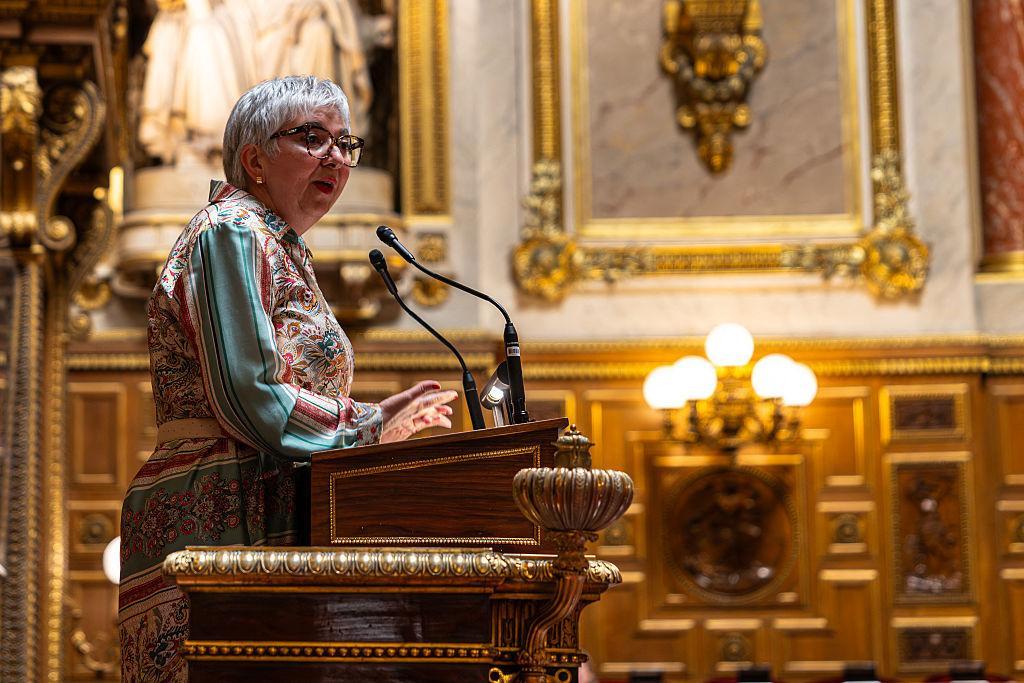
Late on Monday, October 26, 2026, the Corsican nationalist representatives left the Senate and announced their withdrawal from the negotiation process regarding the island's autonomy. The reason: the adopted amendments that call into question several essential elements: a distinct community, resident status, or the recognition of the Corsican language.
The dramatic turn of events occurred shortly after 10 PM on Monday evening at the Palais du Luxembourg. The nationalist senator from Haute-Corse, Paul-Toussaint Parigi, announced, on behalf of the autonomist and independentist elected officials, their withdrawal from the Beauvau process, initiated in March 2022 between the French government and the representatives of Corsica.
This decision comes after the adoption of an amendment presented by Muriel Jourda, a senator from Les Républicains in Morbihan and president of the law commission, which removes from the constitutional project the reference to a "insular, historical, linguistic, and cultural community." The amendment substitutes the notion of heritage for the notion of a distinct community.
This recognition was one of the essential elements of the compromise negotiated between Paris and the island's elected officials. "Since the beginning of the examination of this bill on Corsica, it has been a permanent humiliation," denounced Senator Paul-Toussaint Parigi, before adding: "We cannot continue to be humiliated like this."
Gilles Simeoni, former president of the executive council of Corsica, had already warned against further atrophies of the Beauvau agreements during his visit to Pontivy on October 4 "Tonight, we encountered a clear will to dismantle all of this," he stated to Corse Net Infos. He believes that the necessary conditions for continuing the process are no longer met and announces a consultation of nationalist forces upon their return to Corsica.
The legislative power called into question
Another major point of disagreement: the adoption of an amendment by the senator from Corse-du-Sud, Jean-Jacques Panunzi, also a member of Les Républicains, which excludes the granting of autonomous legislative power to the Collectivité de Corse. This issue is central for the autonomists. Without the ability to adopt their own regulations in certain areas of competence, autonomy risks being limited to enhanced administrative decentralization. Opponents of this legislative power cite the indivisibility of the Republic and the need to preserve the competence of the national Parliament.
What future for the process?
The Beauvau process was launched in 2022, following several weeks of tensions in Corsica. It led to a political agreement in March 2024, paving the way for a constitutional revision aimed at enshrining the island's autonomy within the French Republic. The withdrawal announced by the nationalists does not legally end the parliamentary procedure, but it compromises the political agreement on which the reform was based.
To come into effect, a constitutional revision must be adopted in the same terms by both the National Assembly and the Senate, and then be approved by referendum or, if the President of the Republic chooses this route for a constitutional bill, by the Congress with a three-fifths majority of the votes cast.
The events of October 26 thus open a new period of uncertainty for the institutional future of Corsica and add the Corsican crisis to the multitude of crises faced by the state in recent months.