Cornwall wants to become the next celtic tiger
Réalisation : ABP – 86 vues
Moving away from hydrocarbons requires electrifying the economy. Electrifying requires lithium and other strategic minerals. If Europe refuses to extract them, it will remain dependent either on hydrocarbons or on countries like China. This is the reasoning put forward by Perran Moon, Labour MP for Camborne and Redruth, who supports the mining revival in Cornwall. This direction sharply contrasts with that taken in Brittany.
The Return of Mining in Cornwall
Cornwall was one of the great mining territories of Europe. The Labour MP for Camborne and Redruth in Cornwall, Perran Moon, recalls that in the 19th century, it experienced exceptional prosperity due to the extraction of copper and tin. The mining of Cornish tin dates back to prehistoric times. Perran Moon states in the interview that the Phoenicians came to Cornwall to seek tin and copper. With the decline of the mines, Cornish miners then left by the thousands to export their expertise to the United States, Australia, South Africa, or Latin America.
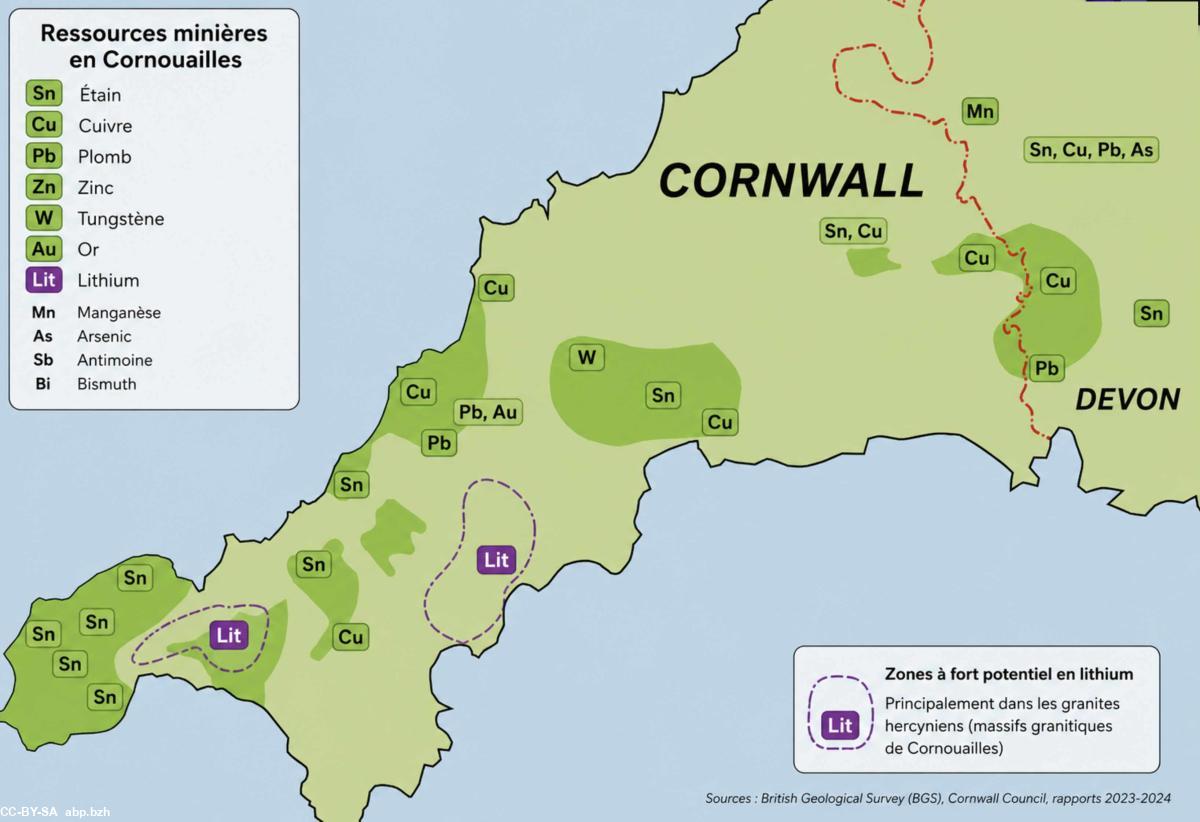
Today, Cornwall is particularly focusing on its lithium, essential for batteries, but also on tin and tungsten. For Moon, exploiting these resources is a condition for moving away from hydrocarbons and achieving strategic independence for Europe. He criticizes environmentalists for this contradiction.
“What are we doing? Either we depend on China, or we depend on oil and gas, or we open mines to extract the minerals we need in order to stop using oil, diesel, and gas.”
In Brittany, the Opposite Choice
This debate finds a very concrete echo today in Brittany. Several mobilizations have taken place against the mining exploration projects Taranis, Bélénos, and Epona, led by Breizh Ressources, a subsidiary of the Canadian group Aurania Resources. While exclusive exploration permits were granted by the state in December 2025, in February 2026, the Regional Council of Brittany requested their “immediate withdrawal,” citing the environmental, health, and social consequences of mining activities. In its resolution, the Region states that “clean” mining does not exist.
The Breton position is therefore at the opposite end of the spectrum from that defended by Perran Moon and supported by a majority in Cornwall.
Moving Away from Mass Tourism
The divergence is all the more striking as both territories face comparable economic issues, not to mention the same housing crisis for locals.
Cornwall has become a major tourist destination. For four months of the year, Moon explains, its population doubles. Second homes contribute to rising property prices, and many young Cornish people can no longer afford to live in their own country.
Moon denounces an economy that is too dependent on low-paid, unskilled seasonal tourism jobs. He wants to restore a more balanced economy, particularly based on the underground, renewable energies, industry, and skilled trades.
On the mining issue, the two Celtic peninsulas thus seem to be taking divergent paths. Yet, let us not forget: the Breton subsoil is also extraordinarily rich.