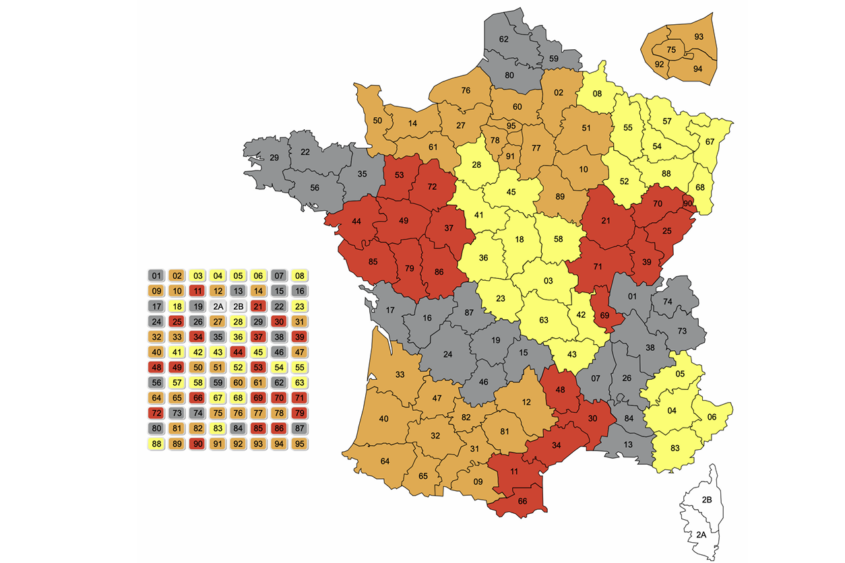
The redistricting project presented by LFI to make way for "eco-regions" is just another attempt to destroy or marginalize our old territories and the peoples within them. In the name of ecology, it is quite possible to dehumanize. The times ahead may be very difficult for Brittany, with LFI and the RN, the favorite in the polls, also promising us the disappearance of regions. When the storm threatens, will we know how to come together as a people?
The regional redistricting project presented by LFI to make way for "ecoregions" around watersheds and rivers would lead to the disappearance of Brittany in favor of a new territorial creation. And if the boundaries of our "region" remained unchanged because LFI would never consider abolishing departments, what would happen to the very name of Brittany?
This is not the first time that plans have been devised from Paris to eliminate every trace of our old "Provinces." The delimitation of regions to break the unity of peoples is one of the favored means of any type of colonial domination. But this time, the ecological argument is clever.
It is difficult to overlook the climate issue, but when the climate is instrumentalized to dehumanize, we must still ask ourselves some questions.
This proposal is part of the temptation to reduce humanity to the measure of national identity. However, our old territories have meaning. They contain peoples who offer a part of otherness within the French system. It is for this reason that Paris will always seek to destroy or marginalize them.
These people act as if we do not exist as Bretons, as if our old territory, which we have marked with our imprint for centuries, had no significance whatsoever.
And if tomorrow Brittany no longer existed, we would no longer be able to save our culture and our languages, which are in great difficulty. For this, we need an autonomous power in tune with its historical territory and the identity of the people.
Current Brittany is amputated from Loire-Atlantique and lacks any political autonomy. The explicit desire expressed by LFI to justify it solely with ecology would be an unspeakable regression and an insult to our Breton identity.
Moreover, the ecological argument is illusory. It is the old peoples who live in connection with their land who are best able to respect their environment and biodiversity (statement from COP 15 on biodiversity in Montreal). A people that does not even know it exists will never respect its land.
Using the climate to destroy humanity will never save the planet but will reinforce the authoritarianism of the current Power. This is the objective sought by Mélenchon, a great admirer of Robespierre. Our old peoples are so many pockets of resistance to the omnipotence of the central Power. Ecology? He does not care. It is merely a means for him to gain power.
Will we also have to put an end to the judicial unity of historical Brittany, which we cherish, so that justice can be rendered within a new Court of Appeal aligned with the Loire watershed? Will justice be better served?
If we add to this that the National Rally, the favorite in the polls, pursues the objective of destroying our "regions," we can gauge the danger of the current context.
To ward off this bad fate, we must put an end to the prevailing resignation. The "region of Brittany" currently functions as a docile relay of the central Power.
From resignation to resignation, a power can disappear. And if Brittany were to be erased from history, what would remain of our people and its development potential? This is what threatens us today. It is high time to oppose a will to be to Paris, to remind this obvious truth that Brittany is our land and that we will never accept its disappearance.
But we will also need to overcome this spirit of factions that makes it so difficult to unite in Brittany, even around obvious concerns.
It is through trials that we judge men as well as peoples. When the storm comes, will we still know how to be a people? This is the question that troubles me at the moment.
Yvon OLLIVIER
author