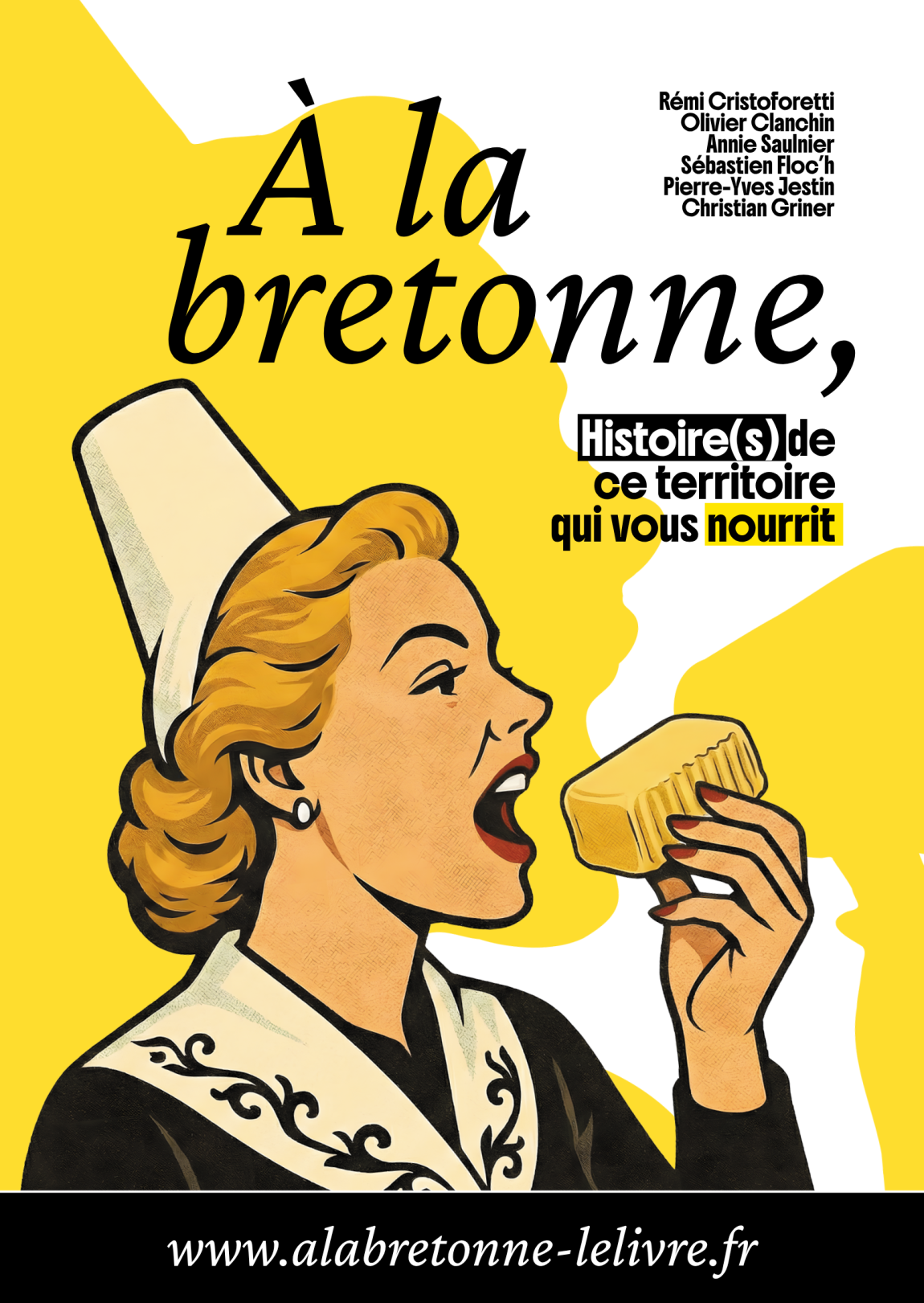
With "À la bretonne," six leaders in the agri-food sector present a richly illustrated work dedicated to the history, heritage, economy, and food in Brittany. Aimed at the general public, this popular science book brings together maps, figures, and infographics to provide a broad overview of the Brittany region.
A Book in PowerPoint Style
More than an essay, "À la bretonne" presents itself as a popular science book that is abundantly illustrated. It is not read like a traditional book, but juxtaposes thematic presentations akin to PowerPoint slides, favoring numerical data, maps, photographs, and infographics over a developed argument. The wordplay adds a touch of humor that balances the coldness of the figures.
Over its 168 pages, it successively addresses the history of Brittany, the internet domain .bzh, the megaliths recently inscribed on the UNESCO World Heritage list, agriculture, food production, nutrition, consumption habits, climate issues, water management, energy, and the economic weight of the agri-food sector. Among the highlighted figures are the 10 billion euros in annual agricultural production value for the Brittany region and the fact that 64% of its territory is dedicated to agriculture.
An Agricultural Model on Trial
This is not an independent investigation, but a popular science work intended for the general public, which presents from the inside a sector too often reduced to the controversies it generates.
For about fifteen years, Breton agriculture has been at the heart of an ongoing debate. The tides of green algae, the consequences of land consolidation and the flattening of hedgerows for biodiversity, issues related to water quality, animal welfare, and the use of pesticides have fueled numerous scientific studies, journalistic investigations, and documentaries. More recently, the investigative media "Splann!" and the film "Les Algues vertes" have helped to place the Breton agricultural model, this intensive agriculture, in the spotlight.
The Floor is Open for Defense
Published by the Breton Association of Agri-food Companies ( ABEA , which brings together 250 member companies representing about 55,000 employees, the book is authored by Rémi Cristoforetti, Olivier Clanchin, Annie Saulnier, Sébastien Floc'h, Pierre-Yves Jestin, and Christian Griner.
The authors aim to tell "the story(ies) of this territory that feeds you," a territory that also largely feeds France and Europe, as 60% of the sector's exports are destined for the European market.
“We wanted to tell an authentic, vibrant, and sometimes surprising Brittany. To see the book today find its place in bookstores, the shelves of large retailers, or at Breton markets is a tremendous recognition. It proves that there is a genuine curiosity to understand Brittany beyond clichés.” — Rémi Cristoforetti, co-author.
The initiative comes at a time when agri-food remains Brittany's leading industry and one of the main drivers of the Breton economy, ahead of tourism in terms of direct employment.
Which Brittany Are We Talking About?
The abundant iconography, numerous figures, and deliberately accessible tone make "À la bretonne" a richly documented popular science work that goes well beyond the sole subject of agri-food to paint a portrait of contemporary Brittany.
However, it is regrettable that the authors use the term "Brittany" interchangeably to refer both to historical Brittany, illustrated from the first pages by a map of five departments, and to the administrative region alone when presenting statistical data. The systematic use of explicit terms like "Brittany region" or "administrative Brittany" would have avoided this ambiguity in a work that aims to be educational.