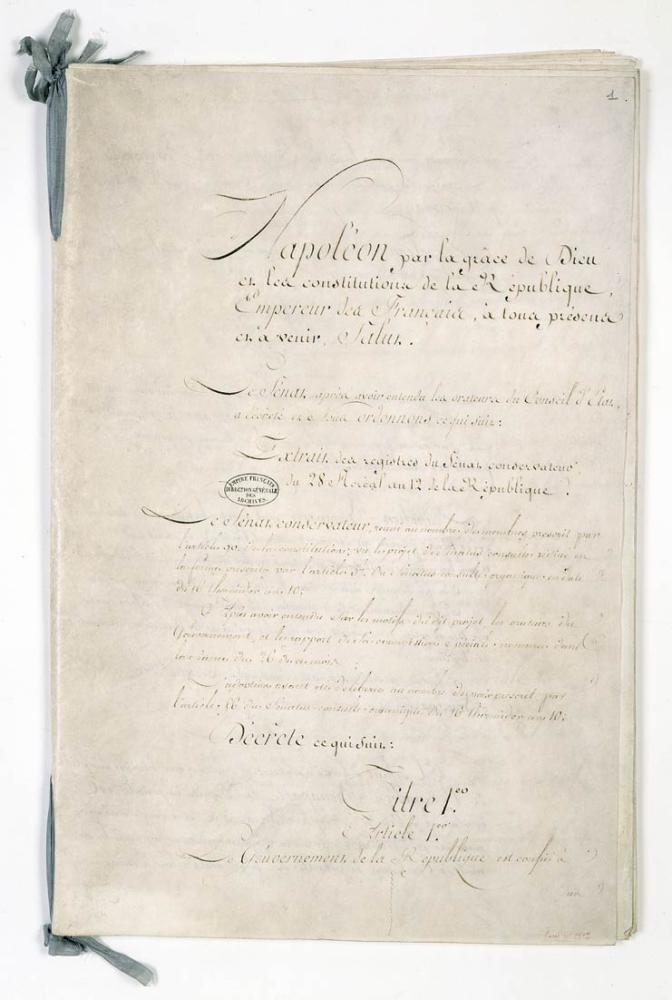
On March 21, 1804, a law unified civil laws into a single Code. Fifty-eight days later, the Senate proclaimed Bonaparte emperor of the French, before citizens voted on the hereditary nature of the title. More than two centuries later, the Court of Cassation still applies a special law concerning the five departments of the former Brittany. So, what have we really abolished?
The privileges abolished in 1789 and the preserved protests
Brittany of the Ancien Régime had its Estates, its Parliament, its Custom, and particular rights historically guaranteed by the acts of 1532.
The decrees adopted between August 4 and August 11, 1789, abolish the particular privileges of the provinces. Article 10 declares them abolished.
The question of the powers entrusted to the deputies was already a topic of debate at the time. Representatives had received instructions and mandates whose scope was contested within the Assembly. René-Jean de Botherel, the general prosecutor syndic of the Estates of Brittany, sent protests to the king against the ongoing transformations.
Our research allows us to return to these documents.
We have notably gathered the 446 views from register 21 C 482 of the Departmental Archives of Morbihan, relating to the liquidation commission of the former affairs of Brittany in 1790 and 1791.
The catalog indicates minutes of sessions, Botherel's protests from February 13, 1790, and an address from the commission to the National Assembly dated May 18, 1791. This file allows for the study of how the old provincial administration was liquidated and how its affairs were handled.
The National Archives have also been consulted to find the original mandates of the Breton deputies and the letters patent of Louis XVI from November 3, 1789, which promulgate the revolutionary decrees accepted or sanctioned by the king.
It is necessary to compare the decisions made, their promulgation, and the protests that were opposed to them to understand this institutional shift.
What the Civil Code abrogates in 1804
The law of 30 ventôse year XII, dated March 21, 1804, consolidates civil laws into a single Code.
Article 7 removes the force of law from Roman laws, ordinances, general or local customs, statutes, and regulations in matters covered by the laws comprising the Code.
The scope of this abrogation thus depends on the matters regulated by the Civil Code. To determine what remains of an old text, one must examine its object and follow the laws that subsequently modified, replaced, or maintained it.
Other reforms and codes adopted in the 19th century also transformed numerous provisions.
As for the old diplomatic treaties, their situation requires a study of each agreement, its duration, subsequent commitments, and the transformations of the parties involved. Their mere antiquity, as well as their absence of mention in Article 7, leaves this analysis to be conducted.
How the Republic receives an emperor
On May 18, 1804, or 28 floréal year XII, the conservative Senate adopts an organic senatus-consulte that modifies the Constitution.
Its first article states that "the Government of the Republic is entrusted to an Emperor." Article 2 immediately designates Napoleon Bonaparte, then First Consul, as Emperor of the French.
The text thus retains the word "Republic" while establishing imperial power. The transition to the First Empire occurs through a transformation of existing institutions, by means of a constitutional text that combines republican vocabulary with imperial dignity.
Bonaparte is already emperor at the time of the plebiscite
The order of events deserves clarification.
Bonaparte becomes emperor through the senatus-consulte of May 18, 1804. Citizens are then called to express their opinion on the heredity of the imperial dignity within the Bonaparte family.
Article 142 formulates the proposal submitted for their acceptance. It concerns the transmission of the title within the descendants of Napoleon, Joseph, and Louis Bonaparte, according to the rules set by the text.
The Senate proclaims the final results of the plebiscite on November 6, 1804. Thus, the popular approval of heredity occurs after Napoleon's installation in his imperial function.
A special Breton right applied in 1970 and in 2025
The decree of August 28, 1792, provides a specific regime for certain wastelands and commons in the five departments of the former province of Brittany.
In a ruling on April 17, 1970, the Court of Cassation explicitly qualifies this regime as a "special right." It explains that the provisions of Article 10 converted certain usage rights into property rights, provided that a valid title corresponding to the rights held at the time of the publication of the text is justified.
On March 26, 2024, in response to a question from Deputy Paul Molac, the Ministry of Justice confirms that the lands concerned remain subject to this regime.
On October 16, 2025, the third civil chamber of the Court of Cassation again applies Articles 9 and 10 of the 1792 decree to a dispute concerning a village common.
The Court of Appeal had recognized the communal nature of a space based on its configuration, use, and titles subsequent to 1792. The Court of Cassation criticizes it for failing to verify whether, at the time of the publication of the decree, the inhabitants had a title allowing them to use the parcel. It overturns the ruling and refers the case to another panel of the Court of Appeal of Rennes.
A revolutionary text containing provisions specific to Brittany thus continues to have effects in contemporary disputes. Its application relies on the precise legal history of the properties and rights claimed.
Custom and transmitted legal regimes
The study of these rights requires distinguishing several mechanisms.
A text may continue to apply. A property right acquired under an old legislation can be transmitted. A historical practice can also receive a modern legislative framework.
The lease with a right to terminate, historically very present in Brittany, is thus included in Articles L. 431-1 to L. 431-23 of the Rural and Maritime Fishing Code. This regime organizes, in particular, the respective rights over the land and the buildings and superstructures.
The Civil Code also refers, in certain matters, to local customs.
These examples invite an inquiry into the current foundation of each rule and the conditions under which the courts apply it.
A monarchist association before the Court of Cassation
On October 2, 2007, the Court of Cassation examines the dissolution of an association whose statutes claimed that France remained a monarchy with an apparent vacancy of the throne.
The Court of Appeal had considered that this sole assertion undermined the republican form of government.
The Court of Cassation overturns this decision and rejects the dissolution request, as the reasons given are insufficient to establish that the association aimed to overthrow the Republic.
The significance of this ruling concerns the freedom of association and the legal conditions for its dissolution. The Court rules on the purpose of the association and the reasons invoked for its dissolution.
The separation of powers before the judges
Article 16 of the Declaration of the Rights of Man and of the Citizen of 1789 makes the separation of powers a condition of constitutional order.
On November 23, 2010, in the case of Moulin v. France, the European Court of Human Rights finds a violation of Article 5 § 3 of the Convention. It examines the guarantees of independence required of the magistrate before whom a detained person must be promptly presented.
On December 15, 2010, the Court of Cassation also specifies that the public prosecutor, as the prosecuting party, provides insufficient guarantees to fulfill this function under Article 5 § 3. In the case judged, however, it rejects the appeal, taking into account the brevity of the deprivation of liberty before the release.
On March 23, 2018, the Council of State annulled the decree creating the General Inspectorate of Justice insofar as it included the Court of Cassation within its scope of intervention. It demanded additional guarantees suited to the position of this jurisdiction at the top of the judicial order.
These decisions show how constitutional and conventional guarantees concretely frame the exercise of power.
What the Council of State decided on the edict of 1532
For territorial organization, a decision from November 9, 1984 provides a precise response.
The association Bretagne-Europe contested the refusal of the Minister of the Interior to initiate the attachment of Loire-Atlantique to the Brittany region. It notably invoked a royal edict from 1532.
The Council of State rejected this argument, considering that the revolutionary legislation of 1789-1790 repealed the previous texts relating to the territorial organization of France.
This decision must be taken into account as much as the rulings from 1970 and 2025 regarding barren and vacant lands. Each dispute concerns a specific area and specific texts.
Retrieving texts and tracking their effects
The archives allow for the reconstruction of Breton institutions, their rights, their transformations, and the protests triggered by their disappearance. Jurisprudence then helps identify the rules that courts apply today.
Our work on the acts of 1532, the mandates of 1789, the liquidation of Brittany's affairs, and the old treaties consists of tracking these transformations, document by document.
Certain specific rights applicable in Brittany continue to produce legal consequences. To determine their scope, it is necessary to find their foundation, track their transmission, and examine the conditions retained by the judges.
Bretaigne DAO — Historical and Archival Research Program Anna Breizh
Elector to the Parliament of Brittany