Anchored in her Breton roots, this keyboardist (piano, fortepiano, harpsichord, clavichord, and organ), musicologist, and specialist in the popular songs of the Celtic Revival of the late 19th century, has always sought to weave connections between traditional music and classical music.
At the end of July 2026, we received a charming and warm letter from… Ireland, from a "regular reader of Culture and celtie, the e-Magazine," loyal to our online pages "since 2022," the period during which the author of this more than kind correspondence "began a research project on Celtic folk songs."
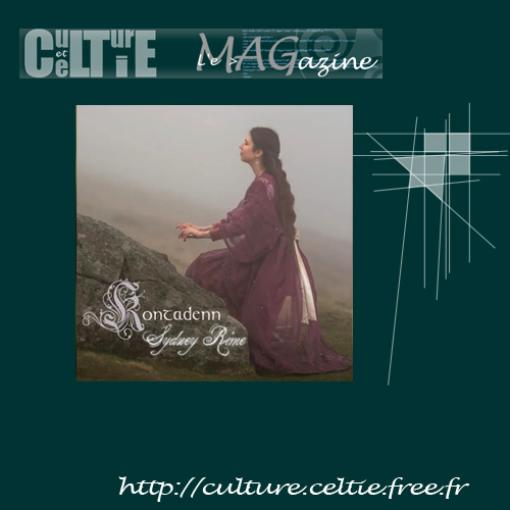 Jaquette du CD de Sydney RIME - Kontadenn photographe
Aside from the fact that we were, very sincerely, touched by such a testimony and interest, and that, to our delight, the letter was signed by a musician, also… a researcher and ethnomusicologist. Moreover, our diligent visitor was… of Breton origin!
Rooted in her Breton heritage, this keyboardist (piano, pianoforte, harpsichord, clavichord, and organ), musicologist, and specialist in the folk songs of the Celtic Revival from the late 19th century, has always sought to weave connections between traditional music and classical music.
"I came across your reviews of albums by Nolwenn MONJARRET and Philippe LE GALLOU, whom I was fortunate enough to meet later" (See our reviews of the works “An Arvor” (2020), “Ar Roue Pri - Le Roi d'Argile” (2013), and “Son Elena - Ballades e Breizh” (2011), added, in her letter, Sydney RIME, whose alert and gratifying writing we had just discovered.
We will refrain here from mentioning other very encouraging words received in our regard, for which we thank, blushing, our very generous visitor.
This very precious sheet that we will keep in our substantial and intimate guestbook, not published online, accompanied a Compact Disc that had indeed been released since November 2025, but which, as the writing specified, had not been promoted by the musician, due to health issues, as it should have been at the time of its release. Especially since it is, moreover, a first recording, an event that is always as stressful as it is exciting for any artist.
At first glance, welcomed and captured by a superb and elegant cover whose visual, tinged with Pre-Raphaelitism, an artistic movement that emerged in England in 1848 inspired by the painting of the Italian masters of the 15th century predecessors of Raphael, was created on a rainy day in the Irish mountains by the photographer "specializing in love stories," Smita DEBNATH (See site) , it was with immediate eagerness that we wanted to listen to this disc, titled "Kontadenn," meaning "tale" in Breton.
Listening, booklet in hand, to the first piano notes emanating from our speakers, we learned that this album was indeed inspired by Breton legends. The subtitle appearing on a double internal booklet leaves no doubt, either about the artistic intention or about the solo narrative instrument: "Eight Breton folk tales for piano - Huit contes populaires bretons pour piano."
In these eight musical pieces constituting this attractive, intimate, aesthetic, and substantial program, you will discover five of them written by composers known as "folklorists," musicians who, in classical music, integrated melodies, rhythms, and folk dances from their region or country, here, Brittany, thus generating a movement that particularly marked the 19th and 20th centuries. You will be invited to listen to works by DEBUSSY, CASSALONGA, as well as those of three Breton composers, BOURGAULT-DUCOUDRAY, AUBERT, and COLLIN.
Always drawn from the scents of tales and legends intrinsically rooted in Breton tradition, two contemporary compositions, respectively written in 2025, join these five musical paintings on display. They were created by Zacharie BLIN, who has been playing the piano since he was six before developing a passion for the harpsichord and the baroque period, known artistically under the pseudonym TRELAIRE (See site) and by the singer-songwriter and jazz-pop bassist, residing in Cambridge, UK, Jemily RIME (See site) , who began playing the piano at the age of three.
As a signature, as a send-off, this musical journey concludes with an improvisation, also drawn from the legendary heritage of Brittany and imagined by pianist Sydney RIME, the mastermind behind this discography publication with its multiple chimerical evocations.
- A Breton artist… living in Ireland!
- Pieces, all drawing from Breton legend, including three written by "classical" composers… Bretons!
- You, dear visitors who love Brittany and its vast musical palette, as well as fine music lovers who have demonstrated this through your numerous visits and listens, appreciate the piano when it tells the story of Armor and Argoat in their ancestral or contemporary context, particularly through a repertoire that lies at the crossroads of traditional Breton music, jazz, and symphonic music, shaped by the legendary Breton composer and pianist, Didier SQUIBAN (See our reviews “Nina” , “Ydill” , or that of “his disciples,” in solo piano, Dominique MARTIN (See our review “Enez glaz” and “Enez Glaz season 2” , Matthieu JUBIN interpreting, notably, works by Louis AUBERT and Charles-Augustin COLLIN, composers featured on this current album “Kontadenn” - (See our review “In Breton Country” or even, Caroline FAGET (See our review “Bro ar Sklerijenn”
All these reasons could only lead us to invite you to discover this first discography publication by Sydney RIME, which the pianist is beginning to present in concert, in Ireland, in mainland France… and very likely in Brittany!
Furthermore, within this interceltic framework, it seemed evident to draw your attention and discerning ear to this remarkable opus entirely produced in Ireland and, as a mark of great quality, funded by the “Irish Arts Council” - in Irish: An Chomhairle Ealaíon – (See site) , the National Government Agency of Ireland responsible for funding, developing, and promoting the arts in Ireland.
Captured, mixed, and mastered in the heart of a forest in the Irish mountains in County Wicklow, located south of Dublin, more precisely, perched above the ground and nestled among the trees, at Treehouse Studios (See site) by Brian CROSBY, the recording is infused with intimacy, warm sound, and interpretative closeness that almost brings Sydney and her Blüthner grand piano from 1920 into your living room – an instrumental similarity with Didier SQUIBAN, who owns a Blüthner from 1905, notably used for his album "Molène Saison II."
As MR. Didier SQUIBAN kindly explained to us, the main feature of Blüthner pianos lies in their string system. A 4th string, slightly elevated and not struck by the hammers, is added in the mid and high ranges, creating a warmer sound that is somewhat reverberated through acoustic sympathy. The BEATLES notably recorded "Let it Be" on a Blüthner grand piano.
An atypical classical music work, within which some pieces are inspired by traditional Breton melodies, while others are influenced by jazz or film music, the program of "Kontadenn" opens with an excerpt from "Préludes," Book 1, "The Submerged Cathedral," by Claude Debussy, born Achille-Claude Debussy.
You can easily guess that the musical piece is inspired by the legend of the submerged city of Ys, once built for the daughter of King Gradlon, Princess Dahut, who became the wife of the ocean... It is one of the most widespread legends in Brittany, that of a supposed city that, at an unknown time, was swallowed by the sea.
As a reminder, the internal booklet specifies: "Some believed that the princess of Ys was bound to the Ocean by a pact: she could take as many lovers as she wished, provided she sacrificed them to the sea. Thus, she lured sailors into her city at nightfall to throw their bodies into the water at dawn... until the day she fell in love with one of her victims. Mad with jealousy, the Ocean swallowed the city of Ys and its inhabitants, and Dahut became a 'Marie-Morgane' (a Breton mermaid)."
After a scattering of notes played in pianissimo, evoking the sound of bells, with a large bourdon deep in the bass and small chimes perched in the treble, the wind rises and dissipates the mist, the playing amplifies, translating the immersion into the depths of the ocean, and in all its majesty of a cathedral. This shipwreck is accompanied by a crashing symphony of organ and bell sounds. Finally, the cathedral disappears from view, and only the bells can be heard, in a distant pianissimo.
As if to extend the musical narration of this iconic Breton legend, the note in the booklet concludes: "Perhaps one day, while walking along the coasts of Cornwall, you will hear her enchanting song as well as the bells of the submerged cathedral?"
Feel free to listen at a good volume; the quality of the recording and mastering allows for it, in this piece, where you will feel, all the more, the pictorial drama of Debussy's work, carried by the pianist's involvement and mastery of nuance.
After this abyssal evocation, in total rupture of rhythm and atmosphere, the piece by Marguerite CASSALONGA (1865-1935), titled "The Dance of the Korrigans," takes us to the heart of a mischievous and bouncing ball led by tiny creatures "adorned with forget-me-nots in their hair and dressed in gowns made of forest moss"... The legendary korrigans!
In Breton tradition, the korrigan is a fairy spirit related to the dwarf. The word "korrigan" means "little dwarf," with "korr" corresponding to dwarf, "ig" being a diminutive, and the suffix "an" a mark of affection or familiarity. It can be likened to the small humanoid legendary creature of European folklore, the gnome, or, as mentioned in the program, to the leprechaun, a small being with a human silhouette from Irish mythology, comparable to a sprite or a fairy.
Carried away by the highly agile piano playing of Sydney RIME, you find yourself, at the end of the Korrigans' Path in the Brocéliande forest, on the circle of burnt grass, the only trace that remains after the nocturnal dance of its mischievous characters. Just like in Breton dance, the piano seems to "stamp its foot on the ground."
On track 3, just like us, you will greatly appreciate the alluring Andante of this literary "Romance" – Op.2, written in 1897 and published in 1902, by the Breton pianist and music critic Louis François Marie AUBERT (187-1968).
The program notes tell us:
"Unrequited love, suicides, sacrifices: love stories in Breton literature are often tragic... this one is not. Or perhaps it is just the beginning of the story?"
The Fortissimo that occurs midway through the piece may suggest a dramatic conclusion, but the final calm leaves us, rather, hoping for a happy ending...
"An Hollaïka" is a traditional Breton song from Cornouaille, also known as "Song of the Shepherds" or "The Call of the Shepherds." First published in 1839 by Hersart de La VILLEMARQUE in his famous collection, the "Barzaz Breiz," the name of this piece comes from the cries "Hollaïka!" shouted loudly by the shepherds and shepherdesses who sing it while tending their flocks. It tells the story of a young man who speaks of his beloved, of their first meeting when they were twelve years old (See, in particular, for the lyrics the reference page Son ha ton
The composer, harpsichordist, and heraldist Zacharie BLIN, takes up the theme of this traditional song here under the title "Bugal Noz," which we can translate as "The Shepherd of the Night." "Associated with darkness, he appears in most Breton tales as a threatening creature," the program notes specify.
Evolving successively, and sometimes abruptly, between traditional, almost hard rock, prospective music, jazz, symphonic, baroque, and pop, infused by this creative forty-something composer, Sydney's interpretation allows us to perceive the extent of his very broad interpretative range. Listening to this piece, featured on track 4 of "Kontadenn," beyond a vocal reprise from one of the beautiful feminine voices of Brittany, we could easily imagine a Celtic rock group, like the collective B.R.E.T.O.N.S., taking up this theme in an ad hoc tempo, treated in a very contemporary manner.
The journey into the land of Armorican legends and tales now continues by joining the Finistère Monts d'Arée.
With "Dans la lande," a composition by the Nantes and Breton composer Louis-Albert BOURGAULT-DUCOUDRAY (1840-1910), it is on the "gwen ha du" keys of his Blüthner that Sydney RIME takes us, through the moor, to the gates of hell, to Yeun Elez, sometimes spelled "Keun Elez," or after deformation, as noted here on the booklet page... "Qeun Glez."
It is in this place of a famous and mystical marshy depression, located in the heart of the Monts d'Arrée, that in Breton culture and tradition, the darkest beliefs have been cultivated, referring to the entryways to the realm of the dead and the domain of Ankou.
One might expect, linked to the place, a dark and unsettling melody; however, this is not the case! Instead, we listen to a "panoramic musical phrasing" under lovely embellishments.
Once again, the commentary in the booklet enlightens us on the composer's intentions, stating:
"However, this piece would rather evoke the story of travelers getting lost in the misty moors while following will-o'-the-wisps, only to find their way back at the return of the sun."
The crystalline sunlight of the final measures seems to corroborate this analysis.
In track 6, we find a narrative contemporaneity with "La Balade des fées des Houles," composed in 2025 by the singer, bassist, and composer, Sydney's sister, Jemily RIME.
The fairies of the waves are legendary creatures from the tradition of Upper Brittany and the Channel Islands that inhabit the caves carved by the sea along the cliffs of the English Channel, called... "houles"!
Let us refer once again to the booklet:
"In most tales, they are immortal and spend their days baking bread, carding wool, singing, dancing in the moonlight, and teaching children. Salt is said to make them mortal, which is unfortunate for fairies associated with the sea."
Served by the alert musician, the composer's pianistic exposition initially reveals itself to be quite dark, evoking, we can assume, the caves, then brightens with the presence of the fairies, the musical discourse even becoming sparkling, seeming to translate their multiple aforementioned activities.
In track 7, Sydney RIME performs "The Legend of Saint Ronan," composed in 1914 by the Briochin, Charles-Augustin COLLIN (1865-1938), who notably worked with the Belgian organist and composer, naturalized French, César FRANCK.
Charles-Augustin COLLIN was the organist of the Notre-Dame church in Rennes and, involved in Breton musical and dance culture, was the honorary president of the Cercle Celtique de Rennes, "Kelc’h Keltiek Roazhon" in Breton, "Cercl Celtiq de Rennes" in Gallo... since the Breton capital has a Gallo-Roman and Gallo tradition!
Ronan was born in Ireland in the 6th century to pagan parents and became a bishop.
Having landed in the land of Léon, he first lived in Saint-Renan. One day an angel appeared to him and commanded him to go live in Cornwall, where he settled not far from the current town of Locronan, which was named Saint-René-du-Bois.
The note in the booklet adds:
"It is said that he crossed the sea by walking on water and that he resurrected dead children."
We find the theme, played here, in "Buhez Sant Ronan," noted in 1867 in the Barzaz-Breiz by Théodore HERSART DE LA VILLEMARQUE; you can listen to a short excerpt of the score on this page of the site Tob.kan.bzh
We are coming to the end of this enchanting journey that has taken us through the mystical lands of Brittany, this time featuring the complete musical signature of Sydney RIME, who, for this finale, acts as both creator and performer, since, not composed but improvised, the artist presents us with "The Night Washers."
But who are these washers that inspired so much fear in nighttime travelers and the reckless who had the misfortune of crossing their path?
"The Night Washers," or "Kannerezed Noz" in Breton, are fantastic and sinister creatures also stemming from Breton legend.
They are specters or revenants, women cursed after their death for having committed sins during their lifetime.
They appear at night near rivers, ponds, washhouses, or wild places, such as the Monts d'Arrée or the Valley of No Return in the Brocéliande forest.
They perform a macabre task imposed upon them. Throughout the night, they wash, wring, and hang shrouds and blood-stained linen while singing.
The very first notes are indeed gloomy and unsettling, then the melody and playing seem to embrace the gesture of alternating immersion and withdrawal of the linen in and out of the water; a short rhythmic pause and the haunting and painful choreography seems to resume, amplifying and accelerating its rhythm.
For this last piece, Sydney recorded three different improvisations and chose the one she preferred.
Whether it be the traditional biniou and bombarde, often played in pairs to make people dance, the diatonic accordions for "festoù-noz ou deiz," the bagpipes and snare drums of a bagad that solemnly opens a procession; between roots and modernity, the acoustic or electric Celtic harps, the Celtic guitars, whether acoustic or electro-acoustic, which, used in open tuning, tell of their vibrant strings the maritime Brittany or that of the lands, the electric guitars of Celtic rock bands more or less "hard" that "granite the moor," or, as we mentioned at the beginning of our chronicle, the pianos in the colors of the nine-striped cloth of Morvan Marchal, which blow their deep sound storms over the Iroise or make the mischievous korrigans of Brocélainde or Huelgoat bounce on their highest crystalline notes, not to mention the great organs that, sometimes, in response to the powerful breath of the talabarder, carry their spiritual notes towards the spires of a celestial Celticity up to the gates of Tír na nÓg...
... and the most beautiful voices of Brittany, both female and male, that "kan ha diskan" or paint with "pop," the traditionals while respecting the root essence, achieving original creation...
We see it, through your marked interest in our online pages, every musical expression that "sings" Brittany, as it does for us... "enchants" you!
Therefore, this very attractive, original, and substantial first discographic recording "Kontadenn" imagined and played by Sydney RIME had, on our, your site "Culture et celtie, l’e-MAGazine," its rightful place, especially since our readership and audience, as we notice through our various exchanges, proves to be of great cultural quality.
Our loyal and knowledgeable visitors can only perfectly agree with the beautiful and solid musical references of the artist who began her career as a pianist and piano teacher at the age of 18, while studying modern literature, music history, piano, and accompaniment technique at the conservatory and university.
By avoiding paraphrasing our initial ratings mentioned at the beginning of the column, we complete here the few words that too hastily skimmed over the stages of Sydney's journey with some clarifications, namely that she studied the piano and harpsichord at the conservatories of Versailles and The Hague (Netherlands).
Also an organist, Sydney RIME has been, among other roles, the principal instrumentalist at the churches of Blessington and Ballymore-Eustace in Ireland. Her doctorate on Celtic popular songs was obtained at Maynooth University. This very rich musical background has led her to become a music teacher and lecturer at the university and internationally.
Opening our musical vision of Brittany even further, by presenting, in particular, works by "classical" Breton composers or from other "folklorist" creators, thus joining the approach of the pianist sponsored by Didier SQUIBAN, Matthieu JUBIN, whose recording we presented on our online pages, Sydney RIME also develops, through her swift, nuanced, and sensitive interpretations, a thematic idea that is very representative of Brittany, that of tales and legends.
With "Kontadenn," the pianist brings her own musical light to tell us about this land that "looks at the sea."
"Kontadenn," by Sydney RIME... an album filled with "well-chosen pieces" that you should acquire, without hesitation, via the online shop of this accomplished artist: HERE
Gérard SIMON
This column was entirely created with AI (Artisanal Intelligence).
_____________________
Sound illustration of the page: Sydney RIME - Album "Kontadenn": "Les Lavandières de la Nuit".
- Improvisation by Sydney RIME - Excerpt from 00:59.
The official website of Sydney RIME: sydneyrimedekertanguy
Other excerpts on culture et celtie, the e-MAGazine
____________________
The tracks of the CD "Kontadenn"
01. La Cathédrale Engloutie - Claude Achille DEBUSSY (1862-1918) - 05:56.
02. Danse de Korrigans - Marguerite CASSALONGUA (1865-1935) - 02:17.
03. Romance - Louis AUBERT (1877-1968) - 04:07.
04. Bugul Noz (An Hollaïka) - Zacharie BLIN (1987- ) - 04:28.
05. Dans la Lande - Louis-Albert BOURGAULT-DUCOUDRAY (1840-1910) - 03:35.
06. Balade des Fées des Houles - Jemily RIME (1998- ) - 03:42.
07. La Légende de Saint Ronan - Charles-Augustin COLLIN (1865-1938) - 06:08.
08. Les Lavandières de la Nuit - Sydney RIME (1993- ) - 02:52.
Total duration: 33:05.
CD by Sydney RIME "Kontadenn".
Release: November 2025.
Ref: PUM1125/1.
Production: Irish Arts Council - An Chomhairle Ealaíon (See site)
Distribution: Entertainment and publishing company PUMPLESTONE.
Available on the official page of the Official Shop of Sydney RIME (See site)
© Culture et Celtie