In this double album, Violaine Mayor and Joël Herrou, the harpist and the luthier, pay tribute to the most famous composer for the ancient Celtic harp: Turlough O’Carolan.
At the end of October, the mailbox of Culture et celtie, the e-MAGazine, was, for the postal messenger, favorably located on the musical and Celtic path that connects our earthly world, mired in its daily troubles and turpitudes, to the serenity of a divine and spiritual universe, as she deposited a wonderful double album that we discovered, dedicated to an instrument rich in symbols, which is positioned, ancestrally, by its ascending shape and the vibration of its strings, at the crossroads of power, the divine, and universal harmony…
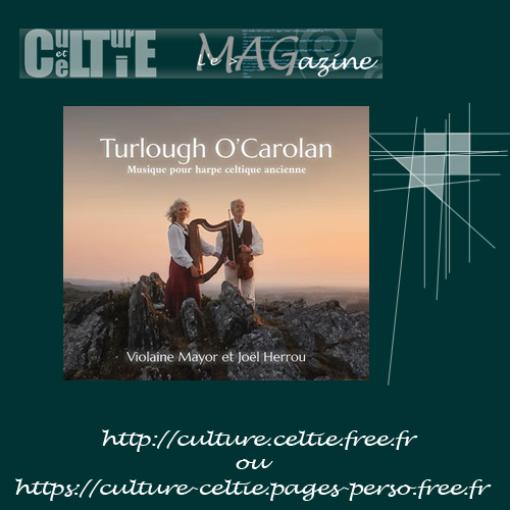 Jaquette du CD de Violaine MAYOR et Joël HERROU - Tutlough O'Carolan Mikaël HERROU
On its part, the inked seal on the envelope unambiguously corroborated the content of the letter:
“Hent Telenn Breizh” (The Way of the Breton Harp), indeed transcribed the name of the sender.
Thus, we had the joy of receiving, presented in the triptych of an elegant cover bathed in the beautiful and ultimate coppery daily lights of the Monts d'Arrée, created by Mikaël HERROU (See site) , the new double opus by Violaine MAYOR and Joël HERROU!
On the front of the cover, in a font size larger than that assigned to the names of these two major artisans, researchers, and reference artists, the label “Turlough O’Carolan” seems, in a way, to crown the front cover, clearly indicating that this present double disc is, in homage, dedicated to the most famous composer for the ancient Celtic harp.
Heir to the ancient tradition, the Irish harpist (1670-1738), who became blind at the age of 18 after contracting smallpox, left us more than two hundred compositions that highlight, like no other, the crystalline sound of the bronze-stringed harp, a millennia-old instrument of Ireland.
“Music for Ancient Celtic Harp,” explicitly subtitles the musical work.
Indeed, the harpist, Violaine, and the luthier, Joël, have dedicated their lives to in-depth research and experimentation exclusively related to the manufacture and practice of the ancient Celtic harp, designed with a soundbox carved from a single block, from willow immersed in peat and equipped with bronze strings, to which some silver and gold strings are added, to generate the lowest, deepest notes.
It is in their shared residence in Finistère, in Plounéour-Ménez, in the Monts d’Arrée, that they have, over the years, pursued their relentless quest for authentic sound and created “Hent Telenn Breizh,” the school of ancient harps of Brittany (See site) where they offer discovery workshops, singing, and harp.
We are particularly pleased to bring to your attention and partial listening this substantial discographic release of extreme quality, in terms, as we have addressed, of packaging, but also and above all, of the content of its program, its exceptional sound, linked, notably, to the refined craftsmanship of precious lutherie and, of course, to the masterful interpretation owed to the subtle and, oh so skillful and experienced harpist, supported in her nuanced interpretations by the embracing violin of the luthier-musician.
No less than 11 tracks for Compact Disc No. 1 and … 13 tracks for the second silver disc, totaling over 90 minutes, on arrangements by Violaine MAYOR, of a Celtic journey that resonates with heart and soul, elevating thought to the highest, to soothing and salvific airy spirals.
A sound universe, masterfully captured and crafted by Jean HERROU, in sound recording and mixing, and the mastering… by a DJ and electro music producer specialized in festoù-noz, Riwall HARJAY (See site)
When current sound knowledge serves the ancestral!
As you can see, this album is also the result of a family collaboration, with Violaine MAYOR on harp, Joël HEROOU on violin, and their two sons, Mikaël and Jean, who, in addition to their artistic and technical skills, also contribute on harp for 3 tracks.
It should be remembered that in 2016, Jean and Mikaël, then aged 19 and 16 respectively, published their first record titled "Beilhadeg er Releg" (Vigil at Relec), produced by "Hent Telenn Breizh." Bringing a new color to the traditional repertoire, which they enriched with their own lyrics, this musical journey of harp and song around the abbey of Relec, an ancient Celtic site and later Cistercian, located in the Monts d'Arrée at the crossroads of the three bishoprics of Cornouaille, Léon, and Trégor, captured our full attention, as this opus still features in our "A RETENIR" section of our reviewed CD summary (See page)
Jean and Mikaël have been playing the traditional Celtic harp with bronze strings since the age of 6, which they learned to play from their mother, Violaine, and in terms of instrument making, in their father's workshop, Joël. Today, while Joël HERROU no longer manufactures instruments, his two sons have taken up the torch, crafting a few pieces upon request, with Jean focusing more on wooden construction and Mikaël on the fine pyrography of instrumental creations.
Having received training from traditional singers, such as the Breton farmer and singer Marcel GUILLOUX (1930-2024) and the famous Costarmorican kan ha diskan singer Louis LALLOUR (1926-2015), in addition to participating in numerous concerts, the two HERROU brothers have been awarded in competitions, such as the Amzer Nevez harp competition or the legendary Kan ar Bobl.
This highlights how the ancient Celtic harp is at the epicenter of the cultural, artisanal, artistic, and spiritual life of the HERROU family!...
During this program, you will delightfully listen to particularly crystalline and profound melodies, stemming from a perfect technique of ancestral playing practiced during the time of O'CAROLAN, then rediscovered, explored, and finely crafted by Violaine MAYOR, who, with the harp resting against her left shoulder—a positioning contrary to the handling of modern Celtic harps—sculpts the notes and resonances of the metal strings by plucking them with her nails. It requires perfect mastery to precisely set certain strings vibrating with the horn plectrum while dampening the long resonance of other previously plucked strings with the flesh of the fingers. This is also what distinguishes it from modern Celtic harps with nylon strings that have a short resonance and do not require any control over unwanted sound prolongation.
In addition to these technical playing difficulties, there is the prior necessity to retune the instrument according to the key of the pieces played, as the ancient Celtic harp has no half-tone mechanics. It is, in fact, an entirely diatonic instrument devoid of any chromatic system, and it is essential to retune certain strings to access neighboring tonalities, knowing that the harmonic fifth or perfect fifth is extremely present on the bronze strings, and this vibratory phenomenon resonates beyond the audible, thus particularly illustrating the sound of the ancient tradition.
The harpist thus restores to the music of the legendary Irish harpist and composer its original dimension, rooted in the ancient tradition of Celtic lands and, consequently, to the millennia-old instrument of Ireland, of which it is one of the most striking symbols.
Some pieces performed during this program come from a manuscript dated 1721, attributed to the Dublin music instrument merchants and publishers John and William NEALE, known for having published the very first collection of notated Irish music, which includes compositions by Turlough O'CAROLAN, edited during the harpist's lifetime.
Others are sourced from manuscripts and editions by Edward BUNTING, an Irish musician and collector of traditional Irish music for the Celtic harp, born in 1773 in County Armagh and died on December 21, 1843, in Dublin.
The third documentary source comes from the work "Carolan, the life times and music of Irish harper," created by the English civil servant, editor, author, and song collector Donal O’SULLIVAN (1893-1973). This is a complete edition of CAROLAN's compositions, however, written without the bass lines. Originally published in 1958, Donal O'SULLIVAN's classic study of Turlough O'CAROLAN has become a musical reference for all those interested in Irish culture.
The harps heard throughout this opus are replicas of historical Celtic harps with a body constructed from a single piece of wood, known as monoxyle, immersed in peat and entirely pyrographed and shaped by Joël HERROU.
While witnessing a great instrumental tradition shared between Ireland and Scotland, ancient Celtic harps are primarily represented by the so-called harp of Brian Boru, or the harp of Trinity College, the Queen Mary, and Lamont.
- For the majority of the recording, from track 1 of CD 1, "Carolan’s Welcome," to track 10 of CD 2, "Carolan’s Concerto," Violaine MAYOR plays on "Weleda," a willow-bodied harp with yew pillars and console, a dense, elastic, and highly durable wood that has historically been used by luthiers, strung with bronze, silver, and gold for the bass. For the last three tracks of CD 2, from "Planxty Burke" to "Carolan’s Farewell to music," the highly talented harpist plays on a "Tara" inspired by the iconic harp from the Hill of Tara in Ireland, model "Queen Mary," with a wide willow body, yew pillars, and strung with bronze, silver, and gold for the bass.
On their part,
- For "Carolan’s Welcome" (CD 1 - track 1) and "Eleannor Plunkett" (CD 2 - track 1), Jean HERROU plays, referencing a contemporary piece for solo Celtic harp composed by the French harpist and pedagogue Mariannig LARC'HANTEC, on a "Galaad," model "Queen Mary," with a body and pillars made entirely of yew, and for the same pieces, as well as on "Fanny Poer," Mikaël plays on a "Chevalier de Jerpoint," with a wide willow body and yew pillars, strung with 32 bronze strings for a round and deep sound.
Spread over two discs, the program composed of 25 musical pieces opens beautifully, as a family, with three harps and a violin, on "Carolan’s Welcome," a title aptly chosen to welcome us into the heart of the compositions of this musician and poet, whose original Irish name is Toirdhealbhach Ó Cearbhalláin, who wonderfully fused the two major musical currents of his time, classical music and popular music.
A very appealing opening where Joël's bowed strings manage to carve a smooth path amidst the plucked strings, we will dare to decline the metaphor here... "fingertipped."
It is evident that, given the consistency and scope of the proposed program, we will refrain from mentioning all the titles from which you will recognize many themes, played in their entirety or in suites, by the great Breton harpists, especially since they will all lead you towards the spires of a salvific harmony and soothing serenity.
Seemingly corroborating this statement, during a radio show dedicated to the presentation of the double album, Violaine did not recount this old quasi-maxim: “A harmonious household was tuned like a well-tuned harp” and added, “The harp was protected by Celtic society for its harmonizing, soothing properties, its ability to unify, and in the oldest texts, its music truly had a powerful effect when it was in the hands of accomplished harpists; it could make one cry, make one laugh, make one sleep, open the doors to the other world, awaken the souls of the deceased, and heal wounds and infirmities.”
Throughout this discographic tribute, you will also discover thematic approaches that, in essence, intertwine and connect, such as, in track 8, collected without a title and here named “Carolin’s Fairy Jig,” and in track 10, “The Fairy Queen,” two compositions that illustrate the relationship O’Carolan had with the world of fairies, since the young artist was accustomed to visiting a “Ringfort” (circular Irish fort), an ancient fortified site in Ireland, primarily dating from the early Middle Ages (5th to 10th century), an abandoned location where the shape of the stone circle remained, planted with hawthorns, shrubs symbolizing the presence of fairies, which, for this reason, according to local popular opinion, should never be cut.
Upon returning from this enlightening place, located just a few steps from his home, the Irish musician composed such musical pieces of identical inspiration. While the first piece is, by nature, the most danceable, in a similar lightness of execution, the second seems more descriptive, panoramic, revealing these Celtic fairies that populate the legend of Gaelic and Brittonic tradition.
In track 1 of CD 2, you will find “Eleanor Plunkett,” a title written by the famous Irish harpist and one of the most renowned instrumental compositions and traditional Irish melodies. Turlough O'CAROLAN composed this piece in homage to Eleanor PLUNKETT, who was said to be the sole survivor of a tragic castle fire that claimed the lives of about thirty members of her family. In 1974, the Irish group CLANNAD recorded a notable version on their album “Clannad 2.” For Bretons, listening to this melody will inevitably evoke the warm and vocal adaptation, with lyrics sung in French, by Gilles SERVAT, released on “L'Albatros fou,” the thirteenth studio album of the Breton singer, released in 1991 by Keltia Musique, an album composed and performed in collaboration with the Celtic music group TRISKELL, featuring Hervé QUEFFELEANT on the Celtic harp. Here is a superb instrumental interpretation in a quartet for three harps and a violin.
We promised not to detail the very many pieces, all more crystalline than the others, that make up this monumental and aesthetically pleasing work, but we draw your attention to, on track 5, the famous traditional Irish slow air "Lament for Owen Roe O'Neill."
This piece commemorates Owen ROE O'NEILL (1582–1649), a military leader and Irish nobleman from the O'NEILL family, originally from County Tyrone, who fought in the Spanish Netherlands before returning to Ireland during the Irish Confederation.
Harp and violin appear, in perfect duo, literally "singing," and the conjunction of sounds and resonances seems to make great organs and whistles play in the most extensive depths and heights. It should be listened to and re-listened to at a good volume, on quality speakers, as the sound work by Jean HEROOU allows for perfect power and clarity. Remarkable!
Ah! Of course, while listening to and re-listening to this double album, friends of the Celtic harp, you will have an emotional thought for Jord COCHEVELOU who, in 1952-1953, when the Celtic harp had almost disappeared, decided to revive this iconic instrument by creating the legendary "Telenn Gentañ" (first harp), also the very first Celtic harp revealed by Alan COCHEVELOU, who became STIVELL.
The instrument has become the icon of the revival of Celtic music in Brittany, allowing for the modern resurrection of the Celtic harp, to the point that in February 2019, the mythical recreation was digitized in 3D and X-rayed in a medical laboratory near Rennes, in order to preserve all its secret manufacturing references.
Alan STIVELL's third work and his second instrumental, "Renaissance of the Celtic Harp," released in 1971, distinguished by the Grand Prix International du Disque from the Charles-Cros Academy in 1972, was it not the best-selling harp album in the world?
In reflection of this iconic "Renaissance of the Celtic Harp" by STIVELL, we could name, label, the gigantic and lengthy research work, studies of form and substance, of this couple of scholars who, through their own creations, concerts, and about ten discographic publications, for many years, have been striving to restore an original dimension, rooted in the ancient tradition of Celtic countries, through their music for ancient Celtic harps: "Quintessence of the Celtic Harp."
"Turlough O'CAROLAN – MUSIC for ancient Celtic harp," by Violaine MAYOR and Joël HERROU, is a double album, a major publication to acquire, available on the site "Hent Telenn Breizh" or ARFOLK
Beyond musical moments, it is appropriate to say, "of the very first order," you will appreciate the excellent texts that enhance the booklet included with the double Compact Disc, a particularly informative, educational, and precise editorial that proves to be much more substantial than our sincere but humble remarks, which have, towards you, the sole mission of soliciting your cultural attention and your attentive listening for an exceptional historical musical and Celtic approach.
Gérard SIMON
Sound illustration of the page: Violaine MAYOR and Joël HERROU - "Carolan’s Welcome" - Excerpt from 01:00.
Other sound excerpts on Culture et celtie, the e-MAGazine (See site)
The page of Violaine MAYOR and Joël HERROU on www.henttelenn.bzh: HERE
The titles of the 2 CDs by Violaine MAYOR and Joël HERROU - Turlough O'Carolan" - Duration of the 2 CDs: 90:37.
CD1:
01. Carolan’s Welcome - 02:44.
02. Sidh beag sidh mor - 03:34.
03. Miss Mac Dermott - 04:22.
04. Carolan’s Dream - 03:41.
05. Planxty Kelly, Patrick Kelly - 03:47.
06. Donal O’Brien, Captain O’Kane - 04:11.
07. Planxty Irwin - 03:13.
08. Carolan’s Fairy Jig - 03:11.
09. James Betagh and Jig - 05:18.
10. The Fairy Queen - 02:30.
11. Carolan’s Cottage - 03:11.
Total duration: 39:46.
CD2:
01. Eleanor Plunkett - 03:04.
02. Carolan’s Draught - 03:17.
03. Mr Connor and Jig - 05:13.
04. Fanny Poer - 03:36.
05. Lament for Owen Roe O’Neill - 02:46.
06. Carolan’s Favorite Jig - 02:06.
07. Mrs Judge and Jig - 05:09.
08. Carolan’s Quarrel with the Landlady - 03:02.
09. Mrs Bermingham & Jig - 06:26.
10. Carolan’s Concerto - 03:48.
11. Planxty Burke - 02:24.
12. Arthur Shaen - 04:59.
13. Carolan’s Farewell to Music - 04:55.
Total duration: 50:51.
Violaine MAYOR and Joël HERROU.
"Turlough O'Carolan".
Release: October 2026.
Production: Hent Telenn Breizh https://www.henttelenn.bzh/.
Distribution: INGALAÑ https://www.ingalan.bzh/ / ARFOLK https://arfolk.bzh/.
Reference: VM05 / AR1257.
© Culture et Celtie