Mythos 2026: ten days where the Rennes scene bursts with life
From April 3 to 12, 2026, Rennes once again transformed into a vibrant capital of spoken arts. The Mythos Festival, a must-attend event of the Breton spring, returned with a rich edition blending theater, music, storytelling, gastronomy, and a constellation of artists from all backgrounds.
There is something infinitely precious about a festival that has chosen, for nearly thirty years, to celebrate the spoken word. In 2026, as our lives are saturated with notifications, instant debates, and disposable opinions, Mythos appears almost as an act of resistance.
What strikes year after year is the way Mythos teaches us to listen again. In the halls of TNB, under the tent of the Cabaret Botanique, or in the heart of Thabor, we find ourselves becoming attentive once more. Allowing a story to unfold without interruption. Accepting that a narrative may take unexpected paths. It is a rare yet vital luxury: that of slowness, nuance, and complexity.
This 2026 edition is no exception. Between concerts by Jeanne Cherhal, Bertrand Belin, Peter Doherty, Imany, Fatoumata Diawara, Thylacine, and Charlie Winston, and performances that question our fragilities, our anger, our contradictions, Mythos offers a sensitive reading of the world.
In a cultural landscape where provocation and depth are sometimes confused, Mythos chooses the most demanding path: that of emotional intelligence. The festival reminds us that the spoken word can still be an art. A fragile, human, imperfect art, but necessary. An art that makes us leave our homes, meet strangers, and resonate together — which, in 2026, is no small matter.
Mythos is not just a festival; it is a space where we relearn to be present. And it is precisely for this reason that it remains indispensable.
Among the impactful performances of this edition, we saw:
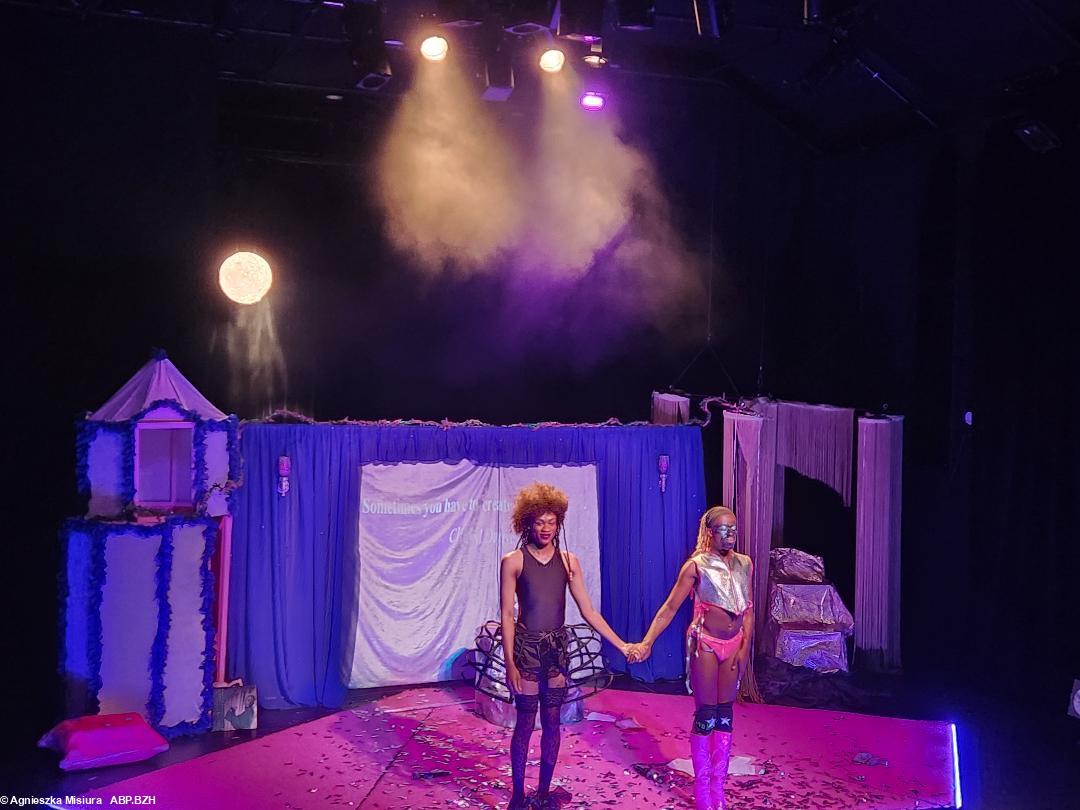
When We Sleep, We Are Not Hungry is the first creation by Anthony Martine, an artist who chooses to revisit the codes of storytelling to include identities long absent from dominant narratives. The performance is a tale set in medieval times, addressing racism and homophobia. It offers a joyful, burlesque, and deeply sensitive journey towards a new intimate mythology.
During his years in preparatory classes, Anthony Martine became aware of the gap between the figures that nourished his imagination — white, heterosexual heroines from fairy tales and pop culture — and his own identity as a young Black gay man. This realization of a lack of representation becomes the starting point for a strong artistic gesture: to create a narrative where he can finally recognize himself.
On stage, the artist invokes the codes of storytelling to better transform them and embodies a gallery of colorful characters. The King's Jester, master of ceremonies, guides the audience through this initiatory quest. Among the notable figures is Paris Ardant. This drag version of Fanny Ardant is a good fairy who opens doors for the artist in his first experiences and discoveries.
The piece blends theater, dance, song, performance, and personal archives to construct a hybrid narrative, both intimate and universal. By reinventing the codes of the marvelous, Anthony Martine offers a space where marginalized identities can unfold, celebrate, and tell their stories differently.
When We Sleep, We Are Not Hungry is a foundational work, a symbolic act of repair, a gesture of reappropriation, but also a declaration of joy. An invitation to imagine new, inclusive, and radiant narratives, where everyone can find their place!
With Soprane, David Gauchard, Emmanuelle Hiron, and Jeanne Crousaud present a show of rare delicacy that lifts the veil on the behind-the-scenes of the lyrical world. Far from the clichés of divas haloed in gold and light, the piece allows us to hear — and see — the intimate, fragile, and profoundly human reality of opera singers. A vibrant tribute, without emphasis, to those for whom voice is a profession, a struggle, a vertigo.
Alone on stage, Jeanne Crousaud carries the performance with a presence of great accuracy. She listens live to the testimonies of singers — choristers, soloists, beginners, stars, emerging voices, or voices nearing the end of their careers — collected over two years by Emmanuelle Hiron. She then conveys them, without imitation, without caricature, with a moving sobriety.
These women speak of their doubts, their joys, their wounds, their tiny victories. Crousaud does not seek to embody: she transmits. And in this transmission, a shared humanity emerges, strong, fragile, luminous.
The piece is also a tribute to the musical repertoire. Jeanne Crousaud presents us a cappella with fragments of melodies brought by four centuries of opera. Her voice, described as "pearly," unfolds in an impressive palette of nuances: from a tenuous breath to a contained cry, from a whisper to the flamboyant.
One of the most touching moments occurs when she dares to sing a few measures of a role she dreams of performing — but which is not within her vocal range. The audience, complicit, mentally completes the wrong notes of the Queen of the Night. A suspended moment, tender and funny, that speaks volumes about the passion and limits of the profession.
But behind the humor, the piece reminds us how singing is a tightrope art: accuracy, fatigue, precariousness, solitude, pressure, ecstasy.
The famous arias no longer convey the emotions of a character, but those of the artist herself. Singing becomes confession.
Jeanne Crousaud offers an interpretation of remarkable finesse, supported by a staging that prioritizes listening, nuance, and truth.
Soprane is not just a show about singers. It is a work about voice — voice as a tool, as a burden, as a miracle. A performance that, behind the mirrors and abstract carpets, reminds us that lyrical art is above all a matter of human beings.
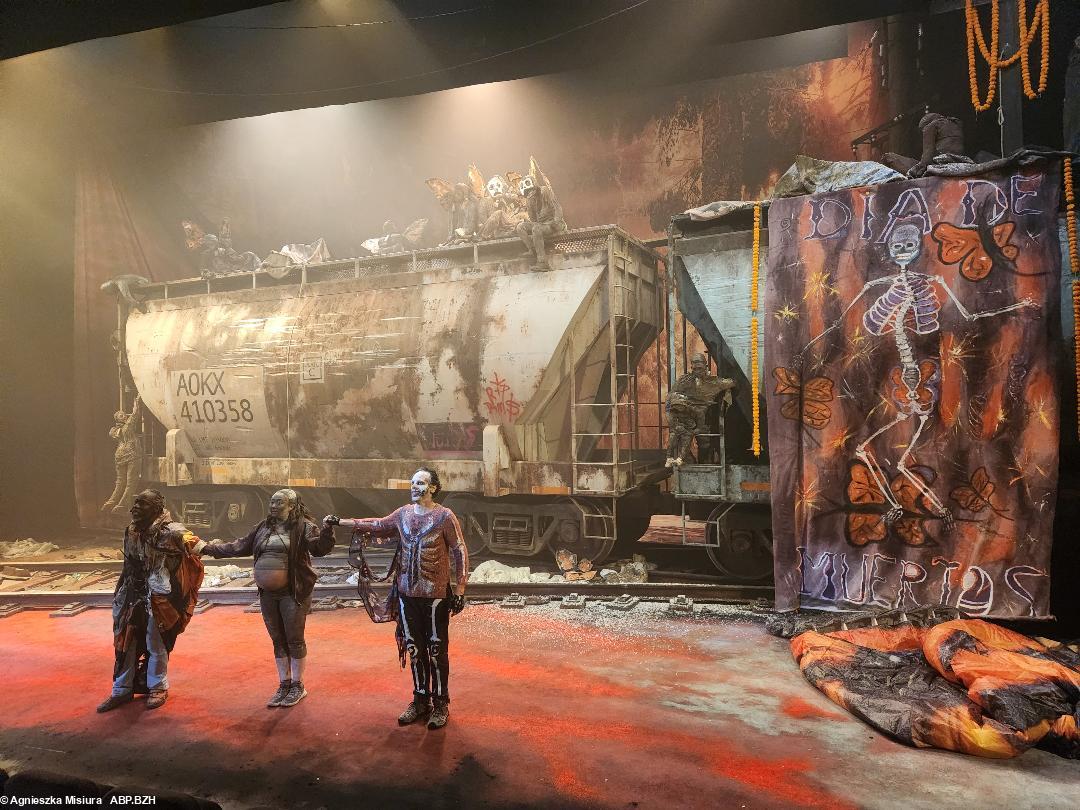
With Monarchs, Emmanuel Meirieu aims to intersect two migratory trajectories: the majestic and natural journey of monarch butterflies traveling from Canada to Mexico, and the tragically human plight of exiles from Central America attempting to reach the United States. On paper, the idea of a parallel between animal freedom and human confinement could open a stimulating poetic and political field. On stage, however, the setup struggles to convince.
The life-size reconstruction of the Bestia — the freight train that thousands of migrants take at the risk of their lives — undeniably constitutes the highlight of the show. Massive, rusty, and omnipresent, the convoy imposes a raw aesthetic that could suffice to carry a powerful narrative. But this visual strength clashes with a script that struggles to find its coherence.
The performance indeed juxtaposes disparate elements: on one side, a paraglider following the migration of the butterflies; on the other, exhausted, hungry, mutilated migrants, represented by two actors surrounded by mannequins meant to symbolize the crowd of undocumented travelers. The whole gives an impression of a clumsy collage, where the narrative threads never truly converge.
The treatment of migrant figures poses particular problems. The characters seem written to evoke immediate emotion rather than to embody human complexity. The amputated migrant, the pregnant woman, the frozen silhouettes: everything seems designed to provoke the spectator's compassion, without ever transcending the cliché or the posture.
This miserabilist approach, which accumulates suffering, deprivation, and moans, ultimately produces the opposite effect of what is sought. Instead of giving flesh to invisible destinies, the performance reduces them to symbols, or even to expected images.
The metaphorical ambition — to bring animal migration and human migration closer — remains too superficial to support the performance. The parallel, hammered but never questioned, appears simplistic.
The result is a fable that aims to be engaged but, lacking nuance, slips into a form of naivety. The spectator struggles to grasp the message truly sought, beyond an observation already widely documented: the violence of the migratory journey.
But Mythos is above all about music, a lot, a lot of music...
We were able to see the concert of Thylacine at Liberté.
It confirms what his albums had already hinted at: his electro is not made for clubs, but for journeys. On stage, the Angers-based artist transforms the venue into a moving territory, where soundscapes succeed one another like so many stops along the way.
From the very first minutes, the visual setup imposes its mark. Panoramic screens, light lines, images captured during his train journeys or in a nomadic studio: Thylacine pays as much attention to aesthetics as to sound. The whole creates an atmosphere faithful to his taste for "geographical" music, inspired by places or routes.
This immersive dimension works fully: the audience is captivated, carried by a visual narrative that accompanies each rise, each break, each pulse.
Musically, Thylacine delivers a concert of great mastery. The transitions are impeccable, the sound textures refined, the rhythms organic. The standout tracks — Train, Saksun, Anatolia, War Dance — immediately elicit enthusiasm. We find that blend of soft techno, airy melodies, and ethnic samples that defines his uniqueness.
As the star guest of the Mythos 2026 festival, Peter Doherty filled the Cabaret Botanique with a suspended atmosphere, balancing controlled chaos and unexpected grace. The former Libertines member, now settled into a form of creative calm, delivered a concert where raw poetry contended with disarming sincerity.
Doherty arrives on stage quietly, wrinkled jacket, guitar slung over his shoulder, shy smile. He is not a spectacular rock star: rather, he is a battered poet who steps forward as one enters a friend's living room. From the first notes, the audience understands they will witness a rare moment, where the unexpected is part of the charm. A few hesitations, whispered asides, a chord played twice: everything that would be seen as a lack of rigor in others becomes a form of authenticity in him.
The concert navigates between solo tracks, Libertines songs, and a few gems from Babyshambles. The classics are there, stripped down and played with an almost fragile simplicity. His voice, deeper than before, carries a raw emotion, without artifice. The minimalist arrangements—guitar and sometimes piano—leave plenty of room for the lyrics, their elegant melancholy, and their tender irony.
Doherty jokes, improvises. This spontaneity creates a bohemian cabaret atmosphere, perfectly in tune with the spirit of Mythos. The audience, captivated, sings along to the choruses, holds its breath during the ballads, and laughs at the unexpected digressions. He delivered a luminous, fragile, and profoundly human concert.
Looking forward to the 30th edition of the Mythos festival.


Commentaires (0)
Aucun commentaire pour le moment. Soyez le premier à réagir !