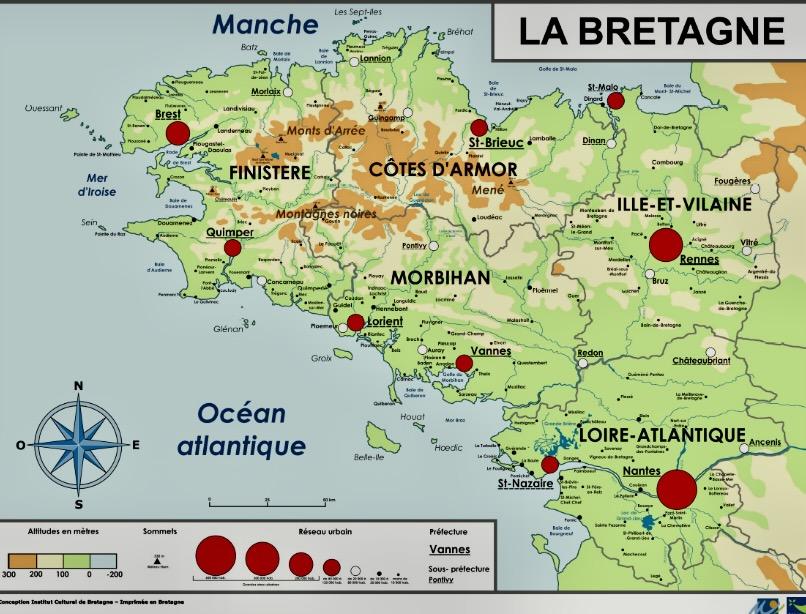
As of January 1, 2026, the total of the departmental populations published by INSEE brings Brittany, with its five historical departments, to nearly 4.94 million inhabitants. While the symbolic threshold of 5 million is now in sight, a detailed analysis of births, deaths, and migration flows shows that growth is primarily based on residential attractiveness, in a context of marked aging and declining birth rates.
At the beginning of 2026, historical Brittany crosses a symbolic threshold: that of 5 million inhabitants. This total results from the addition of the official population of the Brittany region (4 departments), published by INSEE, and that of the Breton department of Loire-Atlantique.
Official figures
According to INSEE, the population residing in the Brittany region (Ille-et-Vilaine, Finistère, Côtes-d'Armor, Morbihan) is estimated at 3,510,100 inhabitants as of January 1, 2026.
The population of Loire-Atlantique (44), a department administratively attached to Pays de la Loire, and this without consulting the inhabitants but historically Breton, stands at 1,487,570 inhabitants (legal population as of January 1, 2026).
The calculation for historical Brittany
By adding — 3,510,100 and 1,487,570 — we obtain 4,997,670 inhabitants.
Historical Brittany thus reaches nearly 5 million inhabitants. Given the statistical rounding and the particularly strong demographic dynamics in Loire-Atlantique, the symbolic threshold of 5 million is now crossed.
A dynamic driven by Loire-Atlantique
INSEE emphasizes that the administrative Brittany region continues to grow at a sustained pace (+0.6% in one year), which is double the national average. This growth is primarily based on a positive migratory balance, while the natural balance is deteriorating (28,200 births for 37,900 deaths in 2025).
Loire-Atlantique, with the urban area of Nantes, is experiencing an even more pronounced demographic increase than administrative Brittany. Its dynamism significantly contributes to the overall demographic weight.
A Brittany of 5 million inhabitants
With nearly 5 million inhabitants, historical Brittany changes its demographic scale. It clearly surpasses several French regions in population while being one of the smallest regions in area (for comparison, Denmark has about 6 million inhabitants).
For all five departments, we can estimate:
- Approximately 40,000 births
- Nearly 54,000 deaths
- A negative natural balance of about –13,800
This confirms that, as with administrative Brittany, the overall growth of historical Brittany relies mainly on a positive migratory balance, rather than on birth rates.
An ABP tool to recalculate results on the B5 scale
ABP provides a small utility that allows calculating an average percentage for "historical Brittany" from five departmental percentages, weighting them:
- either by the departmental population from INSEE
- or by the number of registered voters (useful for electoral results)
The tool (B5 normalizer) from ABP
Instructions:
- enter the 5 values (44, 35, 22, 56, 29)
- choose "population" or "registered voters"
- select the year of the INSEE population
- click on "Normalize for B5"