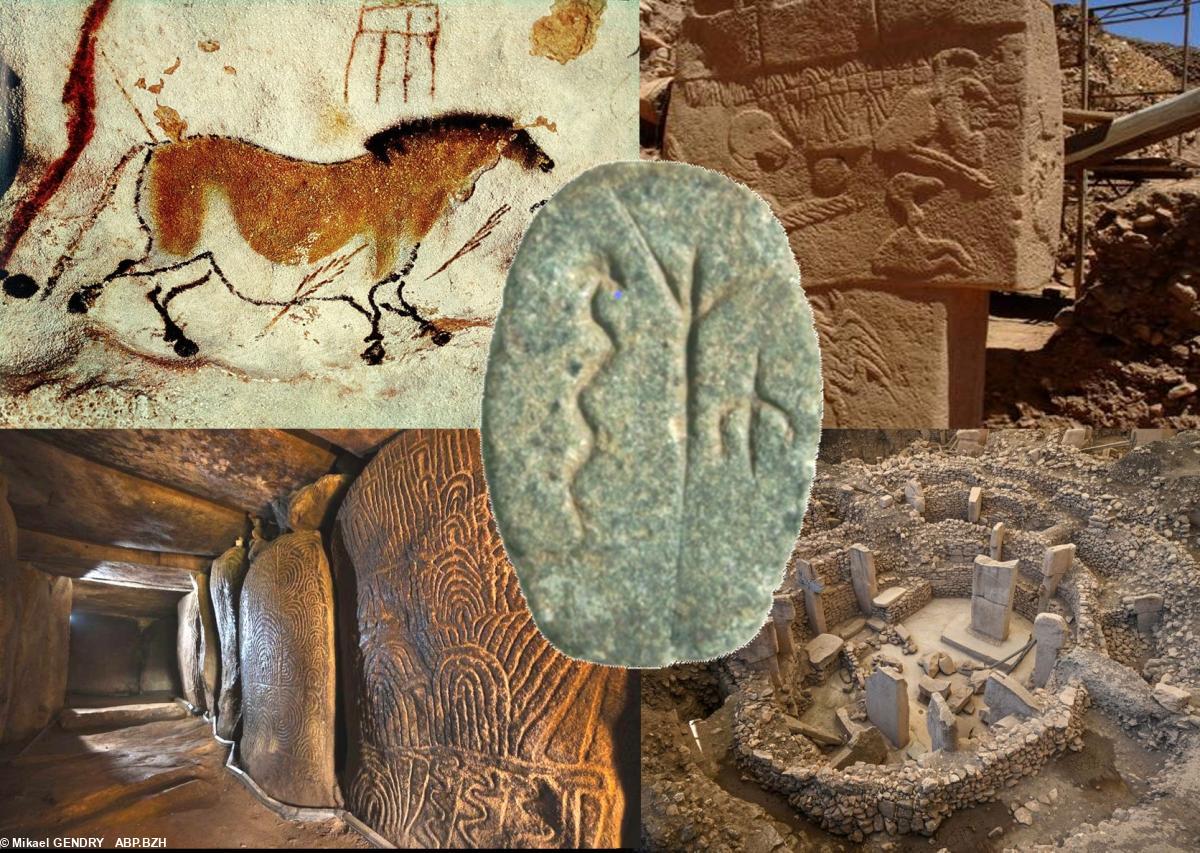
The Lascaux caves, the steles of Göbekli Tepe and Carnac: a semiology of the sacred? The signs of the engravings and cave paintings function as the invariants of a foundational myth. The metonymy at work in the combination of these signs allows access to the dimension of the sacred.
The Stone Verb: When the Sign Precedes the State
Did writing emerge from an immediate accounting need in Sumer around 3300 BCE, or is it the culmination of a praxis of the syntactic sign initiated in humanity's earliest sanctuaries? Conventional historiography, inherited from the 19th century, too often confines the invention of writing to a response to the management needs of the first Mesopotamian city-states. This reductionist view transforms the epic of the sign into a mere technique for storing transactional information, a "barley accounting" that, by functional chance, ultimately gave rise to literature and metaphysics.
However, a new paradigm is emerging, driven by the research of philologist Silvia Ferrara, compelling us to reconsider the profound nature of these early traces not as mere stammerings, but as already mature systems. Ferrara invites us to go beyond the purely figurative dimension to read a pre-existing cognitive structure:
"Call them 'pictograms' if you like (though I do not like this term), but perhaps they are more 'grams' (in the sense of signs) than 'picto' (in the sense of drawing). The potential was entirely there. Abstraction and symbol, undoubtedly, but also the framework: order, code, schema, and paradigm" (S. Ferrara, *Before Writing. Signs, Figures, Words. A Journey to the Sources of Imagination*, Seuil, Paris, 2023, pp. 251 and 253).
This vision is complemented by that of philologist Irving Finkel, who postulates that the management of large monumental projects required, well before Sumer, a system for validating information. This thesis finds material grounding in the "little green stone" of Göbekli Tepe (Southeast Turkey), dated to around 9500 BCE. Klaus Schmidt's work on this major site has revealed the role of this complex as the first global sanctuary, built by the last Mesolithic hunter-gatherers (Pre-Pottery A period). At this pivotal time, the engraved sign is no longer a mere image, but a medium of social and spiritual ratification necessary for the cohesion of the first large human communities.
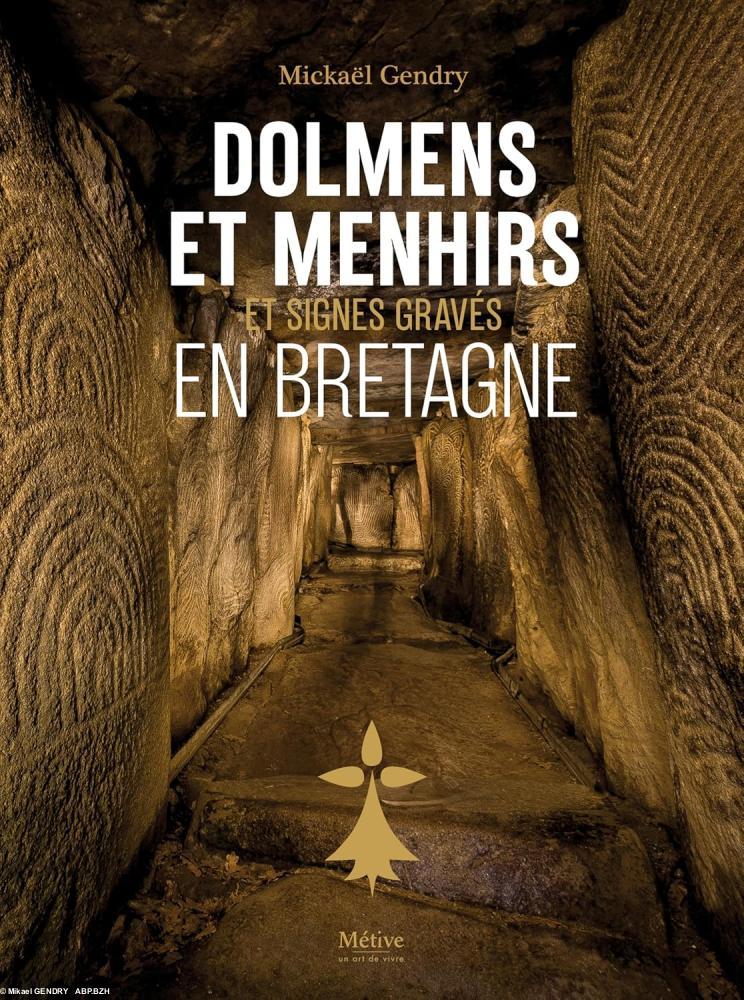
Finally, research on the engraved signs of the megaliths of the Atlantic arc in the Neolithic, around 4500 BCE, demonstrates that the coding of these symbols reflects a structured language. This visual narrative resembles a true mythological culture, articulated around recurring elementary forms engraved on dolmens and menhirs: the square, the crossed polished axe, and the boat. The organization of these signs outlines a metaphysical narrative, particularly through the motif of the "path of the dead." Such a semantic device reveals that the coding of these symbols is not mere decoration, but the expression of a human being seeking to connect with the sacred; it would stem from the fundamental will of Man to project himself into the celestial vault and the beyond.
In fact, it is the sacred that would have led to writing. The awakening of the sign at the dawn of the Holocene necessitates a reevaluation of non-verbal communication systems. This perspective allows us to postulate that human beings were "Homo symbolicus" long before becoming "Homo economicus." The imperative need to "speak" the sacred, through an order and a code already rigorously structured, chronologically and logically preceded the need to "manage" the profane. This quest for a cosmos ordered by the sign also finds its expression in the hermeneutics of Christian religion. At the tympanum of Conques, the order of Paradise opposes the disorder of Hell, a dynamic that continues in the Breton ossuary where the methodical sorting of bones acts as a true viaticum to the beyond, substituting the rigor of the sign for the chaos of death. The ordering of the dead thus becomes the condition for access to the afterlife. Death is the enemy of disorder.
Writing is therefore not the late fruit of an administrative logic of sedentary farmers, but the center of a global "symbolic revolution." This concept, theorized by archaeologist Jacques Cauvin, suggests that a profound mental and religious mutation among the late Paleolithic hunter-gatherer populations preceded and made possible the Neolithic revolution itself. In this context, the initial coding was not a tool for managing terrestrial stocks, but a technology for conquering the invisible, transforming the wild and chaotic world into a cosmos ordered by the graphic verb, these primordial hieroglyphs being the first markers of our eternity.
1. The Hand and the Cortex: The Neurological and Numerical Origin of the Sign
The development of the cerebral cortex is inseparable from the grasp of the hand and the making of tools. This co-evolution has generated a dynamic where "doing" shapes "thinking": manual dexterity stimulates brain plasticity, making the hand the quintessential organ of psychic externalization. Through this motor achievement, human thought has extracted itself from the body to embody itself in matter, thus creating, from the lithic tool, an external memory to the brain.
Silvia Ferrara emphasizes this materiality of the sign because writing begins with a physical gesture in matter. This unique biological capacity allows the mind to embody itself, creating what anthropologists call exosomatic memory, an archive outside the body capable of surviving the individual and transmitting complex knowledge across generations without the necessary physical presence of the speaker.
The engraved trace thus becomes the first data storage medium in human history. From the dawn of humanity, human beings seized this ability to shape their tools and give birth to parietal art. The hand has thus marked matter with its symbolic imprint. From the bifacial knapping of flint to parietal engraving, the gesture remains the same: a controlled pressure aimed at leaving an intentional pattern, an impact bearing meaning. This hand has led our species toward the act of writing