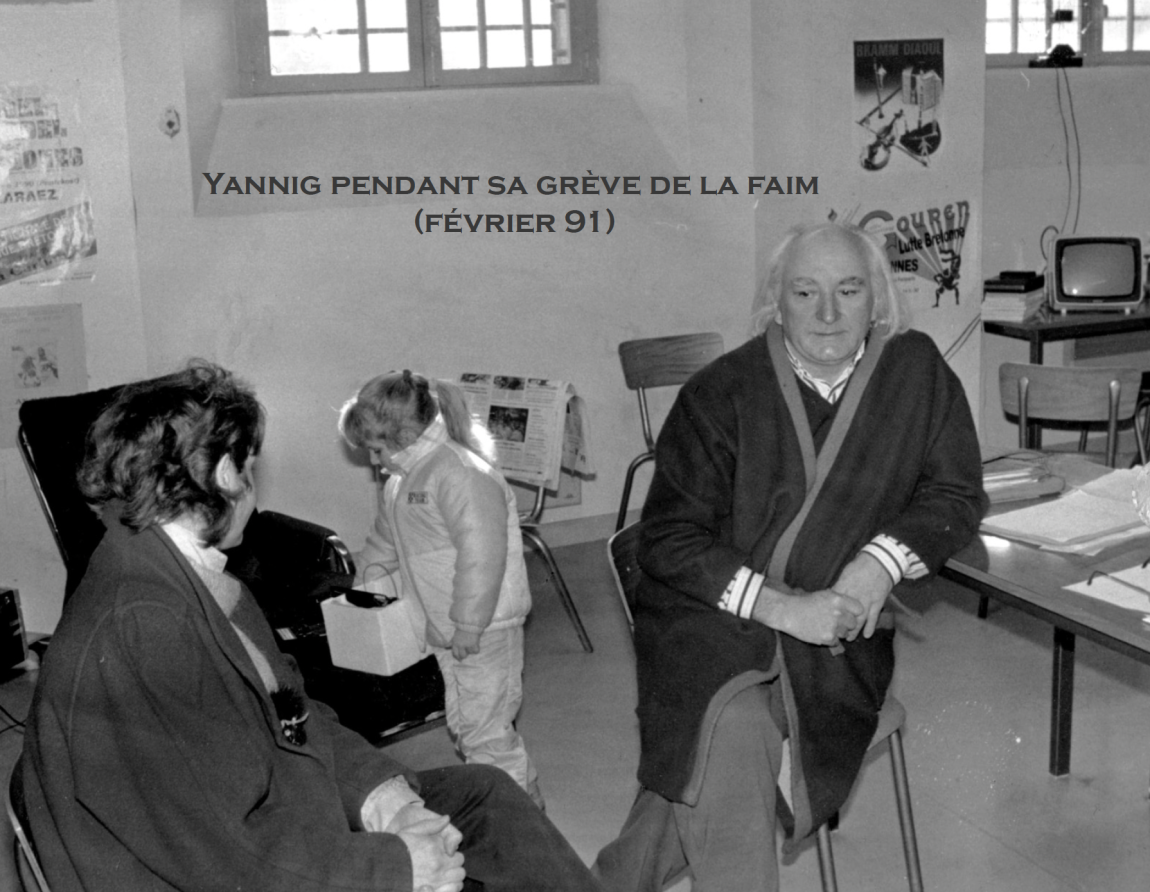
Born in Groix in 1936, musician (bombarde) and cultural and political activist, Yannig Baron has marked several decades of struggles for Brittany, particularly for bilingual education. Founder of Dihun, the association of parents of students in private Catholic schools, he was a hunger striker several times and received the Collar of the Ermine in 2004.
The Breton patriot Yannig Baron passed away on December 15 in Vannes, at the age of 89, his family reported. Born in Groix on October 26, 1936, a musician (bombarde) and a cultural and political figure, he embodied a non-violent commitment to the Breton cause for over half a century. In service of the Breton language, heritage, and, more broadly, the cultural affirmation of Brittany, he also fought for the autonomy and reunification of his country.
A commitment to Brittany
Coming from a large family of nine children from the island of Groix, he experienced food shortages as a child during the war, as the island was not always supplied. Raised by his brothers, he discovered the history of Brittany at a young age and learned to play the bombarde in 1950. At the age of 14-15, he began collecting songs from the island. That same year, he worked as a cabin boy on a sailing tuna boat of the "dundee" type. Maritime memory is at the heart of his family history: his paternal grandfather, Pierre Baron, is presented as the inventor of the “dundee” tuna boat (1883), a vessel that significantly contributed to the rise of Groix as a tuna port in the early 20th century. Yannig Baron also signed texts under the pseudonym "Al Louarn," a nickname given to this grandfather in the maritime community. Engaged for a duration of 5 years in the French Navy, he joined, starting in 1956, the musical ensemble of the bagad of Lann-Bihoué.
His activist journey began early within the networks of the Breton movement. A member of the Movement for the Organization of Brittany (MOB), he later joined the Breton Democratic Union (UDB) in 1988. Upon returning to Brittany, he actively participated, alongside Yann Goasdoué, in the activities of the Menez Kamm center in Spézet, which would become a significant place in Breton cultural life over the years.
Beyond associations, Yannig Baron also worked to transmit a Breton literary memory that was dear to him. Closely related, through his paternal grandmother, to Yann-Bêr Kalloc’h (Bleimor), he notably coordinated commemorative events in Groix (centenary of the birth, then centenary of the death), with the firm intention of promoting the work in the Breton language of the great poet who left us too soon.
The fight for Breton education
Yannig Baron will remain particularly associated with the struggles for the teaching of Breton and the development of bilingual programs. In 1988, he succeeded in obtaining the creation of a new class in the bilingual program of the public school in Brec’h, notably by threatening to go on a hunger strike. In 1990, he founded, with other activists, Dihun, an association of parents for the teaching of Breton in private Catholic schools.
During the period from 1991 to 2006, his name became inseparable from hunger strikes aimed at breaking administrative blockages and achieving concrete advances for the languages of Brittany (Breton and Gallo) in the National Education system. The longest, lasting 38 days, took place in an urgent context: training teachers and securing sustainable arrangements while refusing the blockages from the Academy. It sparked a broad movement of support, culminating in a large demonstration in Vannes, and resonated well beyond Brittany, particularly at the BBC.
Corsican and Occitan elected officials, deputies from several countries, about forty European deputies, and even the Belgian Deputy Prime Minister (an exceptional diplomatic event) intervened with the French government. On February 16, a demonstration gathered 800 people in the streets of Vannes. Then about ten others joined me in fasting in Vannes but also in the offices of the European Parliament in Brussels when, finally, the Academy Rectorate had to agree to make an effort by opening a training program, starting in April, for 12 teachers. -Yannig Baron
His argument was based on a simple idea: the educational choice belongs primarily to families, and it is the state's responsibility to make that choice possible. He liked to recall, in support of this, the principle from the Universal Declaration of Human Rights: "Parents have, as a priority, the choice of the type of education to be given to their children."
In 1994, he became a member of the editorial board of the magazine "Le Peuple breton." In 1995, he resorted to hunger strikes again, alongside other activists, to demand France's signature on the European Charter for Regional or Minority Languages. That same year, he contributed to the establishment of a specific training program at the Catholic University of the West, aimed at preparing a large number of bilingual teachers. He was also, at that time, a co-founder in Carnac of the association "Menhirs libres."
Driven by a committed Christian faith, he participated in 1996 in organizing the Pope's visit to Brittany. In 1998, he began a third hunger strike to obtain more positions in bilingual education. In 2004, he received the Collier de l’Hermine, a major recognition of his journey. In 2006, he began a new hunger strike to protest against what he deemed counterproductive attitudes from the hierarchy of Catholic schools. After the Hermine, his energy did not wane: he continued to help create dynamics of gathering and ideas, notably with the Breizh ImPacte collective, launched in 2011.
Later in life, Yannig Baron advocated for trilingualism. He promoted the early teaching of three languages: Breton (the regional language, which could also be Gallo), French, the common language, and English, the international language.
Publications
Among his publications is "The Message of

Commentaires (0)
Aucun commentaire pour le moment. Soyez le premier à réagir !