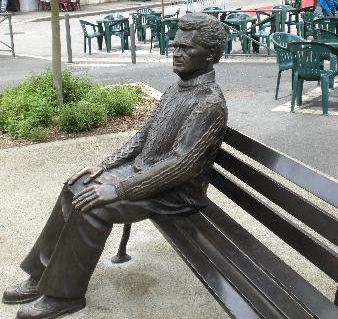
In Lorient, another emblematic city of Celtic cultures thanks to the Interceltic Festival, a comparable initiative is taking shape, but on the scale of the Celtic nations: the city had already inaugurated, on August 3, 2008, a statue of Polig Monjarret. Today, its promoters want to go further: to install eight statues of musicians from other Celtic countries, in order to make inter-Celticism visible on a daily basis.
Carhaix has shown that a trail of statues can become a strong urban marker, recognizable by all. The city has established the “Carhaix Pantheon Trail,” presented as a circuit composed of 14 statues to discover throughout the municipality, including that of the poet Anjela Duval. The latest highly publicized addition is the statue of Alan Stivell, inaugurated in Carhaix on June 6, 2025, in the presence of the artist, Mayor Christian Troadec, and sculptor Elisabeth Cibot.
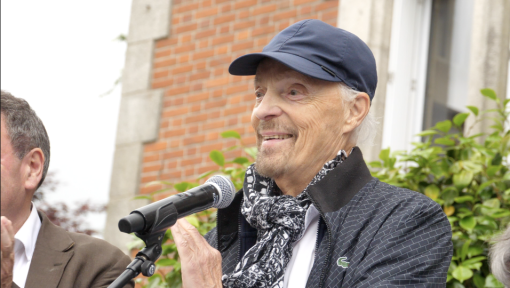
À Carhaix, Alan Stivell entre dans le panthéon breton
In Lorient, another emblematic city of Celtic cultures thanks to the Interceltic Festival, a comparable initiative is taking shape, but on the scale of the Celtic nations: the city had already inaugurated, on August 3, 2008, a statue of Polig Monjarret Today, its promoters want to go further: to install eight statues of musicians from other Celtic countries, in order to make inter-Celticism visible on a daily basis.
A new association to “make inter-Celticism visible year-round”
According to the association Lorient Capitale Interceltique , the goal is explicitly to make inter-Celticism “visible year-round” in Lorient, beyond the festival period.
Eight Celtic nations, eight artists, eight bronze statues
The principle is simple: to install eight life-sized bronze statues in the city center, representing eight artists (both women and men), each associated with a Celtic nation and an immediately identifiable instrument. Together, they would form an urban route, intended to extend Lorient's inter-Celtic identity beyond just the festival time.
According to a report broadcast in Breton on ICI (formerly France Bleu), the first statue could be inaugurated before the end of 2026, with a goal of deploying the eight works over several years. The same report mentions a total need of 400,000 euros to create and install the entire set, or about 50,000 euros per statue (manufacturing and installation).
An existing anchor point: Polig Monjarret
Lorient already has a strong symbolic landmark: the statue of Polig Monjarret, the founder of the festival, inaugurated in 2008 at Place Polig-Monjarret, which has already become a familiar spot where people stop and take photos. For the project’s proponents, this presence constitutes a natural starting point: the future trail could unfold around this emblematic location, linking local memory and inter-Celtic openness.
Three initial artists mentioned
According to the report, three artists are already highlighted to launch the project:
- Paddy Moloney (Ireland), with his uilleann pipes;
- Gordon Duncan (Scotland), with the bagpipes;
- Carlos Núñez (Galicia), with the gaita.
The representation of Brittany remains to be defined. The report mentions a desire to see Alan Stivell chosen to embody Brittany, as a major figure of inter-Celtic openness.
A fundraising campaign via HelloAsso and a territorial roundtable
To kick off the funding, the association has launched an online donation campaign via HelloAsso The platform features fundraising efforts associated with the highlighted statues (Ireland/Paddy Moloney, Scotland/Gordon Duncan, Galicia/Carlos Núñez).
HelloAsso also presents the structure of the association: Alan Stivell is indicated as honorary president, and several local stakeholders are listed as “members by right,” including the City of Lorient, the Interceltic Festival of Lorient, the Cultural Institute of Brittany, Emglev Bro an Oriant, and the Mignoned Polig Monjarret association.
A battle of symbols… and year-round presence
Behind the aesthetics and prestige, the initiative carries a fundamental issue: to make a cultural identity that Lorient already strongly embodies in August “visible year-round,” but which fades the rest of the time. By betting on artists associated with immediately identifiable instruments, the association aims to transform event-based notoriety into a lasting urban marker.


Commentaires (0)
Aucun commentaire pour le moment. Soyez le premier à réagir !